

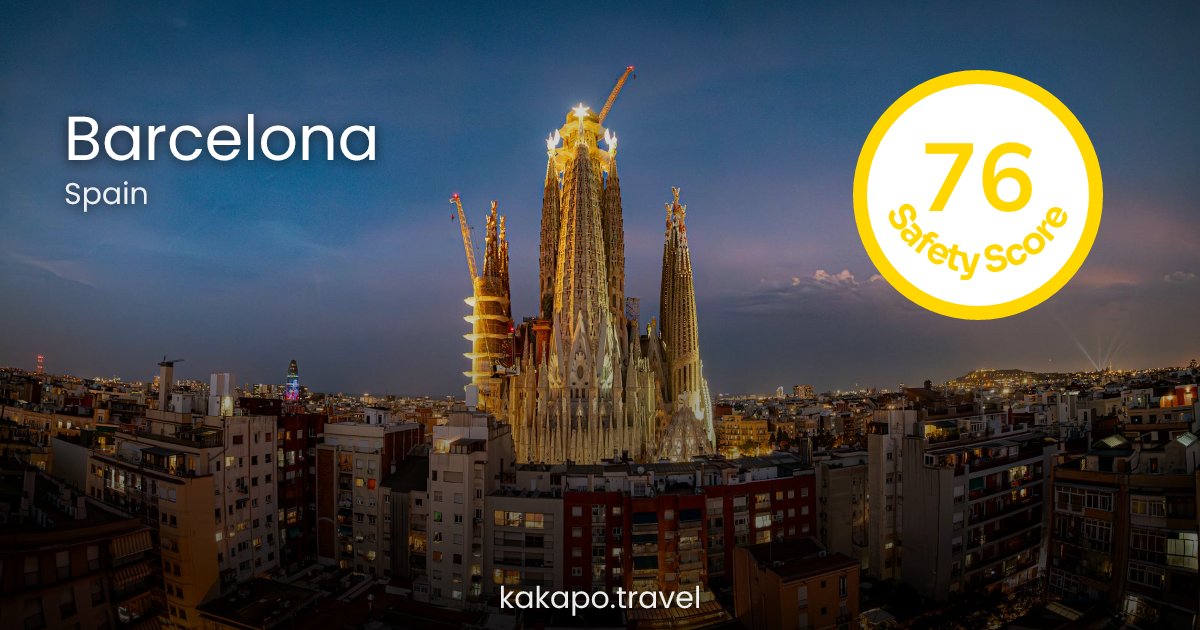
Is Barcelona, Spain Safe? A 2026 Travel Safety Guide
La Rambla pickpockets, Sagrada Família scams, beach theft, and the actually-safe parts of Barcelona at night.

Barcelona is broadly safe but has the most concentrated pickpocket activity of any major European tourist city. The city centre's pickpocket density on La Rambla, around Sagrada Família, and on the Plaça Catalunya/Passeig de Gràcia metro corridor is genuinely industrial.
Spain sits at Level 2 on the US State Department's advisory (general European baseline). Violent crime against tourists is uncommon. The 2017 La Rambla terror attack remains in living memory and you'll see permanent bollards along the avenue; the policing pattern is heavy.
One contemporary note: Barcelona has had visible anti-tourism protests over the last few years, with groups using water guns at tourists in summer 2024 and graffiti calling out visitors. These have not produced safety incidents — they're protest theatre, not threats — but it's a real cultural undercurrent that's worth knowing about. The realistic risks are still pickpockets, not protesters.
Visiting Barcelona for the first time, the thing that catches most travellers off-guard isn't pickpockets — it's the bilingual culture and how confused you'll get reading signs. Street signs, menus, and announcements are in Catalan first, Spanish second; "carrer" not "calle," "plaça" not "plaza." Catalan is closer to Occitan than to Spanish and your high-school Spanish won't help you read it. Everyone speaks Spanish too; many speak English; almost nobody appreciates being asked "do you speak Spanish?" in Catalonia as the opener.
In 2026, the specific things that have changed since pre-pandemic include: the tourist-pressure backlash has produced actual policy — the short-term-rental licence ban announced in 2024 means Airbnb-style lets are being progressively phased out (full elimination targeted by 2028); the cruise port cap is now actively enforced, reducing the daytime crowd peaks at La Rambla; Sagrada Família finally has a confirmed completion date (2026 was the original, now slipped to ~2034) but the central nave is now fully accessible; the L9 Sud metro line from El Prat airport to Zona Universitària is operating reliably and the cheapest airport transfer at €5.50; and post-2024 anti-tourism protest activity continues, but is essentially theatre — visitors are not targeted with violence.
| Night safety | 59/100 |
|---|---|
| Scam / petty-crime risk | High |
| Violent crime (tourists) | Low |
| Most common scams | La Rambla pickpocket cells (3-5 person teams); Sagrada Família / Plaça Catalunya metro-corridor pickpocketing; Barceloneta beach theft |
| Safer neighbourhoods | Eixample, El Born (La Ribera), Gràcia |
| Data sources cited | 4 |
| Last verified |
What the score means — 76/100
- Healthcare (88) — Spain has universal healthcare; Hospital Clínic and Hospital del Mar handle emergencies regardless of citizenship. EU citizens with EHIC pay nothing.
- Transport (80) — TMB metro and bus network is excellent and cheap. Pickpocketing is the only consistent transport-related risk.
- Night (80) — most central districts (Eixample, Gràcia, El Born, Gothic Quarter) are alive late and well-policed. Some specific areas around the port quiet down.
- Personal safety (70) — the lowest sub-band. Mossos d'Esquadra (Catalan police) report ~75,000 pickpocketing incidents annually in Barcelona, with tourists representing the bulk of victims.
La Rambla and Plaça Catalunya — the heat zone

La Rambla — the famous tree-lined avenue from Plaça Catalunya to the port — is genuinely the single most-pickpocketed street in Europe. The pattern:
- Crowd density is the weapon: pickpocket teams of 3-5 work in cells, especially around Boqueria Market, the Liceu metro entrance, and the Christopher Columbus statue at the bottom.
- Phone-snatching by motorbike on the side streets parallel to Rambla — same pattern as London and Paris.
- "Police checking IDs" scam — plain-clothes individuals claim to be police and ask to check your wallet for "counterfeit notes." Real Spanish police carry visible badges and don't ask to handle your wallet on the street.
- Boqueria Market at peak hours — beautiful, packed, pickpocket heaven. Bag in front, phone in deep front pocket.
- Plaça Catalunya metro — pickpockets work the morning rush. Phone away.
Sagrada Família, Park Güell, the Gothic Quarter
- Sagrada Família — the queue area outside is heavily worked by pickpockets. Buy timed tickets online (sagradafamilia.org) to skip the queue and the exposure.
- Park Güell — the entrance/queue zone for the paid area is pickpocket-active. Same online-booking advice.
- The Gothic Quarter (Barri Gòtic) — the labyrinthine medieval streets. Beautiful by day, atmospheric at night, but the narrow lanes and dense crowds make pickpocketing easy.
- Las Ramblas restaurant scams — tourist menu €30-40 for indifferent food. Walk two blocks into Born or Raval for genuine prices.
- "Free flamenco show" flyers — usually low-quality bar shows with high mandatory drink prices. Real flamenco venues (Tablao Cordobés, Palau Dalmases) are paid.
Barceloneta and the beach — theft from the sand

Barceloneta beach is the city's main beach and also one of the most-stolen-from in Europe. The pattern:
- "Distraction theft" while you swim — vendor offers you something or asks for the time, partner takes from your bag.
- Don't leave anything you can't replace on a towel. Bring only what you'd carry into the water.
- Beach hotels usually offer locker rentals — use them.
- The promenade after 11pm: lively, reasonably safe, but bag-snatch incidents do happen on the seafront after-hours. Walk in pairs.
Areas — comfortable, mixed, and aware after dark

Comfortable everywhere: Eixample (the grid neighbourhoods around Sagrada Família and Passeig de Gràcia), Gràcia, El Born, Sant Antoni, Poblenou (Olympic Village area), Sarrià-Sant Gervasi (residential, calm), Pedralbes.
Tourist-magnet, watch for pickpockets: Gothic Quarter, El Raval (mixed — tourist-busy by day, edgier at night), Barceloneta beach.
El Raval at night: a long-standing rough-around-the-edges area. Considerable nightlife (Bar Marsella, the historic absinthe bar; many small clubs). Daytime busy and full of restaurants. Late-night solo walks: stick to main streets, not interior alleys.
Demonstrations: Catalan independence rallies and (more recently) anti-tourism protests gather periodically at Plaça Catalunya and Passeig de Gràcia. They're peaceful but block traffic; consult your hotel for current local info.
Metro, taxis, El Prat airport

- Metro — TMB lines L1-L5, plus L9/L10. Cheap (€2.55 single, T-Casual 10 rides ~€11.35). Open ~5am-midnight (later on Fri/Sat).
- Pickpockets work specific lines and stations: L3 (green) Liceu and Plaça Catalunya are the hottest. Phone in front pocket.
- El Prat (BCN) airport to city: Aerobús (€7.25, ~35 min to Plaça Catalunya), or Metro Line 9 South (€5.50, ~30 min), or train R2 Nord (€4.90), or taxi (~€35-40 fixed-rate).
- Taxis — black-and-yellow, metered, regulated. Honest. Free Now and Cabify operate; Uber's status in Barcelona has been on/off due to local regulations.
- Cycling: Barcelona has good cycle paths; Bicing (city bike-share) is for residents but private rentals are available.
Neighbourhood-by-neighbourhood breakdown
- Eixample — the grid neighbourhood designed by Cerdà in the 19th century. Modernist architecture (Casa Batlló, La Pedrera), Passeig de Gràcia shopping. Very safe, residential-elegant, the most pleasant place to stay for first-timers. The "Gayxample" sub-zone is the heart of LGBTQ+ Barcelona.
- Barri Gòtic (Gothic Quarter) — medieval labyrinth. Cathedral, Plaça Reial, the old Jewish quarter (El Call). Beautiful by day, atmospheric at night, dense with pickpockets. The back alleys after midnight on weekends can feel scrappy; stick to the main pedestrian routes.
- El Born (La Ribera) — east of the Gothic Quarter. Picasso Museum, Santa Maria del Mar church, narrow cobbled streets full of wine bars and small restaurants. Safer and calmer-feeling than the Gothic Quarter despite being adjacent. Excellent evening neighbourhood.
- El Raval — west of La Rambla. Multicultural, working-class, gentrifying. MACBA contemporary art museum is the anchor. Daytime busy with restaurants and bars; late-night solo walks on the interior alleys still scrappy — stick to main streets.
- Gràcia — village-feel neighbourhood north of Eixample. Independent shops, small squares (Plaça del Sol, Plaça de la Virreina), Park Güell to the north. One of the safest and most charming residential evenings in the city.
- Barceloneta — the old fishermen's neighbourhood on the beach. Narrow streets of tall thin buildings, plus the beach itself. Lively, fine to walk; beach theft is the dominant local crime. The beachfront promenade after midnight gets messy but rarely dangerous.
- Poblenou — east along the coast from Barceloneta. Former industrial district, now creative-class with co-working spaces, design studios, Rambla del Poblenou. Calm, safe, increasingly residential-hip.
If it's your first time visiting
- Best arrival airport: El Prat (BCN), one airport with two terminals. T1 to centre: Aerobús €7.25 in 35 min to Plaça Catalunya, or the L9 Sud metro €5.50 in 32 minutes to Zona Universitària (transfer to L3 for the centre), or Renfe R2 Nord train €4.90 in 25 minutes to Passeig de Gràcia. Taxi flat-rate ~€35-40.
- Buy a T-Casual — €11.35 for 10 metro/bus/tram rides, the standard locals' option. Or use contactless tap-to-pay (now active across the TMB network). Single fares are €2.55 each, so the T-Casual pays for itself in 5 trips.
- Best neighbourhood for your first night: Eixample (around Passeig de Gràcia or Sagrada Família) for elegant centrality, El Born or Gòtic for atmosphere, Gràcia for local-village feel. Avoid first-time bookings deep in El Raval (gentrifying but still rough at night), Sant Andreu (residential, far), or anywhere advertised as "near El Prat airport."
- Day 1, jet-lag friendly: morning Sagrada Família (book a timed ticket on sagradafamilia.org weeks ahead — walk-ups don't get in), lunch in Eixample, afternoon walk down Passeig de Gràcia to Plaça Catalunya, then La Rambla to the port. Easy, mostly downhill, hits the iconic stretch.
- Common rookie mistakes: not booking Sagrada Família and Park Güell tickets online (both regularly sell out a week ahead in peak season); eating dinner before 9pm (locals start at 9-10pm, kitchens are empty earlier); ordering "Spanish-style" food in Catalonia and being disappointed (Catalan cuisine is its own thing — try botifarra amb mongetes, escalivada, pa amb tomàquet); paying €30 for a tourist-trap paella on La Rambla (real paella is from Valencia, the Barcelona tourist-paella is usually frozen rice); and walking down La Rambla with a phone in a back pocket (the city's most prolific pickpocket street).
- Catalan vs Spanish: signs and menus are in Catalan first. Most people will switch to Spanish or English for you instantly. Greeting in Catalan ("Bon dia", "Gràcies") earns goodwill, but isn't mandatory.
- Cash vs card: cards everywhere. Cash useful for tipping (5-10% if service is good, often not added) and small market purchases. Spanish ATMs (Caixabank, BBVA, Santander) are cheaper than the "Euronet" tourist ATMs on La Rambla.
- Don't leave anything on the beach: Barceloneta's beach-theft pattern is industrial. Bring only what you can take into the water; locker rentals at most beach clubs cost €5-10.
Practical info — emergency numbers
- European emergency: 112.
- Mossos d'Esquadra (Catalan police): 112.
- Policia Local Barcelona: 092.
- Ambulance: 061.
- Tourist police: there's a dedicated Mossos office for tourists at La Rambla 43 (next to the Liceu) — file police reports here in English or your language.
Bring: a card without foreign-transaction fees, comfortable shoes, an unlocked phone (Movistar, Vodafone, Orange Spain prepaid SIMs at the airport), reef-safe sunscreen, and a small money belt for high-pickpocket days. Tap water is safe but heavily mineralised.

Frequently asked questions
Is Barcelona safe to visit in 2026?
Yes, with the well-documented pickpocket caveat. Barcelona is among the safer European tourist cities for violent crime but has Europe's highest documented pickpocket density on La Rambla, Sagrada Família entry queue, Park Güell, and metro Line 3. Spain sits at US Level 2 (general European terrorism baseline); UK FCDO has no overall advisory against travel.
Is Barcelona's pickpocket problem really that bad?
Yes — it's the city's defining tourist risk. Organised teams work La Rambla, Las Ramblas metro stops (Liceu, Catalunya, Drassanes), Sagrada Família queue, Park Güell viewing terrace, and the Boqueria market. Phone in front pocket; daypack zipped + in front; never set bag on a café table or chair-back. Violent confrontation is extremely rare; the pattern is fast + non-violent extraction.
Is Barcelona safe at night?
Yes for central neighbourhoods — Eixample, Gràcia, El Born, Barri Gòtic, Poblenou. Standard urban awareness applies. The Raval has gentrified but some narrow lanes after midnight are still scrappy — stick to busier streets. La Rambla after 02:00 attracts both party tourists + pickpocket teams; use Uber/Cabify/Bolt for distances over a few blocks.
What's the most dangerous area of Barcelona?
Barcelona has no specific tourist 'no-go' zones in central areas. The Raval has highest petty-crime density historically (pickpocket + occasional drug-zone presence). The outer Nou Barris + Sant Andreu districts have residential crime patterns but aren't on tourist itineraries. The beach (Barceloneta) sees daytime pickpocket density + occasional bag-on-towel theft.
Is Barcelona safe for solo female travellers?
Yes, with standard urban precautions. Barcelona's nightlife (El Born, Eixample, Gràcia) is welcoming + women routinely walk home alone. Watch drinks in clubs in Port Olímpic + along the beachfront strip; documented drink-spiking cases in the late-2010s. Use Cabify/Uber rather than street taxis for late-night rides.
Can you drink tap water in Barcelona?
Yes, it's safe — Barcelona's tap water is chlorinated + heavily-treated. Many locals + restaurants prefer bottled because the tap water's taste is harder (more minerals) than Madrid's. Drinkable + free at restaurants if you ask for 'agua del grifo'.
Is Catalonia independence a safety concern?
Practically no. The independence movement is mostly dormant by 2026; periodic peaceful demonstrations at Plaça Sant Jaume + Passeig de Gràcia. Police presence can be heavy on referendum-related anniversaries (Oct 1, Sep 11 Diada). If you encounter a march, walk away — no specific risk to visitors otherwise.
Sources
Run a business in Barcelona?
Show visitors your Barcelona business is a safe choice. The free Verified by Kakapo badge puts Barcelona's live safety score on your website, links back to your verified page, and updates itself. No cost.
Get the free badge →