


Is Bilbao, Spain Safe? A 2026 Travel Safety Guide
Bilbao is one of Spain's safer big cities. Real risks are pintxos-crowd pickpockets, the wet pavements, occasional Basque political demos, and how to read the city's riverside at night.

Bilbao is one of Spain's safer large cities for tourists. Crime against visitors is low, the metro is excellent, and even the post-industrial riverside has been transformed into one of Europe's better walking cities. The realistic concerns are pintxos-bar pickpockets in the crush at Plaza Nueva, the slick wet pavements (Bilbao rains roughly 130 days a year), and reading the occasional Basque political demonstration correctly — they look intense but are essentially never directed at tourists.
Spain sits at Level 2 on the US State Department's advisory (terrorism, baseline). UK FCDO is similar. ETA dissolved in 2018; the Basque Country today is politically distinct but peaceful. Conflate it with the 1970s-90s and you will misread what you see — modern San Sebastián and Bilbao are simply prosperous Spanish-Basque cities.
Bilbao is mid-sized (~345,000 residents). The Guggenheim, the Casco Viejo's Seven Streets (Siete Calles), the Mercado de la Ribera, the Funicular de Artxanda, and pintxos at Plaza Nueva are the anchor experiences.
The historical context worth carrying for a Basque trip: Bilbao was bombed in 1937 during the Spanish Civil War (overshadowed in Anglo memory by Gernika 30 km east, the more famous Picasso target, but Bilbao itself fell to Franco's forces after sustained bombardment and the breaking of the "Iron Belt" defensive line). The city's recovery from heavy industry — the shipyards along the Nervión closed through the 1980s — culminated in the 1997 Guggenheim and a Foster-designed metro that opened the same year, both visible bets that architecture could rebuild an economy. Today Bilbao is one of Europe's quieter regeneration success stories; the Basque autonomous community has the highest GDP per capita in Spain, the lowest unemployment, and a famously high-quality public-sector food scene.
2026 logistical context: the metro's third line is fully open and runs north to the Uribe coast; the Bilbao-La Coruña high-speed rail link is still under construction (Madrid Renfe is your best long-distance option for now, ~4h45m); the city hosted the 2018 Champions League final and the 2025 Tour de France Grand Départ, so signage and tourist infrastructure are unusually slick by Spanish standards; Barik card top-ups now work via app; and the new BizkaiBus express bus to Bilbao Airport (BIO) is €3 every 20 minutes from Plaza Moyúa.
| Night safety | 72/100 |
|---|---|
| Scam / petty-crime risk | Medium |
| Violent crime (tourists) | Low |
| Most common scams | pintxos-bar pickpockets at Plaza Nueva; slippery pavements in Casco Viejo; Basque political demonstrations |
| Safer neighbourhoods | Casco Viejo, Ensanche, Abandoibarra |
| Data sources cited | 4 |
| Last verified |
What the score means — 84/100
- Transport (90) — the Norman-Foster-designed metro is fast, clean, safe.
- Healthcare (88) — Hospital Universitario Cruces is the major regional facility.
- Personal safety (86) — high; pickpocketing is the main tourist crime.
- Air quality (84) — improved sharply after the steel industry left; occasional valley inversions.
Casco Viejo and Plaza Nueva — pintxos and pickpockets

- The Siete Calles: the seven medieval streets of the old town. Walkable, lively, safe.
- Plaza Nueva: the colonnaded square that turns into a pintxos crawl after 8pm. Crowded — keep your phone in a front pocket. Bag in front, especially during txikiteo (pintxos round).
- Pintxos prices: €2.50-€4 each. A small Rioja or Txakoli (~€2). Counter culture: order, eat standing, pay at the end (honour system).
- Best non-touristy bars: Gure Toki, Sorginzulo, Café Bar Bilbao. Avoid the obviously-touristy "menu in 5 languages" places.
- Late-night Casco Viejo: very safe to walk.
The Guggenheim and the riverside

- Guggenheim: book online (€18). Tuesday 10am or after 5pm avoids the cruise-ship crowd.
- Riverside walk: from the Guggenheim along the Nervión past the Zubizuri footbridge to the Mercado de la Ribera. ~2 km, flat, well-lit until midnight.
- Zubizuri footbridge: glass surface, slippery in rain. Calatrava sued the city when they added grip strips; the strips are still there for a reason.
- Riverside at night: north bank near the Guggenheim is very safe. South bank further west (closer to San Mames) gets quiet after midnight; not dangerous but not lively.
Basque political context — what tourists actually see

- Modern reality: ETA disbanded 2018. No tourist-targeting incidents.
- Demonstrations: occasional weekend marches over Basque-prisoner repatriation. Loud, peaceful. Walk around, not through.
- Independence flags: ikurriña flying widely is not separatism in the violent sense; it's regional pride.
- What you'll notice: bilingual signs (Euskara + Spanish), and a strong local food/identity culture.
- Police: three forces — Ertzaintza (Basque), Policía Nacional, Guardia Civil. The Ertzaintza in red berets handle most local issues.
Weather — the rain you came for

- Bilbao rains: ~130 days/year, 1,200 mm/year. Atlantic climate.
- Slippery pavements: the granite paving in the Casco Viejo gets glass-slick when wet. Slow down. Sturdy shoes with grip.
- Best season: May-Oct; July is peak. The siri-miri (Basque mist) is constant in winter.
- Floods: the Nervión flooded catastrophically in 1983; modern defences are good. Heavy rain occasionally still raises the level uncomfortably.
Metro, BizkaiBus, and the airport

- Metro Bilbao: Foster-designed entrances ("fosteritos"). 3 lines. €1.85-€2.10 depending on zone. Barik card €3 + top-up.
- Bilbao Airport (BIO): 11 km north. Bizkaibus A3247 to centre €3 (~25 min). Taxi €25-30.
- Trains: Madrid 4h45m by Renfe; San Sebastián 1h via Euskotren narrow-gauge.
- Trams: one line along the river — useful for Guggenheim → San Mames.
- Buses to San Sebastián: PESA every 30 min, ~1h15m, €13.
Neighbourhood-by-neighbourhood breakdown
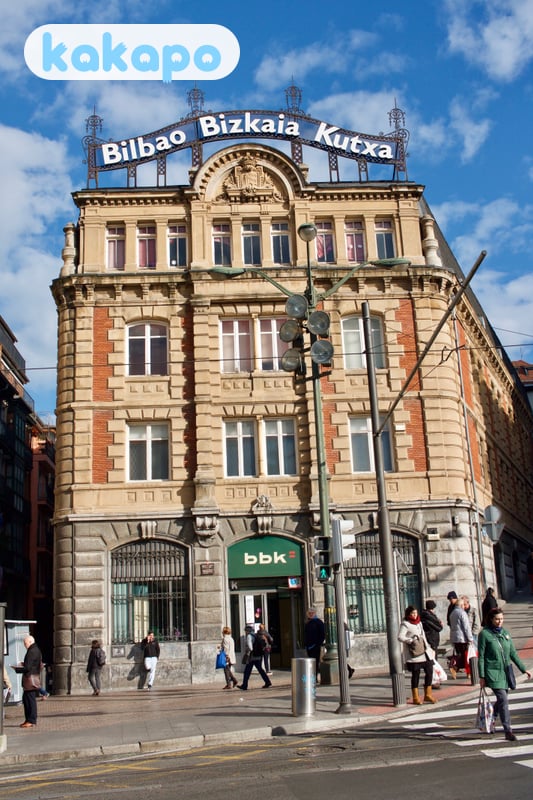
- Casco Viejo (Zazpikaleak / Siete Calles) — the seven medieval streets of the old town, bounded by the Nervión and the Cathedral of Santiago. Pintxos epicentre at Plaza Nueva and along Calle Somera, Calle Belostikale and Calle Barrenkale. Pedestrianised, lively until 2am, very safe. Metro Casco Viejo (lines 1 and 2).
- Ensanche — the 19th-century planned expansion across the Nervión, organised around Plaza Moyúa and the Gran Vía boulevard. Upscale shopping (El Corte Inglés, Loewe, Gran Vía retail), business hotels, and the main banks. Comfortable any hour. Metro Moyúa.
- Abandoibarra + the Guggenheim — the post-industrial riverside spine, redeveloped from shipyards into the Guggenheim, the Iberdrola Tower (Cesar Pelli), the Euskalduna Conference Centre, and the wide Paseo de Abandoibarra walk. Glass-and-steel Bilbao; tourist density peaks here. The Zubizuri footbridge is the Calatrava-with-Foster-tower photo spot.
- Indautxu — the residential-bourgeois neighbourhood between Ensanche and the San Mamés stadium. Restaurants on Diputación, Rodríguez Arias and the Plaza Indautxu. Where well-off Bilbao actually lives; the better mid-range restaurants are here, not in Casco Viejo. Metro Indautxu.
- Pintxos circuit (Plaza Nueva + beyond) — the actual ritual: order at the bar, eat one or two pintxos standing, pay before leaving (honour system; some bars now use tickets), move to the next bar. Standard pintxos €2.50-4 each; a Txakoli or Rioja Crianza €2-3. Standout bars: Gure Toki, Sorginzulo, Café Bar Bilbao, Xukela (all Plaza Nueva); Bar Charly, Río-Oja on Calle del Perro for txangurro (spider-crab) and casseroles.
- Bilbao Metro (lines 1 + 2 + 3) — the Foster-designed system with the distinctive "fosterito" glass-entrance pavilions. €1.85-2.10 single depending on zone; Barik card €3 deposit then top-up via app. Lines 1 and 2 are the urban backbone; line 3 (opened 2017) runs north to Etxebarri and is mostly residential.
- 1937 bombing memory + Civil War context — Bilbao itself was bombed and besieged during the Spanish Civil War, surrendering in June 1937 after Franco's forces broke the Iron Belt defensive line. The more famous Picasso-immortalised bombing of Gernika happened 30 km east on 26 April 1937. The Gernika Peace Museum (€5) and the Casa de Juntas with the Tree of Gernika are an essential 35-minute Euskotren train day-trip for anyone interested in the Civil War context that shapes modern Basque identity.
- Bilbao La Vieja + San Francisco — south of the river, traditionally rougher; gentrifying through cafés, galleries and the street-art scene. Visit in daytime for street art; locals avoid certain corners (lower San Francisco / Cortes) after midnight.
- Funicular de Artxanda — €2.50 each way; runs every 15 minutes from Plaza del Funicular up to Mount Artxanda. The viewpoint at the top is the single best photograph of Bilbao laid out below; sunset is the popular slot.
- Getxo + the Bizkaia Suspension Bridge — the wealthy seaside neighbourhood at the mouth of the Nervión, 30 minutes by Metro line 1. UNESCO-listed Vizcaya Bridge (the world's first transporter bridge, 1893; €0.45 to walk across, €10 to walk the top gantry).
If it's your first time visiting
- Best arrival: Bilbao Airport (BIO) is 11 km north. BizkaiBus A3247 to Plaza Moyúa €3 (~25 min, every 20 min); taxi €25-30 to centre. Renfe from Madrid via Vitoria 4h45m; flight from Madrid 1h.
- Pre-book the Guggenheim — €18 timed tickets online via guggenheim-bilbao.eus. Tuesday at 10am or after 5pm is meaningfully quieter than mid-day weekends. Allow 2-3 hours including the riverside walk.
- Best base neighbourhoods: Casco Viejo for atmosphere and pintxos (Hotel Petit Palace Arana, Iturrienea Ostatua); Ensanche / Indautxu for upscale comfort and walking access to both Guggenheim and old town (Gran Hotel Domine, Ercilla); Abandoibarra for Guggenheim-adjacent design hotels.
- Pintxos pricing reality — €2.50-4 per pintxo, €2-3 per glass. A serious pintxos crawl is €25-35 a head with wine for 2-3 bars; cheaper than sit-down dinner and the proper way to eat. Don't tip; round up. The "menu in 5 languages" tells you which Plaza Nueva bars to skip.
- The metro routine — buy a Barik card at any station (€3 deposit + top-up); tap on entry only (no exit tap). Single fares €1.85-2.10. The system shuts ~23:00 weekdays, all night Friday-Saturday.
- Shoes for the wet pavements — Bilbao rains ~130 days a year; the granite paving in Casco Viejo and the Zubizuri footbridge glass become genuinely slippery. Sturdy soles with grip; the Calatrava bridge has retrofitted black strips because of the litigation.
- Day-trip planning — San Sebastián 1h15 by PESA bus (€13 every 30 min); Gernika 35 min by Euskotren (€3.50); Vitoria-Gasteiz 1h by bus (€7); the Vizcaya Suspension Bridge in Getxo 30 min on Metro line 1 (€2.10 plus €0.45 bridge crossing).
- Common rookie mistakes — confusing the Basque Country with Catalonia in conversation (entirely different language and political history, easily offended over the comparison); skipping breakfast and trying to do a noon pintxos crawl (eat before, drink with); booking dinner for 7pm (locals eat 9-11pm); flying in via Bilbao when San Sebastián's airport is closer for the coast (it isn't really — BIO is far better connected); forgetting that Mondays close most museums including the Guggenheim's special exhibitions.
Practical info — emergency numbers
- European emergency: 112 (handles all in Basque, Spanish and English).
- Ertzaintza: 112 → ask for Ertzaintza.
- Hospital de Cruces: +34 946 006 000.
Bring: a rain shell, shoes with grip for the wet stone, a contactless card, and travel insurance. ATMs are everywhere; tipping is round-up only.
Frequently asked questions
Is Bilbao safe to visit in 2026?
Yes. Bilbao is one of Spain's safer large cities. US State Department lists Spain at Level 2 (terrorism baseline). ETA dissolved in 2018; the Basque Country today is peaceful and politically distinct. Realistic concerns are pintxos-bar pickpockets in the Plaza Nueva crush, slick granite paving when wet (Bilbao rains ~130 days a year), and reading occasional Basque political demonstrations correctly — never directed at tourists.
Is Bilbao safe at night?
Yes. Casco Viejo stays lively until 2am with very safe walking. Ensanche and Indautxu are upscale and safe. The only neighbourhoods where local women would say 'take a taxi after midnight' are Bilbao La Vieja and San Francisco (south of the river), traditionally rougher and gentrifying — fine in daytime for the street art, but the lower San Francisco / Cortes corners are best avoided late.
Is Bilbao safe for solo female travellers?
Yes — comfortably so in Casco Viejo and Ensanche at any hour. Bilbao ranks well for solo-female safety; the Foster-designed metro is fast and clean at all operating hours. The pintxos crawl culture is notably welcoming to solo travellers — order at the counter, eat standing, pay at the end on the honour system.
Can you drink tap water in Bilbao?
Yes. Bilbao's tap water comes from Basque mountain reservoirs and is safe and extensively tested. Free at every restaurant on request. Refill bottles anywhere.
What's the biggest scam to avoid in Bilbao?
Pintxos-bar pickpocketing in the Plaza Nueva crush — bags placed on bar floors or hooks get lifted during the standing-and-eating culture. Bag strap across the body, front pocket only. The other recurring issue is bilingual menus in 5 languages signalling tourist-trap bars; locals stick to spots like Gure Toki, Sorginzulo, and Café Bar Bilbao where pintxos run €2.50-4 and quality is high. There's no significant scam culture beyond this.
Are the Basque political demonstrations a concern?
No. ETA disbanded in 2018 — there have been no tourist-targeting incidents since. Occasional weekend marches over Basque-prisoner repatriation are loud but peaceful; walk around them, not through. Ikurriña (Basque) flags flying widely is regional pride, not separatism in the violent sense. The three police forces (Ertzaintza in red berets, Policía Nacional, Guardia Civil) all maintain visible presence; dial 112 for any of them.
Sources
Run a business in Bilbao?
Show visitors your Bilbao business is a safe choice. The free Verified by Kakapo badge puts Bilbao's live safety score on your website, links back to your verified page, and updates itself. No cost.
Get the free badge →