


Is San Sebastián, Spain Safe? A 2026 Travel Safety Guide
Donostia is among the safest city beach destinations in Europe. The honest risks: rip currents at Zurriola, pintxos-bar pickpockets, the cobbled Parte Vieja after rain, and Film Festival weekends.

San Sebastián is one of Europe's most liveable small cities and one of Spain's safest. Crime against tourists is low. The realistic concerns are coastal — rip currents at Zurriola beach are genuine, the Parte Vieja gets pickpocket-busy in the pintxos crush, and the Film Festival every September turns the centre into a logistics challenge for a week.
Spain sits at Level 2 on the US State Department's advisory (baseline terrorism). UK FCDO is the same. ETA disbanded in 2018; today's Basque Country is peaceful and politically distinct rather than dangerous — Basque (Euskara) signs sit alongside Spanish ones, the city's official name is Donostia, and locals will appreciate a "kaixo" or "eskerrik asko" much the way Madrileños appreciate "hola".
The city is small (~190,000 residents) and built around three beaches in a horseshoe bay. The Parte Vieja (Old Town), La Concha promenade, Zurriola surf beach across the river, and the funicular up Monte Igueldo are the four anchor experiences. Three Michelin three-star restaurants in the metro area (Arzak, Akelarre, Martín Berasategui) help explain the food obsession; the pintxo counters of the Parte Vieja are the democratic version of the same culture.
In 2026, the practical changes since pre-pandemic include: Euskotren's "topo" service to Hendaye (French border) now runs every 30 minutes and accepts contactless Mugi-card top-ups, so the cross-border day trip is genuinely walk-in; the Tabakalera cultural centre in Egia has matured into the city's contemporary-art and indie-cinema hub; the Boulevard pintxo counters increasingly take card from €0.50 up; and the city's summer crowd-management for La Concha now closes the promenade to bicycles 11:00-22:00 in July-August (the bike-lane is on the carretera level instead).
| Solo female safety | 88/100 |
|---|---|
| Night safety | 90/100 |
| Scam / petty-crime risk | Medium |
| Violent crime (tourists) | Low |
| Most common scams | pickpocketing in pintxos crowds; rip currents at Zurriola beach; crowd management during Film Festival |
| Safer neighbourhoods | Egia, Antiguo, Gros |
| Data sources cited | 4 |
| Last verified |
What the score means — 88/100
- Healthcare (90) — Hospital Universitario Donostia is regional reference.
- Air quality (90) — Atlantic, generally excellent.
- Personal safety (88) — high. Pickpocketing in pintxos crowds is the main tourist crime.
- Transport (88) — small, walkable, well-served by Lurraldebus + Euskotren.
La Concha vs Zurriola — the rip current question
- La Concha: the postcard beach. Sheltered horseshoe bay. Calmest water in town. Lifeguards Jun-Sep. Generally safe to swim Jun-Sep with normal sea-awareness.
- Ondarreta: extension of La Concha, equally calm.
- Zurriola: across the Urumea river. Open Atlantic, surf beach. Powerful shore-break and rip currents. Lifeguards but they get busy.
- Rip currents: at Zurriola the current pulls outward, especially mid-tide. If you're caught: don't swim against it; swim parallel to shore, then back in.
- Flag system: green safe, yellow caution, red no-swimming. Red flag means red flag — locals follow it.
- Surfing: Zurriola is among Europe's best urban surf. Beginners take a lesson; the impact zone is unforgiving.
The Parte Vieja — pintxos and pickpockets
- Pintxos crawl: the Parte Vieja has 100+ bars in a square kilometre. Order one or two pintxos per bar, move on.
- Standing-and-eating culture: bags get put on bar floors or hooks. Pickpockets work the crush. Front pockets only; bag strap across the body.
- Gilda: the original pintxo (anchovy, olive, pickled pepper). €2.
- Best bars: Bar Néstor (tortilla 1pm and 8pm only — queue 30 min before), La Cuchara de San Telmo, Atari, Zeruko.
- Walking back across the river: completely safe at all hours.
Monte Igueldo and the cliff paths
- Funicular: 1912 wooden funicular up Monte Igueldo. €4.50 return. View over the bay.
- Walking up: paths are well-maintained but the cliff edge has minimal fencing in places. Don't lean for selfies.
- Peine del Viento: Eduardo Chillida's iron sculptures at the western end of Ondarreta. Spray during winter storms is dramatic and dangerous — stay back of the line.
- Monte Urgull: the eastern hill, free, easy walk up to the Christ statue. Low-effort viewpoint.
Weather, the Film Festival, La Tamborrada
- Film Festival (Festival de San Sebastián): 3rd week of September. Hotels triple in price, Parte Vieja restaurants book out months ahead. Streets around Kursaal are closed.
- La Tamborrada: Jan 19-20. 24-hour drumming festival. Charming for one night, exhausting if you're trying to sleep near Plaza de la Constitución.
- Storms: December-February Atlantic storms send waves over the La Concha railing. The promenade is occasionally closed; obey the closure signs — people get swept off.
- Best season: June + September. July-August are warm but busy.
- Rain: ~110 days/year. Bring a shell.
Buses, Euskotren, and the airport

- Walking: the centre + all three beaches are 25 min end-to-end on foot.
- Dbus: city buses €1.55. The Mugi card discounts further.
- San Sebastián Airport (EAS): 22 km east near Hondarribia, small, mostly Madrid + Barcelona. Bus Ekialdebus E20/E21 €2.55 (~45 min).
- Bilbao Airport (BIO) as alternative: 100 km west; PESA bus direct to/from city centre €17, ~1h15m. Often cheaper flights.
- Biarritz Airport (BIQ): 50 km north, in France. Often cheapest. Bus €7, ~1h.
- Trains: Madrid 5h, Bilbao 1h via Euskotren topo.
Solo travellers and the city at night
- Solo women: San Sebastián is one of the most comfortable European cities for solo female travellers. Safe to walk all neighbourhoods after midnight.
- Late-night drinking: the Parte Vieja stays alive until 2am Fri-Sat.
- Beach at night: La Concha is busy + safe in summer evenings; deserted off-season; safe but quiet.
- Gros (across the river, Zurriola side): surfer/young-pro neighbourhood. Safe.
- Egia (south of the train station): residential, quiet. Egia and Antiguo are perfectly safe, just not where the action is.
Neighbourhood-by-neighbourhood breakdown
- Parte Vieja (Old Town) — the medieval grid between Mt Urgull and the Boulevard; 100+ pintxo bars in a square kilometre. Standing-and-eating culture means bags get put on bar floors — front pockets only, strap across the body. Bar Néstor (tortilla 13:00 and 20:00, queue 30 min ahead), La Cuchara de San Telmo, Atari, Zeruko, Ganbara are the headline counters. Plaza de la Constitución (the old bullring) is the heart.
- Centro / Área Romántica — the 19th-century grid south of the Boulevard; the Buen Pastor cathedral, Avenida de la Libertad, the better hotels, El Diario Vasco offices. Comfortable any hour.
- Gros — across the Urumea river on the Zurriola side; surfer / young-professional flavour, indie cafés, La Madame and Bergara are the standout pintxo bars here (less touristy than Parte Vieja). The Kursaal cubes sit on the river edge.
- Antiguo — west of La Concha at the foot of Monte Igueldo; residential, Real Sociedad's Anoeta-region quiet end, family-paced. The El Diario quarter has good neighbourhood restaurants without Parte Vieja prices.
- Egia — south of the train station; up-and-coming, anchored by the Tabakalera cultural centre (former tobacco factory turned art / cinema / library hub). Calm and increasingly stylish.
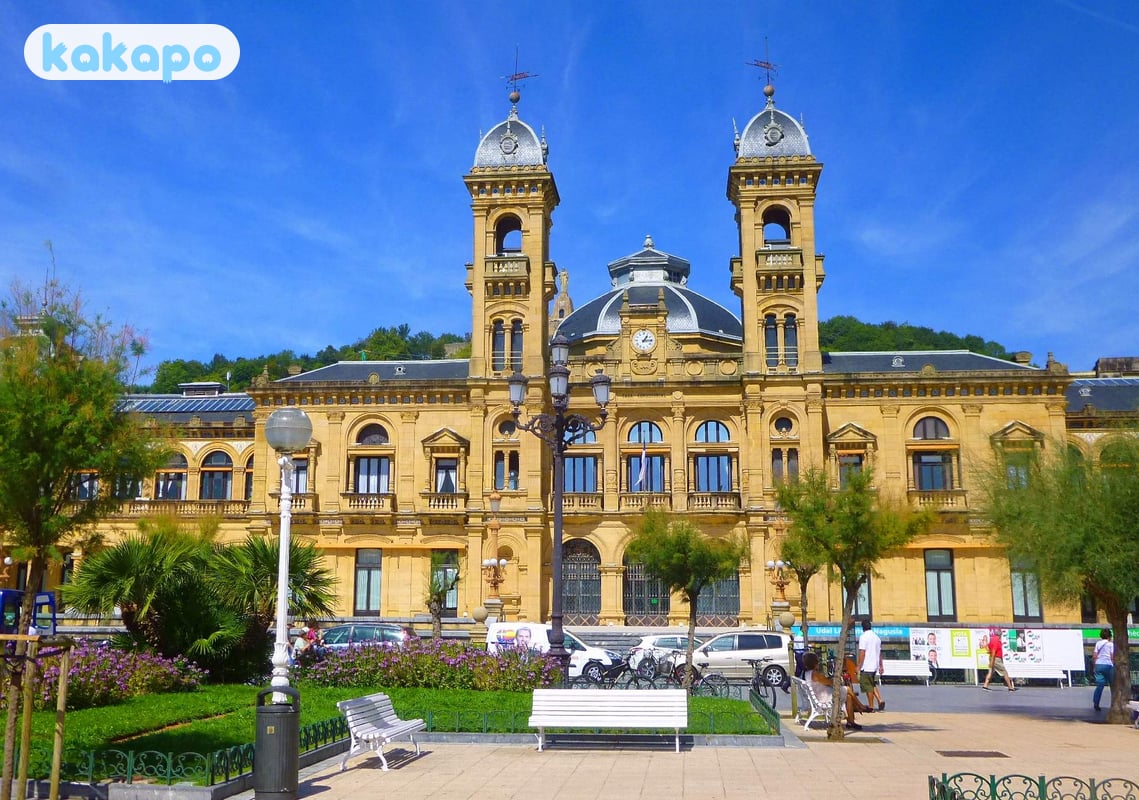
- La Concha + Ondarreta — the postcard horseshoe bay. Sheltered, calmest swim water in town, lifeguarded June-September. The promenade walk from the City Hall to Peine del Viento is 3 km of the world's best urban seafront.
- Mt Urgull + Mt Igueldo — the two hills bracketing the bay. Urgull (free, eastern, 30 min up to the Christ statue) is the easy viewpoint; Igueldo (€4.50 funicular, western) is the 1912 wooden-funicular classic with the small old-timey amusement park at the top.
- The Renfe line to Hendaye — Euskotren's narrow-gauge "topo" runs every 30 min from Amara station to Hendaye (France) in 35 min, €2.95 contactless. Walk-in cross-border day trip; the French side has the lighthouse and the Saturday market.
If it's your first time visiting
- Best arrival airport: Bilbao (BIO) is usually the cheapest flight — PESA bus direct city-to-city €17.10, 1h15m, every 30-60 min from Bilbao Termibus / Aeropuerto. San Sebastián (EAS) at Hondarribia is small but works for Madrid/Barcelona connections; Ekialdebus E20/E21 €2.75, 45 min. Biarritz (BIQ) in France is often the cheapest of all — Ouibus / Flixbus €7-15, 1h.
- Public transport: the city is 25 minutes walking end-to-end and most visitors never need a bus. Dbus single €1.85, Mugi contactless card €1.10 per ride. The Mugi card is sold at any Estanco (tobacconist) for €5 and works on Euskotren, Lurraldebus and Dbus.
- Best neighbourhood for your first night: Centro/Romántica for proximity to La Concha and easy walk to Parte Vieja; Gros if you want surf-village feel and the Zurriola morning swim; Parte Vieja itself if you want to roll out of bed into the pintxos but expect noise until 02:00 Fri-Sat.
- Day 1, jet-lag friendly: walk Mt Urgull (30 min up, free, Christ-statue viewpoint), drop down into Parte Vieja for an early pintxo crawl (start 12:30 before the crush), 90 min on La Concha sand, finish with sunset from Peine del Viento at the western end. All walkable.
- Common rookie mistakes: eating dinner at 19:00 (Spanish dinner is 21:00-22:30; pintxo bars get going at 20:00 and pintxos are not dinner — they're tapas), trying to swim at Zurriola without a lesson (it's an Atlantic surf beach, La Concha and Ondarreta are the swim beaches), driving into the centre (residents-only ZTL plus tiny streets — park at OTA Boulevard and walk), missing the Bar Néstor tortilla window (one batch at 13:00, one at 20:00, queue 30 min before).
- Currency and tipping: euro. Round up only — Spain isn't a tipping culture. Pintxo counters typically run you a tab on a paper or a beermat; pay at the end. Most counters now take card from €0.50, but carry €30 in coins anyway.
- Book Michelin restaurants 2-3 months ahead — Arzak, Akelarre, Martín Berasategui (the 3-star trio) all open reservations roughly 12 weeks out. Mugaritz further afield. If you don't get one, Kokotxa, Mirador de Ulía and Aratz are excellent and easier to book.
- Plan around the Film Festival — 3rd week of September, hotels triple. Embrace it or visit in late September / June. La Tamborrada (Jan 19-20) is a charming 24-hour drumming festival; book accommodation away from Plaza de la Constitución if you want to sleep.
- Tap water and tipping: tap is safe and free at every restaurant — ask for "agua del grifo". Tipping is round-up only, never expected as a percentage.
Practical info — emergency numbers
- European emergency: 112.
- Ertzaintza (Basque police): 112.
- Hospital Donostia: +34 943 007 000.
- Beach lifeguard service (Cruz Roja): signposted at La Concha and Zurriola.
Bring: a rain shell, swimwear (year-round if you're hardy), a contactless card, and reservations for Sep weeks. Tipping is round-up only.
Frequently asked questions
Is San Sebastián safe to visit in 2026?
Yes. San Sebastián (Donostia) is one of Spain's safest cities and one of Europe's most liveable small destinations. US State Department lists Spain at Level 2 (terrorism baseline); ETA disbanded in 2018 and the Basque Country today is peaceful. Realistic risks are coastal: rip currents at Zurriola beach, pintxos-bar pickpockets in the Parte Vieja crush, and Film Festival logistics during the 3rd week of September.
Is San Sebastián safe at night?
Yes — exceptionally. All neighbourhoods (Parte Vieja, Centro, Gros, Egia, Antiguo) are safe to walk after midnight. The Parte Vieja stays alive until 2am Friday-Saturday with heavy pintxos crowds. La Concha promenade is busy and safe through summer evenings, quieter but still safe off-season. December-February storms occasionally send waves over the promenade railing — obey closure signs as people get swept off.
Is San Sebastián safe for solo female travellers?
Yes — among the most comfortable European cities for solo women. Safe to walk all neighbourhoods after midnight, the pintxos counter-culture is notably welcoming to solo travellers (order, eat standing, pay at the end), and beach culture is family-active. Standard pickpocket awareness in the Parte Vieja crush is the only practical note.
Can you drink tap water in San Sebastián?
Yes. Tap water from Basque mountain reservoirs is safe and extensively tested. Free at every restaurant on request. Refill bottles anywhere — multiple fountains along La Concha promenade.
Is Zurriola beach really dangerous to swim at?
Treat it with respect — it's an open Atlantic surf beach with powerful shore-break and rip currents that pull outward, especially mid-tide. La Concha (sheltered horseshoe bay) and Ondarreta are the calm-water swim beaches; Zurriola is for surfing or experienced ocean swimmers. Lifeguards run June-September but get busy. Heed the flag system: green safe, yellow caution, red no-swim. If caught in a rip don't fight it — swim parallel to shore, then back in. Beginner surfers should take a lesson; the impact zone is unforgiving.
How do I plan around the Film Festival?
Book accommodation 6+ months ahead for the 3rd week of September — hotels triple in price and Parte Vieja restaurants fill out weeks ahead. Streets around Kursaal are closed. If you want the festival buzz, embrace it; if not, visit in June or late September after the festival ends. La Tamborrada (Jan 19-20) is a charming 24-hour drumming festival but exhausting if you're trying to sleep near Plaza de la Constitución — book elsewhere if light-sleeping.
Sources
Run a business in San Sebastián?
Show visitors your San Sebastián business is a safe choice. The free Verified by Kakapo badge puts San Sebastián's live safety score on your website, links back to your verified page, and updates itself. No cost.
Get the free badge →