


Is Hangzhou, China Safe? A 2026 Travel Safety Guide
West Lake crowds, the brutal summer, the Shanghai high-speed rail run, the cashless China problem, and why Hangzhou is one of the easier mainland cities.

Hangzhou is a calm, prosperous city of 12 million people, dominated by West Lake (Xī Hú) tourism and the Alibaba headquarters complex. Crime against foreign visitors is rare; the city is one of the easier mainland-China introductions for first-time visitors.
The realistic concerns are crowds (West Lake takes 100,000+ visitors on a Saturday in May), the brutal Yangtze Delta summer (Hangzhou is one of the "three furnaces" — 37-40°C with humidity is normal in July-August), the logistics of getting in by Shanghai-Hangzhou high-speed rail, and the now-standard problem foreigners have with mainland China's cashless WeChat/Alipay economy. Throw in the visa-on-arrival rules, the limited English signage outside major hotels, and the typhoon season (Hangzhou inland enough that strikes are rare but rainfall does cause Qiantang River flooding).
The US State Department lists China at Level 2 ("exercise increased caution") — the standard advisory, citing arbitrary enforcement and exit-ban risk. UK FCDO has no advisories against travel to Hangzhou specifically. Both note the broader China-context concerns rather than tourist-street risks.
Three 2026 updates matter for Hangzhou. First, the 240-hour transit visa-free programme now covers Hangzhou for 54 nationalities — most Western tourists can do a Shanghai-Hangzhou-Suzhou-Shanghai loop on transit-visa-free terms without applying for a tourist visa. Second, the post-Asian-Games (held in Hangzhou in late 2023) infrastructure upgrade is fully online: Metro Line 19 now connects Xiaoshan Airport directly to West Lake area in 60 minutes for ¥9, and the Asian Games Village area in eastern Hangzhou has been converted into permanent residential and convention space. Third, the Alibaba and Hangzhou-tech-startup wave means English-language support at international hotels and headline sites has improved noticeably; the West Lake scenic-area signage is fully multi-language, and Didi/WeChat Pay/Alipay all handle foreign-card linking reliably. The cashless friction that defined a 2018 Hangzhou trip is essentially gone if you set up payment apps before flying.
| Night safety | 82/100 |
|---|---|
| Scam / petty-crime risk | Medium |
| Violent crime (tourists) | Low |
| Most common scams | tea ceremony scam near West Lake; art student scam near Su Causeway; black taxis at Hangzhou East rail station |
| Safer neighbourhoods | Hubin, Wulin Square, Xixi Wetland area |
| Data sources cited | 4 |
| Last verified |
What the score means — 83/100
- Personal safety (90) — high. Petty theft in West Lake crowds is the primary risk; violent crime against tourists nearly nonexistent.
- Transport (86) — Hangzhou Metro 12 lines and growing; HSR to Shanghai 45-60 min; new airport metro 2024.
- Healthcare (80) — Sir Run Run Shaw Hospital and Zhejiang University Hospitals are excellent. Limited English; international clinics fewer than Shanghai/Beijing.
- Air quality (70) — moderate. Yangtze Delta haze; winter inversions push PM2.5 unhealthy.
West Lake — crowds, pickpockets, and timing
- The crowd reality: West Lake is free, in the middle of a city of 12 million, and a sacred Chinese cultural reference point (Su Dongpo, Bai Juyi). Saturday-Sunday daytime brings 80,000-150,000 visitors.
- Pickpockets: Su Causeway, Broken Bridge (Duanqiao), and the area in front of Leifeng Pagoda are documented hot zones. Phones, cash, dropped passports.
- National holidays: avoid Golden Week (1-7 Oct) and the Spring Festival period entirely — West Lake during Golden Week is a humanitarian event.
- Best timing: weekday mornings 06:30-08:00 for joggers and tai chi practitioners; sunset around Lingyin Temple (west side); Sunday evenings after 19:00 once daytrippers leave.
- Boats: West Lake cruises CNY 70 — operators on the public quays (north shore, Hubin) are licensed; touts on the south shore are not, and overcharge.
- Photography: drones banned over the entire scenic area.
Summer heat — one of the 'three furnaces'
- July-August: 35-40°C with 80-90% humidity. Hangzhou is regularly grouped with Wuhan, Chongqing, and Nanjing as the worst-summer cities in China.
- Heat-stroke hospitalisations: spike each summer; tourists who underestimate are the typical case.
- Defences: aggressive water intake, indoor mid-day breaks (Hangzhou's malls — Hubin Yintai, MixC — are ice-cold and free to walk through), umbrellas/wide-brim hats.
- Avoid the long tea-plantation walks (Longjing, Meijiawu) midday in summer — full sun, no shelter.
- Best windows: mid-March to early May (cherry blossom + lotus), mid-September to early November (autumn).
- Typhoons: rare to hit Hangzhou directly (inland) but heavy rain bands cause Qiantang River flooding. Late August's annual Qiantang tidal bore is a tourist event — stay behind the safety barriers (deaths every year from people standing too close).
Shanghai high-speed rail and arrival logistics
- Most foreign visitors arrive via Shanghai: Pudong (PVG) or Hongqiao (SHA). Hongqiao has the directly attached HSR station with 10+ trains per hour to Hangzhou (45-60 min, CNY 73-117).
- From Pudong: take the Maglev or Metro Line 2 to Hongqiao (50-70 min) then HSR. Or fly Pudong-Hangzhou direct (rare, slower door-to-door).
- Buying HSR tickets: passport required at the booking AND at boarding. Trip.com or 12306.cn (the official app) work for foreigners — 12306 now supports foreign passports as of 2023.
- Hangzhou stations: Hangzhou East (most HSR) and Hangzhou Railway Station (older, central). Both connect to metro.
- Hangzhou Xiaoshan Airport (HGH): 27 km east. Metro line 19 reaches the airport since 2024 (CNY 9, 60 min). Airport bus to West Lake CNY 20 (60-90 min). Taxi CNY 100-130.
- 144-hour visa-free transit: covers Hangzhou for many nationalities. You can fly into Shanghai/Hangzhou, train freely within Zhejiang/Shanghai/Jiangsu, and exit through any port within 144 hours, no visa.
The cashless China problem — and how to solve it
Mainland China is overwhelmingly cashless. Cash is legally required to be accepted but in practice many small shops, taxis, and even ticket booths refuse it. WeChat Pay and Alipay are the universal rails.
- Set up before arrival: Alipay's "Tour Card" feature (since 2023) lets foreign visitors link a Visa/Mastercard for in-app payments. WeChat Pay similarly. Test in your home country before flying.
- Cash backup: bring some CNY for emergencies. ATMs at Bank of China and ICBC accept foreign cards.
- "Foreigner-friendly" credit cards: now usable at most chain restaurants and large hotels — but not at noodle shops, taxis, or street vendors.
- Didi for taxis: now supports foreign cards via the in-app option. Default for tourists.
- Don't share passport details casually: required for hotel check-in, train booking, SIM purchase. Otherwise keep it tucked.
Areas, temples, and the day-trip to Wuzhen
Recommended bases: Hubin (West Lake east shore) — luxury hotels (Four Seasons, Amanfayun, Hyatt Regency at Hubin), shopping, walking distance to West Lake. Wulin Square — central commercial; metro hub; mid-priced hotels. Xixi Wetland area — quieter, nature-focused; further from West Lake.
Lingyin Temple: Hangzhou's most important Buddhist site. Working temple — dress modestly (covered shoulders and knees). Free incense at the gates; vendors selling "expensive incense" outside are a recurring scam.
Day-trips: Wuzhen water town (90 min by bus); Mogan Mountain (90 min, the colonial-era hill station now full of boutique hotels); Suzhou (90 min HSR).
There are no genuinely dangerous neighbourhoods in Hangzhou.
Tourist scams to know
- "Tea ceremony" scam: friendly English-speaking "students" approach near West Lake, invite you to a "traditional tea house", you get a CNY 2,000-5,000 bill at the end. Common around Su Causeway and Hefang Street.
- "Art student" scam: "view my exhibition" leads to a high-pressure sale of mass-produced calligraphy.
- Black taxis: at Hangzhou East rail station, unbadged drivers offer rides at 3-5x meter price. Use the official taxi rank or Didi.
- Rickshaw photo scams: rickshaw operator near West Lake offers a "free photo opportunity", then charges CNY 100. Agree price first.
- Counterfeit notes: rare now (most people use mobile pay), but check CNY 100 notes received as change at small shops.
Hangzhou neighbourhood-by-neighbourhood

- Hubin / West Lake East Shore (湖滨) — the lakefront luxury and walking-circuit core. The Four Seasons Hangzhou at West Lake, the Hyatt Regency at Hubin, the Amanfayun (out toward Lingyin Temple), and the InterContinental Hangzhou Liangzhu cluster around or near here at ¥1,500-6,000 a night. The lakefront promenade north to the Broken Bridge (Duanqiao) and south to the Su Causeway is the standard walking tour; Hubin Yintai mall provides the air-conditioned refuge.
- Wushan Square and Hefang Street (吴山广场·河坊街) — restored Qing-era pedestrian heritage street running east from the lake's southeast corner. Tea shops, traditional medicine museums (the famous Hu Qing Yu Tang pharmacy), street food, and the cluster of cafés that the "tea ceremony" scam touts use as recruitment ground. Walkable, photogenic, slightly tourist-trap; eat at the smaller alley spots not on the main street.
- Lingyin Temple and Feilai Feng (灵隐寺·飞来峰) — Hangzhou's most important Buddhist site, in the western hills 8 km west of West Lake. ¥75 entry to Feilai Feng peak (the 470 Buddhist rock carvings dating from the 10th century) plus ¥30 to enter Lingyin Temple itself. Working temple — modest dress; free incense at the gates (vendors selling "premium incense" outside are a documented scam). Allow half a day.
- Wulin Square (武林广场) — central commercial hub north of West Lake, where Metro Lines 1 and 3 cross. Mid-range hotels (Crowne Plaza, Sheraton Wushan, Pullman Hangzhou Xixi at ¥600-1,200), the Yan'an Road shopping spine, and the Hangzhou Tower department store complex. The best mid-range base if Hubin's luxury prices put you off.
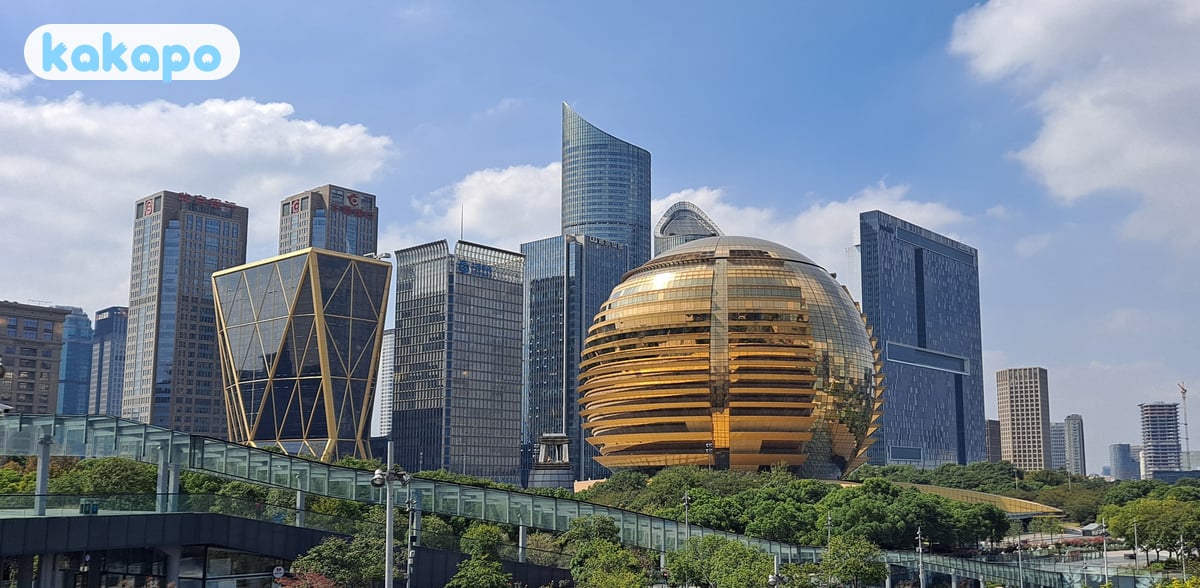
- Qianjiang New CBD (钱江新城) — modern business district east of central, on the Qiantang River. The Citizen Center (the dramatic curving "moon" twin towers), the Hangzhou Grand Theatre, and the modern Park Hyatt Hangzhou (¥1,200-2,800/night). Cleaner air, walkable riverside; useful base for the Qiantang tidal bore viewing in late August.
- Xixi Wetland (西溪湿地) — the 1,000-hectare freshwater wetland 7 km west of West Lake, sometimes called "Hangzhou's lungs." ¥80 entry; quieter than West Lake; boat tours through the reed channels. The Banyan Tree Hangzhou and Westin Resort & Spa are here.
- Longjing Tea Villages (龙井村) — Meijiawu and Longjing villages tucked in the hills south-west of West Lake. The source of Longjing (Dragon Well) tea. Free to wander; the China Tea Museum is nearby. Buy tea from the China National Tea Co-operative or named brands (Lu Yu, Bao Da Xing) at fixed prices rather than from the "farm-direct" touts along the West Lake path who sell fake Longjing at premium rates.
- Hangzhou East Railway Station area (杭州东站) — the main HSR hub in eastern Hangzhou, with 12+ trains per hour to Shanghai Hongqiao (45-60 min). Useful pass-through; not a destination. Avoid the unbadged taxi touts at the station — use the official rank or Didi.
If it's your first time in Hangzhou
- Set up Alipay Tour Pass and WeChat Pay before flying. Both accept foreign Visa/Mastercard reliably as of 2024-2025. SMS verification is much easier on your home SIM. Without them, you'll struggle at Metro vending machines, taxis, temple ticket booths, and most small restaurants.
- 240-hour transit visa-free covers Hangzhou for 54 nationalities arriving via Hangzhou Xiaoshan (HGH), Shanghai Pudong/Hongqiao, or several other approved ports. Confirm current eligibility at the Chinese embassy site before booking.
- VPN before arrival. Google, Gmail, Maps, WhatsApp, Facebook, Instagram, X all blocked. Download Astrill, ExpressVPN's China-tuned config, or NordVPN at home — provider sites are blocked from inside. For short trips, a Hong Kong-routed eSIM (3HK, Nomad, Airalo Hong Kong) bypasses the firewall on its own. Working alternatives inside the wall: WeChat, Alipay, Baidu Maps, Amap (Gaode), Didi.
- From Shanghai (most international visitors): HSR from Shanghai Hongqiao to Hangzhou East takes 45-60 min, ¥73-117 second class, 10+ trains per hour. Buy via Trip.com or 12306.cn (the official app, now supports foreign passports). Passport required at both booking and boarding. From Shanghai Pudong, take the Maglev or Metro Line 2 to Hongqiao first (50-70 min) then HSR.
- From Hangzhou Xiaoshan Airport (HGH): Metro Line 19 ¥9 (60 min to central); airport bus to West Lake ¥20 (60-90 min); Didi ¥100-130 (50 min). Don't use freelance taxi touts at arrivals.
- Best first-night base: Hubin (Four Seasons, Hyatt Regency, InterContinental at ¥1,500-5,000) for lakefront luxury; Wulin Square (Crowne Plaza, Pullman at ¥600-1,200) for mid-range; Qianjiang New CBD (Park Hyatt at ¥1,200-2,800) for modern. Skip first-night bookings in Xixi Wetland unless you want an explicitly nature-focused stay.
- West Lake timing: weekday mornings 06:30-08:00 for joggers and tai chi practitioners; sunset around Lingyin Temple (west side); Sunday evenings after 19:00 once daytrippers leave. Saturday-Sunday daytime brings 80,000-150,000 visitors. Avoid Golden Week (1-7 Oct) and Spring Festival completely — West Lake then is a humanitarian event, not a walking experience.
- Eat Hangzhou cuisine: Beggar's Chicken (the slow-cooked clay-baked chicken, ¥120-250 at Lou Wai Lou — the famous lakefront restaurant with the 170-year history); Dongpo pork (¥80-150); West Lake fish in vinegar / xī hú cù yú (¥80-180); Longjing tea-flavoured shrimp (¥120-220); the Grandma's Restaurant / Wai Po Jia chain for cheap reliable family-style meals (¥80-200 per person).
- The "tea ceremony" scam is the most-reported tourist trap. Friendly Mandarin-speaking "students" (usually a young man-woman pair) approach foreigners on Hubin Road or near the Broken Bridge, practise English, suggest a "traditional tea ceremony just nearby" — you end up with a ¥1,500-4,000 bill for tea and dim sum, with a bouncer at the door if you refuse. Decline tea invitations from strangers; if you want a genuine tea experience, take the Bus 27 to Meijiawu Tea Village where prices are posted and the experience is real.
- Cash and ATMs: ¥500-1,000 backup. ICBC, Bank of China, and HSBC ATMs accept foreign Visa/Mastercard with PIN. Foreign cards are now accepted at most chain restaurants and large hotels but rarely at small shops, taxis, or street vendors — these expect mobile pay.
- Qiantang tidal bore (late August) — the famous annual reverse-flow tidal wave on the Qiantang River, peaking around the 8th day of the 8th lunar month. The official viewing area at Yanguan Town has safety barriers; deaths every year from people standing on unprotected banks or in old riverside fishing villages. Stay behind the cones.
- Common rookie mistakes: skipping VPN setup; following "tea ceremony" or "art student" touts; assuming Google Maps will work for navigation; visiting West Lake during Golden Week; underestimating the West Lake walk (the full perimeter is 15 km — pick a section); not booking the Lingyin Temple ahead in autumn; forgetting passport for HSR booking; trying to swim near the Qiantang tidal bore.
Money, food, emergency numbers
- Currency: Chinese yuan (CNY/RMB). $1 ≈ CNY 7.2.
- Tipping: not customary.
- Food: Hangzhou cuisine is mild, sweet-and-sour, river-fish-heavy. Try Beggar's Chicken, Dongpo pork, West Lake fish in vinegar (xī hú cù yú), Longjing tea-flavoured shrimp. Grandma's Restaurant (Wai Po Jia) chain is reliable and cheap.
- Tap water: not drinkable. Bottled or kettle-boiled.
- Internet/VPN: Google, Facebook, Instagram, X/Twitter all blocked. Set up a VPN before flying — many providers don't work once you're in-country. Astrill, ExpressVPN's China-tuned config historically work.
- Emergency: 110 (police), 119 (fire), 120 (ambulance). Tourist hotline 12301 (24h). English is limited — having a Chinese-speaker available helps.
- Hospitals: Sir Run Run Shaw Hospital International Medical Center (+86 571 8600 6118); Zhejiang Provincial People's Hospital (+86 571 8589 3114).
- SIM: China Mobile, China Unicom, China Telecom — passport required to buy. Tourist eSIM (Airalo, Holafly) often easier and avoids the registration step.

Frequently asked questions
Is Hangzhou safe to visit in 2026?
Yes — Hangzhou scores 84/100 here. UK FCDO and US State Department both treat mainland China as low-to-moderate advisory with no Hangzhou-specific warning; the city's profile as the West Lake / tea capital and headquarters of Alibaba has only grown post-pandemic with the 240-hour visa-free transit. Violent crime against visitors is rare. The realistic risks are: West Lake teahouse 'tea ceremony' bait by friendly English-speaking 'students' on Hubin Road, pickpocketing in the Hefang Street tourist crush, and air quality on still winter days (Yangtze-delta industrial PM2.5 sits between Shanghai and Suzhou levels).
Is Hangzhou safe at night?
Yes. The West Lake promenade, Yan'an Road, Hubin Road, Wushan Plaza and the Qianjiang New CBD around the Civic Centre are well-lit and busy until late. The Xixi Wetland boardwalks close around dusk and aren't lit for after-hours walking — daytime only. Didi is the default ride app and runs 24/7; signing up takes Alipay or WeChat with a foreign card (now possible since 2024). Metro runs to about 23:00. Avoid the unlicensed taxi touts outside Hangzhou East railway station — use the official rank or Didi pickup zone.
What's the biggest scam to avoid in Hangzhou?
The 'tea ceremony' scam. Friendly Mandarin-speaking 'students' (often a young man-woman pair) approach foreigners on Hubin Road or near Broken Bridge, practise English, suggest a 'traditional tea ceremony just nearby' — you end up with a ¥1,500-4,000 bill for tea and dim sum, bouncer at the door if you refuse. Decline tea invitations from strangers; if you want a tea experience, go to the Longjing Tea Village in Meijiawu where prices are posted. Second-place is fake 'Longjing tea' sold along the West Lake path at supposedly 'farm-direct' prices — buy from the China Tea Museum shop or a named brand.
Can you drink tap water in Hangzhou?
No — do not drink unboiled tap water. Hangzhou municipal water meets Chinese standards at the treatment plant but rooftop tanks and older building pipework mean locals universally boil it. Every hotel room has a kettle and thermos for this reason. Bottled water is ¥2-4. Tea is the everywhere-default. Brushing teeth with tap is fine. Ice in hotels and chain restaurants (Starbucks, Heytea, hotpot chains) is filtered and safe; avoid roadside-stall ice in summer.
Will Google Maps and WhatsApp work in Hangzhou?
No — Google services (Maps, Search, Gmail), WhatsApp, Instagram, Facebook, X/Twitter and most Western news are blocked behind the Great Firewall. Install a VPN BEFORE arrival — VPN provider sites are themselves blocked from inside China. Working alternatives: WeChat (everything from chat to payment to ride-hail), Alipay (now accepts foreign Visa/Mastercard), Baidu Maps and Amap (Gaode) for navigation, Didi for taxis. Hangzhou is genuinely cashless — even temple donations take WeChat Pay QR. eSIMs that route via Hong Kong (3HK, Nomad, Airalo Hong Kong plans) bypass the firewall and are the cleanest fix for short trips.
Sources
Run a business in Hangzhou?
Show visitors your Hangzhou business is a safe choice. The free Verified by Kakapo badge puts Hangzhou's live safety score on your website, links back to your verified page, and updates itself. No cost.
Get the free badge →