


Is Fes Safe for Solo Female Travellers?
9,500 medina alleys, the faux-guide hustle, the riad-pickup rule, and what solo women need to know about Morocco's most overwhelming city.

Fes is the most overwhelming city in Morocco. The medina (Fes el-Bali, UNESCO-listed since 1981) contains 9,500+ named alleys inside its ramparts; it is the largest car-free urban area in the world. The single most useful fact: a first-time solo female visitor will get lost in Fes el-Bali within 20 minutes; the "faux-guide" hustle — local boys and young men who attach themselves to confused tourists, lead them on circuitous routes, and demand payment — is the defining solo-female Fes experience.
That said, Fes is not unsafe. Violent crime against tourists is rare; the harassment baseline is hustle-and-pressure, not aggression. Solo female travellers who book a vetted half-day guide on arrival, use their riad's pickup service, and adopt the "I have a guide already" line emerge from Fes with stories of incredible architecture and food rather than incidents.
Fes is a 2-3 day stop, not a base. The standard solo-female itinerary is Casablanca → train → Fes (2-3 nights) → train → Marrakech (3 nights) → bus → Essaouira (3 nights). The Casablanca-Fes-Marrakech ONCF Al Boraq high-speed train (since 2018) makes the logistics straightforward — Casablanca to Fes is 3.5 hours, Fes to Marrakech is 6.5 hours by regular train (no direct Al Boraq high-speed leg).
| Solo female safety | 70/100 |
|---|---|
| Night safety | 55/100 |
| Scam / petty-crime risk | High |
| Violent crime (tourists) | Low |
| Most common scams | faux-guide hustle in Fes el-Bali; shop scam with faux-guides; pressure from local boys at Bab Bou Jeloud |
| Safer neighbourhoods | Fes Jdid, Ville Nouvelle |
| Data sources cited | 4 |
| Last verified |
Fes el-Bali — why it's harder than Marrakech
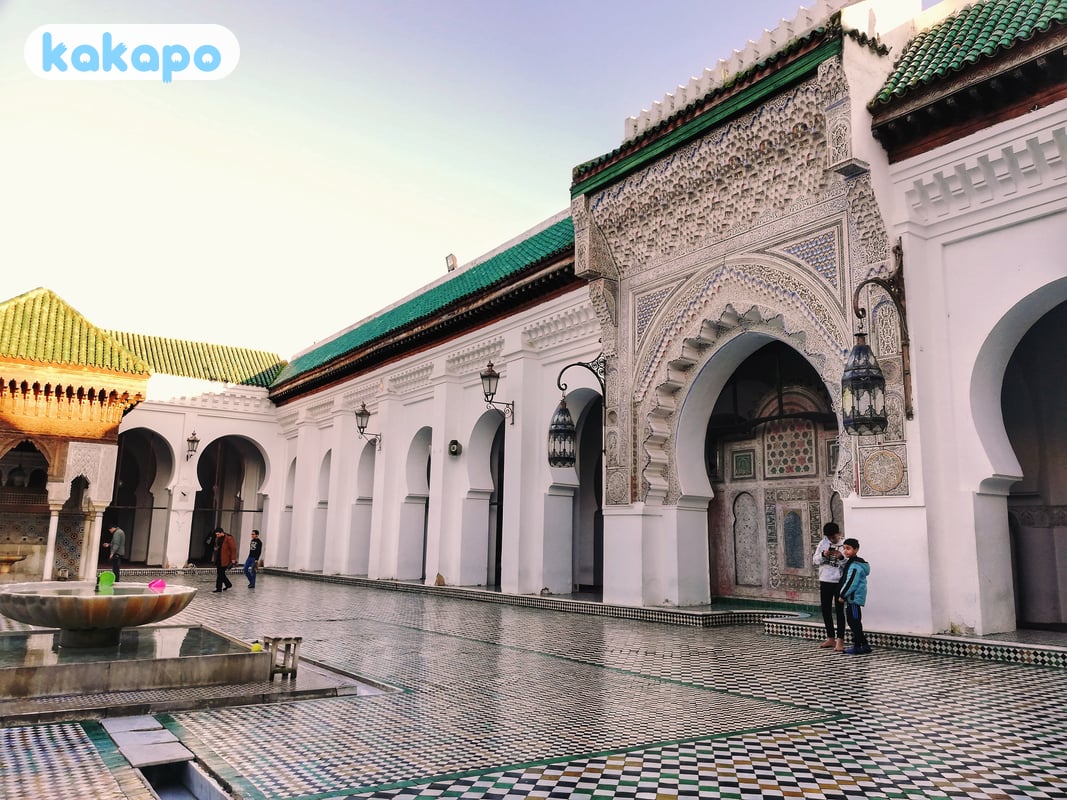
- Size: 9,500+ alleys; ~280 hectares; entirely car-free. The largest car-free urban area on earth.
- Layout: organic-medieval. No grid, no logical north-south axis, alleys end in dead ends or open into private courtyards. GPS works erratically (high walls, narrow alleys).
- Bab Bou Jeloud (Blue Gate) — the main tourist entry from Place Boujloud. Always busy; restaurants, juice stalls, faux-guides.
- Talaa Kebira / Talaa Seghira — the two main descending arteries from Bab Bou Jeloud down through the medina. The "main streets" — easier to follow but still serpentine.
- Tanneries (Chouara, Sidi Moussa, Aïn Azliten) — the famous coloured-dye pits. Approached through leather shops that hand you a sprig of mint for the smell.
- Al-Qarawiyyin — the oldest continuously-operating university on earth (founded 859 AD by Fatima al-Fihri, a woman). Non-Muslims can view from the entrance but not enter.
- Fes Jdid (the "new" 13th-century city) — the smaller medina with the Royal Palace, the Mellah (Jewish quarter), Place des Alaouites. More gridded and easier than el-Bali.
- Ville Nouvelle (modern Fes) — boulevards, modern hotels, the train station; safe, ordinary, less interesting.
The faux-guide hustle — Fes's defining annoyance
- What it is: local boys and young men attach themselves to confused tourists at Bab Bou Jeloud or elsewhere in the medina. They lead you toward a tannery or carpet shop, then demand payment (50-200 MAD).
- The pressure: they're persistent but rarely physically threatening. Hassle is verbal: "Madam, that way is closed", "I show you", "I help".
- Why it works on solo women: getting lost in Fes is universal; the offer of help is genuinely tempting; refusing once doesn't always stop them.
- How to refuse: confident "la, shukran, andi guide" (no thanks, I have a guide). Keep walking; do not slow down; do not engage in conversation. Eye contact and small talk are interpreted as a yes.
- If they follow you: walk into a shop or restaurant; ask the shopkeeper to deter them; they'll move on. Tourist police (Police Touristique) are visible at Bab Bou Jeloud and respond to requests.
- Hiring a real licensed guide: MAD 250-450 for half-day (€25-45). Book through your riad or the Office of Tourism (CRT Fes, Place de la Resistance). Licensed guides carry photo IDs.
- The "shop scam" version: the faux-guide takes you to a "co-operative" or "tannery viewing platform" where the high-pressure carpet/leather sales begin. You owe the venue nothing; saying "la, shukran" and walking out is acceptable.
The riad-pickup rule
- Why it matters: riads inside Fes el-Bali are not findable on first try. GPS fails in the medina; landmarks are buried; alleys turn unexpectedly. Even local taxi drivers won't enter the medina (no cars) and will drop you at the nearest gate.
- The rule: arrange for your riad to send a porter (carette) to meet you at the train station, the airport, or at the nearest medina gate (Bab Bou Jeloud, Bab R'cif, Bab Ftouh, Bab Guissa). Most riads do this for free or for a token fee (MAD 50-100).
- Why solo women especially: dragging suitcases through Fes el-Bali alone is exhausting and a magnet for faux-guides. The porter pre-empts the entire problem.
- If you arrive without a pre-arranged pickup: hail a petit taxi to the nearest gate to your riad; phone the riad and ask them to send someone; wait at a café (Café Clock, Café Bab Bou Jeloud) until they arrive.
- Best riads for solo women: Riad Fes (Relais & Châteaux, 5-star), Karawan Riad (boutique), Palais Amani (luxury), Dar Bensouda (mid-range, 4 well-reviewed riads), Riad Laaroussa.
Dress code, harassment intensity, the conservative reality
- Fes is more conservative than Marrakech, Essaouira or Casablanca. The medina population is more traditional; women cover more; harassment for inappropriately dressed tourists is more likely.
- Recommended dress: shoulders covered; knees covered; loose fits. Linen shirts, light cotton trousers, long skirts. Headscarf not required but appreciated in some quarters (Al-Qarawiyyin area, Mellah religious sites).
- What attracts attention: bare shoulders, short shorts, tight clothing. The attention is verbal not physical; persistent rather than aggressive.
- The "where are you going" pattern: solo women report being asked their destination by strangers in the medina constantly. This is a faux-guide opener; smile-and-keep-walking is the response.
- Riad interior: dress as you like inside the riad. Hammams (public bathhouses) have separate men's and women's hours.
- Ramadan (Feb-March 2026 approximately): dress more conservatively; restaurants closed during daylight in the medina; the medina is dramatically calmer (and the faux-guides take the month off).
Fes in the evening for a solo woman
- The medina at night: alleys are dimly lit; the faux-guide pressure drops dramatically (they go home); the genuine medina life takes over — locals walking, cafés, restaurants. Solo women report it as one of the most magical experiences in Morocco.
- Safe evening walks: Talaa Kebira and Talaa Seghira until 22:00 are busy; the souqs close around 20:00-21:00; restaurants serve until 22:00-23:00.
- After 22:00: walking the medina alone is safe but quiet. Carry a printed riad address (Arabic + French) and a torch (most riads provide one).
- Recommended evening restaurants: Café Clock (Talaa Kebira; international + Moroccan, alcohol-free), Restaurant Numero 7 (alcohol-licensed), Dar Hatim (traditional dinner; book ahead), The Ruined Garden (riad-restaurant, atmospheric).
- Alcohol: Fes is conservative. Inside the medina only a handful of restaurants serve alcohol (Café Clock has wine; The Ruined Garden has wine + beer). Ville Nouvelle hotels (Hyatt Regency, Hotel Sahrai) have full bars.
- Live music: Café Clock runs cultural evenings (live music, storytelling, calligraphy); Dar Tazi hosts Sufi music nights in season.
The solo-female Fes rules
- Pre-arrange riad pickup at the train station or medina gate. Don't try to find the riad alone.
- Hire a licensed guide (CRT Fes or your riad) for the first half-day; €25-45 well spent.
- Refusing faux-guides: "la, shukran, andi guide" + keep walking; no eye contact.
- Dress conservatively: shoulders and knees covered; loose fits.
- Medina at night: safe on main axes (Talaa Kebira, Talaa Seghira); carry a torch + printed riad address.
- Hammam etiquette: women's hours separate; bring flip-flops, swimsuit (the hammam is wet, not nude in tourist-oriented venues).
- Tannery viewing: free from terraces of leather shops; you owe nothing but a small tip (MAD 10-20) for the mint sprig.
- Emergency: 19 (police), 15 (medical), 112 (any), Police Touristique +212 5 35 62 32 22.
Frequently asked questions
Is Fes safe for solo female travellers in 2026?
Yes — violent crime against tourists is rare; the issue is hustle-and-pressure rather than aggression. The defining experience is the faux-guide hassle (local boys and men attaching themselves to confused tourists, then demanding payment). Solo women who pre-arrange riad pickup, hire a licensed guide for the first half-day, and adopt the 'I have a guide' line emerge with great memories rather than incidents.
Is Fes harder than Marrakech for solo women?
Yes — the medina is significantly larger and more disorienting (9,500 alleys vs Marrakech's ~3,000), the population is more conservative, and the faux-guide hustle is more persistent. Marrakech has the Jemaa el Fna anchor square; Fes has no equivalent navigational reference. Plan 2-3 days in Fes, not a week.
How do I avoid faux-guides in Fes?
Hire a real licensed guide for the first half-day (MAD 250-450 via your riad or CRT Fes); after that you'll know the main arteries. When approached, refuse confidently in Darija: 'la, shukran, andi guide' (no thanks, I have a guide). Keep walking; no eye contact; do not engage in conversation. Police Touristique at Bab Bou Jeloud will help if pressured.
How do I find my riad in the Fes medina?
Pre-arrange a riad pickup at the train station or nearest medina gate. Every reputable riad sends a porter (carette) to meet guests — most for free or MAD 50-100. Do not try to find your riad alone; GPS fails in the medina (high walls, narrow alleys), landmarks are buried, and dragging suitcases through the alleys is exhausting and a faux-guide magnet.
What should I wear in Fes?
More conservative than Marrakech or Essaouira. Shoulders covered, knees covered, loose fits. Linen shirts, light cotton trousers, long skirts. Headscarf not required. Bare shoulders and short shorts attract verbal attention but rarely physical harassment. Inside the riad, dress as you like.
Is the Fes medina safe at night?
Yes on the main axes (Talaa Kebira and Talaa Seghira until ~22:00). The medina is dimly lit but the faux-guide pressure drops dramatically after dark; locals are out, restaurants are open, the atmosphere is calmer. Carry a printed riad address (Arabic + French) and a small torch (most riads provide one).
Can I drink alcohol in Fes?
Limited inside the medina — Café Clock (wine), The Ruined Garden (wine + beer), Restaurant Numero 7, a handful of upscale riads (Riad Fes, Karawan, Palais Amani). Ville Nouvelle hotels (Hyatt Regency Fes, Hotel Sahrai) have full bars. Don't bring open alcohol into the medina alleys; consume inside licensed venues.
Sources
Run a business in Fes?
Show visitors your Fes business is a safe choice. The free Verified by Kakapo badge puts Fes's live safety score on your website, links back to your verified page, and updates itself. No cost.
Get the free badge →