


Is Zagreb, Croatia Safe? A 2026 Travel Safety Guide
The 2020 earthquake recovery, winter cold, the road to Plitvice and the coast, and the realistic risks of one of Europe's safer mid-sized capitals.

Zagreb is one of Europe's safer mid-sized capitals for tourists. Crime against visitors is rare; the city is small enough that the tourist core (Upper Town, Lower Town, Tkalčićeva) is walked end-to-end in 30 minutes.
The realistic risks for visitors are limited. The most common visitor concerns: winter ice on the Upper Town hill (Gradec/Kaptol), the lingering visible damage from the March 2020 5.5M earthquake (some buildings in Upper Town still under restoration; cathedral spires were damaged), the road conditions on the popular drives to Plitvice Lakes (2 hours south) and the Adriatic coast, and the standard pickpocket risk at peak Christmas-market season.
Croatia sits at Level 1 on the US State Department's advisory list. UK FCDO is the same. The honest framing for first-time visitors: Zagreb is medium-sized (~770,000 in city, 1.1 million metro), Central-European in character (more like Budapest or Vienna than Split or Dubrovnik), and rebuilt itself rapidly from the 2020 earthquakes. Most visitors stay 2-3 days before heading to Plitvice and the coast.
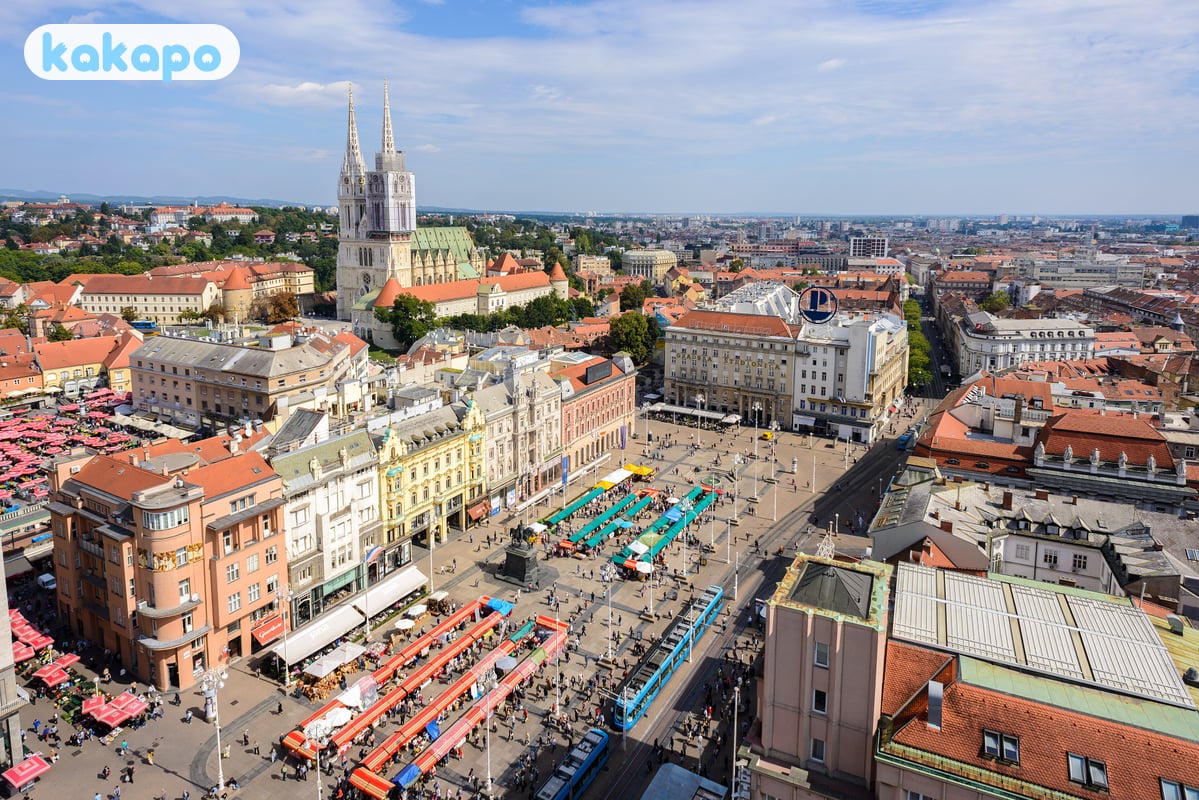
The geography first-timers should learn: Zagreb has two distinct cores. Gornji Grad (Upper Town) is the medieval hilltop reached by the 1893 funicular (Uspinjača) — St Mark's Church with the famous tiled coat-of-arms roof, the Stone Gate (Kamenita Vrata), the Lotrščak Tower with its noon cannon. Donji Grad (Lower Town) is the 19th-century Habsburg-planned grid below, with the "Green Horseshoe" of parks (Tomislav, Strossmayer, Zrinjevac) framing the National Theatre, the Museum of Arts and Crafts, the Botanical Garden. Tkalčićeva — pedestrianised, café-and-bar lined — runs between them. Kaptol is the cathedral neighbourhood. The Sava river is a 15-min walk south but Zagreb is essentially a "back to the river" city, with the centre oriented north toward the Medvednica hills.
In 2026, the specific things that have changed since pre-pandemic include: Croatia adopted the euro on 1 January 2023 (no more kuna — the old prices on signage are long gone) and joined the Schengen Zone the same day (border controls with EU neighbours gone); ZET trams now use contactless tap-to-pay at €0.60 single / €5 day pass; the Cathedral spires remain under scaffolding from the March 2020 (5.5M) earthquake (restoration is multi-year — current ETA for full spire reopening is 2027); the Plitvice Lakes National Park has hard daily caps on visitor numbers with timed entry (book online at np-plitvicka-jezera.hr — €40 summer); and Advent in Zagreb consistently ranks among Europe's top-three Christmas markets, with December crowds matching peak summer.
| Night safety | 78/100 |
|---|---|
| Scam / petty-crime risk | Medium |
| Violent crime (tourists) | Low |
| Most common scams | pickpocketing during Advent in Zagreb; winter ice on the Upper Town hill; road conditions on drives to Plitvice Lakes |
| Safer neighbourhoods | Gornji Grad (Upper Town), Donji Grad (Lower Town), Kaptol |
| Data sources cited | 4 |
| Last verified |
What the score means — 83/100
- Personal safety (86) — high. Pickpocketing on tourist routes; otherwise low.
- Transport (86) — modern tram + bus network.
- Healthcare (84) — Croatian healthcare is solid; KBC Zagreb is the major hospital.
- Air quality (80) — moderate. Some winter inversions.
The 2020 earthquake — what's still visible
- March 22, 2020 (5.5M): Zagreb's most destructive earthquake in 140 years. Damage concentrated in Upper Town and the Cathedral.
- December 29, 2020 (6.4M): a much larger quake hit Petrinja (50 km south-east). Felt strongly in Zagreb but most damage was in Petrinja town. Mosaic of older buildings throughout the region damaged.
- What's still visible in 2026: scaffolding on Cathedral towers (renovation ongoing), some Upper Town buildings still under structural work, occasional fenced-off pavements.
- Tourist impact: minimal. Walking routes are open; museums are open; most accommodation is post-quake-cleared.
- Future seismic risk: Croatia sits on a known fault zone. Real but unpredictable.
- If you feel a tremor: drop, cover, hold under sturdy furniture or in a doorway. Don't run outside during shaking.
Areas — Upper Town, Lower Town, Tkalčićeva

Recommended for visitors: Gornji Grad (Upper Town) — the medieval hilltop with St Mark's Church, the Stone Gate, the Lotrščak Tower. Kaptol — the cathedral district, slightly down from Upper Town. Donji Grad (Lower Town) — 19th-century planned grid with parks (the "Green Horseshoe"), museums, the National Theatre. Tkalčićeva — the pedestrianised café-and-bar street, alive evening into night.
Stay aware: around Glavni kolodvor (central railway station) at night. Outer industrial areas — no tourist relevance.
There are no specific "no-go" zones for tourists in Zagreb proper.
Winter cold and the famous Christmas market
- December-February: -3 to 5°C standard, occasional -10°C. Snow common.
- Cobbled Upper Town: slippery on icy days. Boots with grip.
- Advent in Zagreb (Christmas market): late Nov - early Jan. Among Europe's best-rated for the past decade. Hot wine (kuhano vino), sausage, roasted chestnuts, music.
- Crowds and pickpockets: elevated during Advent. Front pocket only.
- Best summer: June-September, 22-30°C.
Plitvice and the coast — day-trip logistics
- Plitvice Lakes National Park: 2-2.5 hours south on the A1 motorway. Stunning UNESCO-listed cascading lakes.
- Don't try in one day in summer: park gets clogged; you want a leisurely 4-6 hours of walking. Stay overnight in Plitvice village or nearby.
- By bus: from Zagreb bus station, ~3h.
- By car: 2-2.5h. A1 toll motorway.
- Stick to marked paths: the boardwalks are popular and slippery; rangers actively police off-path walkers.
- To the Adriatic coast: Split 4h, Zadar 3h, Dubrovnik 6.5h. A1 motorway throughout. Tolls add ~€20-30 to the toll-pass.
- Driving: Croatia's A1 is modern and well-maintained. Petrol stations every 30 km.
Transport, taxis, the airport
- Trams (ZET): extensive 15-line network. €0.60/single, €5/day pass.
- Buses: city + suburban.
- Funicular (Uspinjača): 1893 line connecting Lower and Upper Town. 64 m, 60 sec. Fun and useful. €0.80.
- Taxis: regulated, metered. Bolt operates.
- Zagreb Airport (ZAG): 17 km south-east. Pleso bus €8 to centre. Taxi €25-30.
- Trains: Vienna 6h, Budapest 6h, Ljubljana 2.5h.
Money, food, and the cost story
Zagreb area-by-area
- Gornji Grad (Upper Town) — the medieval hilltop. St Mark's Church (with the famous tiled coat-of-arms roof), the Stone Gate shrine (Kamenita Vrata), Lotrščak Tower (noon cannon fires daily), Croatian Parliament. Reached by the 1893 funicular (Uspinjača, 64m, 60 sec, €0.80) or the steep Strossmartre stairs. Cobbled, slippery in winter, atmospheric in any season.
- Donji Grad (Lower Town) — the 19th-century Habsburg-planned grid. The "Green Horseshoe" of parks (Tomislav, Strossmayer, Zrinjevac), National Theatre, Mimara Museum, Museum of Arts and Crafts, Botanical Garden. Wide boulevards, café terraces.
- Tkalčićeva — pedestrianised café-and-bar street running between Upper Town and Kaptol. The locals' Friday-Saturday choice. Walkable, lively into the night, dozens of bars and restaurants (Karijola, Curry Bowl, Capuciner).
- Dolac Market — open-air market just off Tkalčićeva (the iconic red-umbrellaed stalls). Tuesday-Sunday mornings; produce, cheese, flowers, fish. Photographic and authentic. The Strukli stand serves the local cheese pastry.
- Kaptol + Cathedral — the cathedral district just east of Tkalčićeva. Cathedral spires still under scaffolding from the 2020 earthquake (renovation through ~2027). The Žitnjak Christmas market location during Advent.
- Funicular (Uspinjača) — 1893 line connecting Lower and Upper Town. 64m, 60-sec ride, €0.80, one of the world's shortest funicular lines. Useful and charming.
- Tram network (ZET) — extensive 15-line network, contactless tap-to-pay €0.60 single / €5 day pass. Modern trams from 2020s; trip from anywhere in central Zagreb to anywhere else is rarely more than 15 min.
- Plitvice Lakes National Park (2-2.5h south on A1) — UNESCO-listed cascading lakes. Hard daily visitor caps with timed entry (€40 summer, book at np-plitvicka-jezera.hr). 4-6h walking the wooden boardwalks. Stick to marked paths; rangers actively police off-path walkers. Stay overnight nearby in peak summer.
- Zagreb Airport (ZAG) — 17 km south-east. Pleso bus to centre €8 (35 min). Bolt operates and is cheaper than the official taxi rank.
If it's your first time visiting
- Use ZET tram day pass (€5) or single (€0.60), tap-to-pay on the reader. Validate by tapping a contactless card; daily cap is automatic. Fare-dodging fines are €40 on the spot.
- From ZAG airport: Pleso bus €8, 35 min, every 30 min. Bolt from airport €15-22. Taxi from official rank €25-30.
- Best neighbourhood for your first night: anywhere in the centre, but Tkalčićeva-adjacent for walking-everywhere convenience. Hotel Esplanade (the legendary Orient Express-era), Esplanade by Mövenpick, Hotel Capital, Sheraton, or boutique like Hotel Jägerhorn (off Tkalčićeva). €100-250/night standard, €300+ for the Esplanade.
- Day-2 plan: funicular up to Upper Town at 11:30 for the noon cannon, walk to St Mark's, Stone Gate, the museums, descend via Strossmartre stairs. 3-4 hours.
- Plitvice Lakes: book timed entry online + go overnight, not as a day-trip in summer. €40 summer; daily caps mean walk-up tickets can sell out by 10:00. Direct bus from Zagreb's main bus station (Autobusni kolodvor) runs ~3h, ~€15 each way. By car, 2-2.5h on A1 (€20-30 tolls round trip).
- Eat at Pod gričkim topom for the view, Konoba Didov San for traditional Croatian, Mali Bar for Sunday brunch. Mains €15-30. Croatian food: štrukli (cheese strudel — the local pastry), purica s mlincima (turkey with pasta), pršut (cured ham), paški sir (sheep cheese from Pag island).
- Advent in Zagreb (late November - early January) is genuinely Europe's top-tier Christmas market. Hot wine (kuhano vino) €3-4, sausages, music, ice rinks. Crowds and pickpockets are elevated; front-pocket discipline matters. Book accommodation early — December is now matching summer prices.
- Always pay in EUR on card terminals — decline DCC. Croatia adopted the euro in 2023.
- Tap water is excellent and free in restaurants. Karst aquifer supply. Ask for "voda iz slavine." Carry a refillable bottle.
Practical info — emergency numbers
- European emergency: 112.
- Police: 192.
- Ambulance: 194.
- KBC Zagreb (University Hospital): +385 1 2388 888.
Bring: warm layers if Nov-March, boots with grip, a contactless card, an unlocked phone (A1, T-Mobile HR, Telemach prepaid SIMs), and travel insurance.

Frequently asked questions
Is Zagreb safe to visit in 2026?
Yes — Zagreb scores 86/100 here, one of Europe's safer mid-sized capitals. Croatia sits at US State Department Level 1 and UK FCDO is the same. Crime against tourists is rare and the city's tourist core (Upper Town, Lower Town, Tkalčićeva) is small enough to walk end-to-end in 30 minutes. The realistic concerns are the lingering visible damage from the March 2020 (5.5M) and December 2020 (6.4M Petrinja) earthquakes — scaffolding on Cathedral towers, some Upper Town restoration ongoing — plus winter ice on the Gradec/Kaptol hill, Advent in Zagreb pickpocketing, and the standard road conditions on the A1 to Plitvice and the coast.
Is Zagreb safe at night?
Yes. Tkalčićeva is the pedestrianised café-and-bar street alive into the night, and the Upper Town, Kaptol and Lower Town are all comfortable late. Trams run frequently. The Glavni kolodvor (central railway station) area is the only zone worth a bit of extra awareness late at night — more rough sleepers than danger. Solo walking from a Tkalčićeva bar back to a central hotel is routine. Drink-spiking is rare. The cobbled Upper Town and the funicular path get slippery on icy December nights — boots with grip are essential. The Advent Christmas market keeps the centre busy and well-policed until late.
Is Zagreb safe for solo female travellers?
Yes. Zagreb is one of the easier Central European capitals for solo women — low harassment, friendly atmosphere, and small enough that you'll see the same staff repeatedly. The Upper Town, Tkalčićeva and Lower Town parks (the 'Green Horseshoe') are all routine solo experiences day or night. Solo dining at Tkalčićeva cafés works fine. The Advent in Zagreb Christmas market is family-saturated and feels secure. Standard awareness on tram routes during commute hours — bag in front. Plitvice day-trip solo is routine via the direct bus from Zagreb bus station; the park is family-saturated and ranger-policed.
Can you drink tap water in Zagreb?
Yes — Zagreb tap water is excellent, drawn from karst aquifers in the surrounding hills and meeting Croatian/EU standards. Locals drink it routinely and the city has public fountains in the parks. Restaurants will serve tap water (voda iz slavine) on request, though bottled is the default. Carry a refillable bottle. On Plitvice day trips bring water — the park has limited fountains and the wooden boardwalks make for a long walking day. The cascading lakes themselves are off-limits for swimming and drinking — strictly protected UNESCO water.
What's the biggest scam to avoid in Zagreb?
There genuinely isn't much of a scam scene — Zagreb is one of the lowest-scam Central European capitals. The closest things to traps: restaurant tourist-menu pricing right on Tkalčićeva (walk one block off for better prices), DCC card-reader markups (always pay in EUR — Croatia adopted the euro in 2023), and Plitvice 'private tour' resellers at 3-4x the cost of a direct bus from the central bus station. Currency-exchange offices around Glavni kolodvor offer worse rates than bank ATMs (Zagrebačka banka, PBZ). Advent pickpockets in the Christmas market crush front-pocket only — but base rate is low.
Is the 2020 earthquake still affecting Zagreb visits?
Minimally. The March 22, 2020 (5.5M) Zagreb earthquake was the city's most destructive in 140 years, with damage concentrated in Upper Town and the Cathedral; the December 29, 2020 (6.4M) Petrinja quake 50km south-east was larger but most damage was in Petrinja town. In 2026 you'll still see scaffolding on Cathedral towers (renovation ongoing), some Upper Town buildings under structural work, and occasional fenced-off pavements. Walking routes are open, museums are open, accommodation is post-quake-cleared. Croatia sits on a known fault zone — if you feel a tremor, drop/cover/hold under sturdy furniture or in a doorway. Don't run outside during shaking.
Sources
Run a business in Zagreb?
Show visitors your Zagreb business is a safe choice. The free Verified by Kakapo badge puts Zagreb's live safety score on your website, links back to your verified page, and updates itself. No cost.
Get the free badge →