


Is Vienna, Austria Safe? A 2026 Travel Safety Guide
What to expect from one of Europe's safest capitals — and the real-world rough edges nobody mentions.

Vienna is one of the safest large cities in Europe, and the data backs that up: Mercer and the Economist Intelligence Unit have ranked it #1 or #2 globally for personal safety for most of the last decade. Both the UK FCDO and the US State Department list Austria at their lowest advisory level (Level 1 / "exercise normal precautions"). Violent crime against tourists is genuinely rare.
The realistic risks for visitors are mundane: pickpocketing on a few specific U-Bahn lines and at major tourist sites, occasional aggressive drunks around the Praterstern station late at night, and the same ATM-skimming risk you'd face in any large European city. Bicycles are stolen at high rates — but cars and tourists generally are not.
This guide is the candid version, not the disclaimer-padded one. If you're a tourist, the most likely "incident" on your trip is leaving a phone on a café table and finding it returned by the waiter twenty minutes later. That isn't unusual here.
What surprises most first-time visitors is the formality. Vienna takes manners seriously in ways that have largely disappeared in Berlin or Amsterdam — the waiter in a Kaffeehaus is a trained "Herr Ober", greeted with "Grüß Gott" not "hi", and you address strangers with "Sie" (formal) not "du". An espresso is a "kleiner Schwarzer"; a long coffee with milk on the side is a "Verlängerter braun". Sit at a Kaffeehaus table for three hours nursing one Melange and reading a newspaper — that's not loitering, it's the original use case. Tipping is round-up plus 5-10%, stated verbally when paying ("zwanzig, bitte" for a €17.50 bill).
In 2026, the practical updates: the U2/U5 reconstruction is partially complete with new central stations rolled out through 2024-2025 — expect partial U2 closures and replacement-bus services through 2026; the Wiener Linien 24h weekend U-Bahn is permanent; Austria's Klimaticket "Wien" annual pass at €365 covers all transport in the city and is sold day-prorated; and Vienna officially overtook Melbourne for the EIU Most Liveable City top spot for the third straight year. Christmas markets (Christkindlmärkte) operate from mid-November through 24 December and the Glühwein-glass deposit (Pfand) for the souvenir mugs is universal — €4 returned when you bring the cup back.
| Night safety | 86/100 |
|---|---|
| Scam / petty-crime risk | Medium |
| Violent crime (tourists) | Low |
| Most common scams | costumed 'Mozart' ticket sellers outside Stephansdom; restaurant overcharging around Stephansdom and the Hofburg; petitions / 'deaf-mute' clipboard scams |
| Safer neighbourhoods | 1st (Innere Stadt), 3rd (Landstraße), 4th-5th (Wieden, Margareten) |
| Data sources cited | 4 |
| Last verified |
What the score means
Vienna scores 88/100 — solidly in the "very safe" band. The breakdown:
- Transport (92) — the highest sub-band. The Wiener Linien network (U-Bahn, S-Bahn, trams, buses) is clean, reliable, and well-policed. Drivers use it; this isn't a "tourist-only" system.
- Healthcare (90) — Austria has universal healthcare and Vienna's hospitals are world-class. AKH (Allgemeines Krankenhaus) is one of Europe's largest hospitals and is the major public emergency facility.
- Personal safety (88) — high but not perfect. Pickpocketing in tourist hotspots and a small number of areas with concentrated late-night drinking pull this down.
- Night (84) — the softest sub-band. Vienna is broadly safe to walk at night, but the few honest "areas to know after dark" are night-time issues, not day-time issues.
Areas to know — and the few where awareness helps

Vienna is divided into 23 numbered districts (Bezirke). The 1st (Innere Stadt) is the historic centre — virtually 100% tourist-safe, day or night.
Comfortable everywhere: 1st (Innere Stadt), 7th (Neubau — MuseumsQuartier), 8th (Josefstadt), 9th (Alsergrund), 13th (Hietzing — Schönbrunn), 18th/19th (Währing/Döbling — leafy residential).
Areas where late-night awareness helps:
- Praterstern (2nd district, by the Prater amusement park) — the train/U-Bahn station has a long-standing reputation for late-night drunks and occasional aggressive begging. Increased police presence in 2024-2025; daytime is fine, walking through at 2am alone is the realistic concern. The Prater itself is a normal park.
- Westbahnhof / Gürtel (15th district) — the ring road around the inner districts. Some of Vienna's adult-entertainment district sits along it. Not "dangerous" in the muggings sense; just the part of town where you'll see things you might not want to see, and where late-night noise complaints are loudest.
- Karlsplatz U-Bahn — the underground passages have historically attracted a small open drug scene. Heavy police presence; the actual risk to a passer-through is low, but it's the most uncomfortable space in the centre.
- Favoriten (10th) and Brigittenau (20th) — working-class districts. They get mentioned in Austrian media around crime statistics, but for visitors there's nothing specific to avoid; tourists are very rarely there.
U-Bahn, trams, taxis

Use public transport without hesitation — it's part of how the city works. A few practical notes:
- Pickpocketing is concentrated on the U1 and U3 lines through tourist stations (Stephansplatz, Karlsplatz, Schwedenplatz). Standard advice: phone in front pocket, wallet in front pocket, day-bag zipped in front of you on crowded platforms.
- Tickets: Vienna has random ticket inspectors. The fine for fare-dodging is €105 cash on the spot. Buy a 24h or 72h pass; it's straightforward.
- Taxis vs Uber: both work. Uber is regulated as a taxi service (drivers are licensed). FREE NOW is widely used. Standard taxis are honest; bolt-meter scams are uncommon but happen at the airport — agree the fare or insist on the meter ("mit Taxameter, bitte").
- Bikes: Vienna has good cycle infrastructure but bike theft is the city's most common reported property crime. Use two locks if you bring/rent your own.
Scams and tourist traps

Vienna has the standard European tourist scams plus one local specialty:
- Costumed "Mozart" ticket sellers outside Stephansdom and Karlskirche selling concert tickets. The concerts are real but quality varies wildly — read reviews on a phone before paying. Real Vienna State Opera and Musikverein tickets are bought through their official sites.
- Restaurant overcharging in the streets immediately around Stephansdom and the Hofburg — €8 for a small coffee, no posted prices, "service charge" added. Walk one block away. Anywhere with a German-language menu in the window is fine.
- ATM skimming — same as any European city. Use ATMs inside bank branches, not free-standing tourist ATMs.
- Petitions / "deaf-mute" clipboard scams — present in every European tourist city, Vienna included. Wave them off; never let them touch your bag.
Healthcare and what's covered
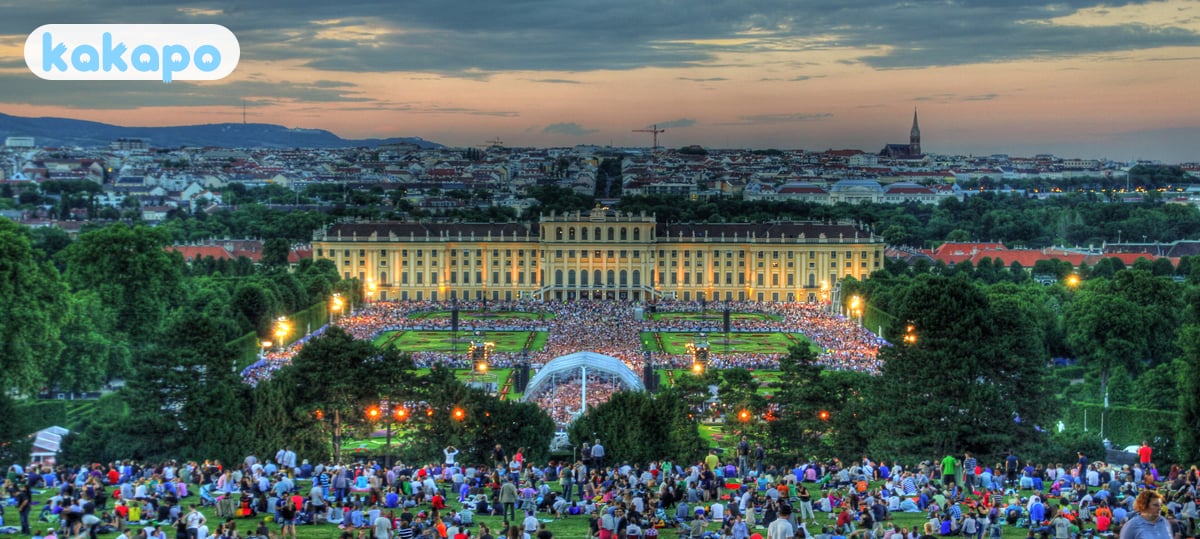
Austrian healthcare is excellent. EU citizens with an EHIC/GHIC card get the same access as locals at no cost (or low co-pay). Non-EU visitors should have travel insurance — the system will treat you, but the bill will then be invoiced.
- Major emergency hospital: AKH (Allgemeines Krankenhaus), 9th district. 24h emergency room, English-speaking staff.
- Pharmacies (Apotheke): closed on Sundays; one in each district stays open ("Bereitschaftsdienst") — list posted on every closed pharmacy door.
- Tap water: excellent — Vienna's water is piped from Alpine springs and is among the best in Europe straight from the tap.
Neighbourhood-by-neighbourhood breakdown
- 1st (Innere Stadt) — the historic core inside the Ring road: Stephansdom, Hofburg, Graben, Kärntner Straße. Heavily policed, very safe at any hour. Pickpockets work the cathedral plaza and the Mozart-ticket strip.
- 2nd (Leopoldstadt) — across the canal from the centre. Augarten park, the Karmeliterviertel café strip, the Prater amusement park. Mostly safe; Praterstern station has a long-standing reputation for late-night drunks and aggressive begging — police-presence has improved sharply since 2024.
- 3rd (Landstraße) — Belvedere palace, the Hundertwasserhaus. Diplomatic and residential, very safe.
- 4th-5th (Wieden, Margareten) — Naschmarkt food market, the Freihausviertel boutiques. Hip, walkable, very safe.
- 6th-7th (Mariahilf, Neubau) — Mariahilfer Straße shopping mile, MuseumsQuartier, indie cafés around Spittelberg. Very safe and genuinely fun for an evening stroll.
- 8th-9th (Josefstadt, Alsergrund) — university and theatre districts. Calm, residential, very safe; the AKH hospital is in the 9th.
- 15th (Rudolfsheim) and Gürtel ring road — adult-entertainment district along the Gürtel. Not "dangerous" in the muggings sense; the part of town where you'll see things you might not want to see. The Westbahnhof end gets ambient drinking late.
- Outer districts (Favoriten, Brigittenau, Floridsdorf) — working-class, multicultural, residential. Statistically slightly higher crime rates but no tourist relevance — you'd only be there if you're staying in a budget hotel near a U-Bahn endpoint.
If it's your first time visiting
- Best arrival airport: Vienna International (VIE), 18km east. The CAT (City Airport Train) is €14.90 in 16 minutes to Wien Mitte — fast but pricey. The standard S7 S-Bahn is €4.30 in 25 minutes, identical destination, just slower trains. Regulated taxi to centre is €40-50; Uber and Bolt are similar. Skip the rental car — Vienna's Ring + Gürtel one-way system is a nightmare for first-timers.
- Buy a 24/48/72-hour Wiener Linien pass from any U-Bahn vending machine (€8 / €14.10 / €17.10) — covers all U-Bahn, S-Bahn, trams, buses, the night network. Or just tap a contactless bank card on the readers (rolled out 2024). Single ride is €2.40. Random ticket inspectors do €105 cash fines on the spot — don't try to ride free.
- Best neighbourhood for your first night: the 1st district for atmosphere (but tourist-priced hotels), Neubau (7th) for hip/calm, Josefstadt (8th) for residential charm, or Mariahilf (6th) for budget options near transport. Avoid booking right at Praterstern or the Westbahnhof immediate area.
- Day 1, jet-lag friendly: walk a loop of the Innere Stadt — Stephansdom, the Graben, Hofburg, the Volksgarten, and end with cake and a Melange at Café Central or Café Sperl. Flat, walkable, no booking needed.
- Common rookie mistakes: buying "Mozart" concert tickets from the costumed touts at Stephansdom (the concerts are real but mid-quality — book Musikverein, Konzerthaus, or Wiener Staatsoper directly online instead); paying €8 for an espresso at a tourist-strip café (walk one street back); confusing "Wiener Schnitzel" (veal, more expensive) with "Schnitzel Wiener Art" (pork, cheaper and what most menus actually serve unless specified); not validating a paper Wiener Linien ticket in the blue box before boarding; calling waiters "Kellner" rather than "Herr Ober" (the formal title actual locals still use).
- Book Wiener Staatsoper standing-room tickets day-of — €15, queue from 16:30 for the 19:30 show; one of the great cultural-tourism values in Europe.
- Don't skip the Heuriger taverns in the wine villages (Grinzing, Nussdorf, Stammersdorf) — take tram D or the 38 from Schottentor, eat Bauernschmaus and drink young wine at a wooden table outside.
- Carry €20-40 cash. Most places take cards, but small Beisl, museums' coat-checks, and the U-Bahn ticket machines (for paper tickets) still want coins.
Practical info
- Police: 133.
- Ambulance: 144.
- Fire: 122.
- European emergency number: 112 — works on any mobile, with or without a SIM, and operators speak English.
- Tourist police / English help: the LBA (Landespolizeidirektion) at 01-313 10 has English-speaking duty officers.
Vienna is a card-friendly city; contactless works on all public transport vending machines and most shops, but small wine bars and traditional Beisl still occasionally do cash-only — keep €30-50 in euro on you.
Frequently asked questions
Is Vienna safe to visit in 2026?
Yes. Vienna consistently ranks as one of the world's safest + highest-quality-of-life capitals. US State Department lists Austria at Level 1 (lowest tier). UK FCDO has no overall advisory against travel. Crime against tourists is rare; pickpocketing on U-Bahn U1 + U4 at peak tourist hours is the main concern. Violent crime essentially nonexistent in tourist areas.
Is Vienna safe at night?
Yes — Vienna is one of the safest European capitals to walk alone at night. Standard urban awareness still applies; Praterstern + the area immediately north of the canal are scrappier after midnight. Vienna's nightlife (Naschmarkt area, Gürtel, Bermuda Triangle) runs late + safely. U-Bahn runs 24h on Friday + Saturday nights.
What's the most dangerous area of Vienna?
Vienna doesn't have tourist 'dangerous' areas. Praterstern train station + immediate Nordbahnhof area have some after-dark grittiness (some homelessness, occasional rough sleepers). Karlsplatz subway also has drug-zone reputation but is heavily policed. Outer districts (Favoriten, Simmering, Floridsdorf) are residential + safe.
Is Vienna safe for solo female travellers?
Yes. Austria ranks among Europe's safest for solo women. Standard precautions: phone in pocket on U-Bahn at peak hours, watch drinks in clubs (rare but documented spiking in Bermuda Triangle bars), use Bolt/Uber for late-night solo rides. Catcalling is rare.
Can you drink tap water in Vienna?
Yes — famously the best tap water of any European capital. Vienna's water comes from Alpine springs via the Hochquellenleitung pipeline since 1873; it's of mineral-water quality + heavily-tested. Drinkable + free everywhere; public fountains across the city are all drinking-grade.
What's the biggest scam to avoid in Vienna?
Vienna has very few scams. Fake-Mozart concert ticket touts in costume on Stephansplatz + Kärntner Straße — they push tickets to mid-quality string quartets at expensive prices. Reputable Mozart concerts: Vienna State Opera (Wiener Staatsoper), Musikverein, Konzerthaus, Mozarthaus Vienna — buy from official sites. Other: occasional U-Bahn ticket-control scams (real controllers wear plain clothes but show official ID; insist on seeing it).
Is Vienna's classical music scene worth the price?
Yes for genuine venues. State Opera (€10-200 + €15 standing-room same-day), Musikverein (Vienna Philharmonic home, €20-200), Konzerthaus (€20-150). Tourist-trap 'period-costume Mozart' concerts at the Kursalon or Palais Auersperg are €40-80 + mid-quality. Skip the touts; book directly from the venues 1-3 months ahead for major productions.
Sources
Run a business in Vienna?
Show visitors your Vienna business is a safe choice. The free Verified by Kakapo badge puts Vienna's live safety score on your website, links back to your verified page, and updates itself. No cost.
Get the free badge →