


Is Rotterdam, Netherlands Safe? A 2026 Travel Safety Guide
Rotterdam is comfortably safe with a sharper edge than Amsterdam. The honest concerns: cycling-pedestrian conflict, the port environment, and the Maas riverfront.

Rotterdam is one of Europe's safer big cities — sharper-edged than Amsterdam in feel but with comparable crime stats. Crime against tourists is mild. The realistic concerns are practical: dense cycling infrastructure that catches out walking visitors stepping into bike lanes; the working-port environment + the Maas riverfront edges; the post-WW2 reconstructed-modern architecture (Rotterdam was 90% destroyed in May 1940 — there's almost no medieval centre to navigate, the city is modernist by necessity); and minor neighbourhood differences that don't appear in any guidebook (West-Kruiskade + Beverwaard + Charlois have rougher edges, but tourists won't be there).
The Netherlands sits at Level 2 on the US State Department's advisory (terrorism, baseline). UK FCDO is similar. The honest framing for visitors: Rotterdam is large (~660,000 in city, 1.5 million metro), Europe's largest port, with a deliberately modern + architecturally adventurous centre. The Cube Houses, Markthal, Erasmus Bridge, Kunsthal, and Boijmans van Beuningen Depot are world-class architecture. Less tourist-saturated than Amsterdam — you'll see locals, not other foreigners.
The defining experiences: Cube Houses + Markthal, Erasmus Bridge, the Boijmans van Beuningen Depot (the world's first publicly accessible art-storage facility), Kop van Zuid + Hotel New York (former Holland-America Line HQ), Maritiem Museum, port boat tours, and Kinderdijk windmills 30 min south.
| Night safety | 81/100 |
|---|---|
| Scam / petty-crime risk | Medium |
| Violent crime (tourists) | Low |
| Most common scams | bike lane accidents due to pedestrian missteps; pickpockets in Markthal; drink-spiking in larger anonymous bars |
| Safer neighbourhoods | Centrum, Kop van Zuid, Delfshaven |
| Data sources cited | 4 |
| Last verified |
What the score means — 82/100
- Healthcare (90) — Erasmus MC is among Europe's leading academic hospitals.
- Transport (90) — RET metro + trams + buses + ferries (the famous water-taxi).
- Air quality (84) — Atlantic + port; cargo ships + traffic add NO₂ on busy days.
- Personal safety (82) — high. Bike theft + pickpocketing the most common.
Cycling culture — the unwritten rules

- The reality: Rotterdam has dense cycle infrastructure (less iconic than Amsterdam but as dense). Bike lanes are usually red-asphalt strips between footpath + road.
- Don't walk in the bike lane: the #1 way tourists get hit. Stay on grey footpath; cross bike lanes briskly + at right angles.
- Don't stop in the bike lane: photos, maps, gawking at architecture.
- Ringing: cyclists ring liberally; move out of the bike lane.
- Renting: easy + pleasant. Donkey Republic, OV-fiets at the train station €4.45/day.
- Drinking + cycling: same blood-alcohol limit as driving (0.5‰); enforced.
- Bike theft: high in Rotterdam; two locks always.
- Tram tracks + bikes: rails catch tyres. Cross at 90°.
Cube Houses, Markthal, the modern centre
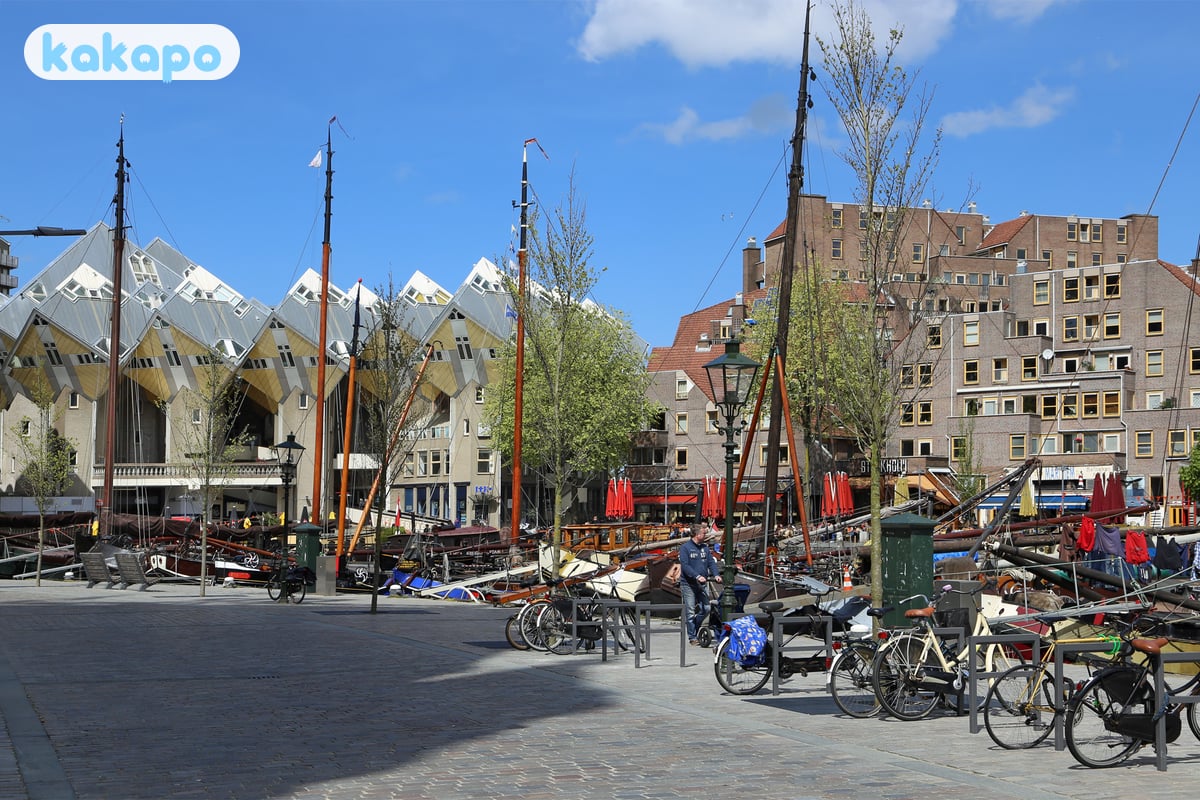
- Cube Houses (Kubuswoningen): 1984 yellow tilted-cube residential block; one is a museum. €3.50.
- Markthal: 2014 horseshoe-shaped market hall over apartments. Free; food stalls + the famous painted ceiling.
- Erasmus Bridge ("the Swan"): pedestrian-cyclist-tram crossing.
- Boijmans van Beuningen Depot: visible storage of 151,000 artworks. €20.
- Most of central Rotterdam is post-1945: don't expect Bruges or Haarlem. The visit is about architectural ambition.
- Pickpockets in Markthal: low base rate; ordinary precautions.
Port + Maas riverfront
- The reality: Rotterdam is Europe's largest port. The wider working-port area is industrial; tourists never visit container terminals.
- Spido Harbour Tour: 75-min boat tour from Willemskade; €15. The legitimate way to see the port.
- Cocaine-related context: Rotterdam port is a major European cocaine entry point. Violence is gang-on-gang; almost zero impact on tourists. Don't wander port-area gates.
- Maas riverfront walks: from Erasmus Bridge → Hotel New York → Kop van Zuid is well-lit + safe.
- Riverfront edges: low railings in some places; cold-water risk in storms.
- Water-taxi: the famous yellow Watertaxi crosses the Maas; €10-€15. Fast + fun.
Neighbourhoods — what to know
- Centrum + Kop van Zuid + Witte de Withstraat: where tourists go; safe at all hours.
- Delfshaven: pretty pre-WW2 Old Harbour district that survived the bombing; very safe.
- Kralingen + Hillegersberg: leafy residential; safe.
- West-Kruiskade + parts of Beverwaard + Charlois: rougher edges; not tourist-experiences.
- Centraal Station area: well-policed inside; some visible homelessness outside but Daytime through is fine.
- Solo women: comfortable in central + Witte de With + Kop van Zuid at any hour.
- Drink-spiking: ordinary precautions in larger anonymous bars.
Weather + water context
- Rain: ~140 days/year, ~830 mm.
- Wind: Atlantic gales hit hardest October-March.
- Temperature: 3-7°C winter, 17-22°C summer.
- Best months: May-September.
- Storm warnings: KNMI yellow/orange/red codes — take orange seriously.
- Maas flood risk: managed by Maeslantkering storm-surge barrier (closes during severe North Sea storms).
Metro, trams, the airport

- Rotterdam-The Hague Airport (RTM): 6 km north; small. Bus 33 to Centraal €4.30, ~25 min.
- Schiphol (AMS): 70 km; main international. Direct Intercity Schiphol ↔ Rotterdam Centraal 25 min.
- RET: metro + trams + buses + ferry. €4 single, €9.50 day. Tap contactless EMV (debit/credit) directly.
- Trains: NS Intercity to Amsterdam 40 min, ~€18; The Hague 25 min; Antwerp 1h via Brussels Thalys.
- Driving: avoid centre — limited parking + LEZ.
Districts — Centrum to Kop van Zuid

- Centrum — the rebuilt post-1940 modernist core: Coolsingel, Beursplein, the Lijnbaan (Europe's first pedestrian shopping street, 1953), the Stadhuis (one of the few pre-war survivors). Bookended by Centraal Station to the north and the Erasmus Bridge to the south. Walkable end-to-end in 20 minutes; the city's compactness is the point.
- Witte de Withstraat — the main nightlife and gallery street, 5 minutes' walk south of Centraal. Independent restaurants, art galleries (Witte de With Center for Contemporary Art, TENT), and bars that stay open until 02:00 weekends. Safe and busy late; the only meaningful caveat is drink-spiking awareness in the largest anonymous bars.
- Kop van Zuid — the redeveloped southern docks across the Erasmus Bridge. Hotel New York (the former Holland-America Line HQ where millions of European emigrants embarked), Las Palmas, Fenix Food Factory, and the Rem Koolhaas-designed De Rotterdam towers. The walk across the Erasmus Bridge ("the Swan") at sunset is the city's signature view.
- Delfshaven — the surviving pre-WW2 old harbour district 2 km west, the only stretch of medieval-and-Golden-Age Rotterdam the bombing missed. Stepped-gable houses, the Pelgrimvaderskerk (where the Pilgrim Fathers worshipped before sailing for the New World), Distilleerderij De Zes Sterren. Genuinely pretty and uncrowded; tram 8 from Centraal in 12 minutes.
- Erasmus Bridge + Markthal — the two iconic structures. The bridge is a 802 m cable-stayed pedestrian-tram-cyclist crossing of the Maas. Markthal (2014) is the horseshoe-shaped market hall with the famous painted-ceiling and 96 food stalls underneath; free to walk through. Both pickpocket-aware on summer weekends.
- Cube Houses + Oude Haven — the 1984 yellow tilted-cube residential blocks (one is a museum, €3.50) over the medieval Oude Haven inner harbour. The Witte Huis (1898) tower next door was Europe's first skyscraper at 43 m.
- Hoek van Holland — the seaside terminus of Metro Line B, 30 minutes from Centraal. Stena Line ferry to Harwich (UK) departs from here; broad North Sea beach at the end of the line for a half-day. Genuinely a Rotterdam suburb despite the distance.
- RET network — metro, tram, bus, ferry — €4 single, €9.50 day pass, or tap a contactless EMV card (debit/credit, Apple Pay) directly at the gate. The yellow Watertaxi (€10-15) crosses the Maas faster than the bridge and is the locals' favourite small luxury. Centraal Station's NS Intercity to Schiphol is 25 min direct; Amsterdam 40 min, €18.
- Stay aware — West-Kruiskade and parts of Charlois and Beverwaard have rougher edges late at night. Tourists do not find themselves there by accident. The Centraal Station kerbside has some visible homelessness but the inside is well-monitored.
If it's your first time visiting
- Best arrival — from Schiphol (AMS), NS Intercity Direct from Schiphol to Rotterdam Centraal is 25 minutes for €18, every 15-30 min. Rotterdam-The Hague Airport (RTM) is 6 km north with bus 33 to Centraal in 25 min for €4.30. The Centraal Station building (2014) is itself worth a look — the angular silver pediment is one of the city's recent architectural landmarks.
- Best neighbourhood for your first night — Centrum near Witte de Withstraat for walkability to bars and museums, or Kop van Zuid at Hotel New York for the iconic location. Mid-range €130-220 (citizenM Rotterdam, Mainport Design Hotel, Hotel New York); the upper end is Mainport's Maas-side suites at €350+.
- Treat bike lanes as roads, not pavements — the red-asphalt strips between the grey footpath and the road carry cyclists at 25-30 km/h, ringing liberally. The #1 way tourists get hit is stepping into the bike lane to photograph the Cube Houses or the Erasmus Bridge. Stay on grey footpath, cross briskly at right angles after looking. Tram tracks have priority over both.
- Renting a bike yourself — Donkey Republic and the OV-fiets at Centraal (€4.45/day with an NS-Flex subscription, or a tourist day-pass €10) are the easy options. Use two locks always — Rotterdam bike theft is high. Helmet not legally required but sensible if you're new to Dutch cycle traffic.
- Eat where the locals eat — Markthal underneath the painted ceiling for casual lunch (€10-15), Fenix Food Factory at Kop van Zuid for the warehouse food-hall scene, Hotel New York for the Holland-America-Line heritage room (kibbeling and seafood platters €25-40), De Jong (Michelin tasting menu, €120+). Coffee at Heilige Boontjes or Hopper Coffee.
- The architecture day — Cube Houses + Markthal (15 min on foot), Erasmus Bridge crossing to Hotel New York, the Boijmans van Beuningen Depot (the world's first publicly accessible art storage, €20, mirror-clad bowl visible from across the city), Kunsthal, and the Witte Huis tower. The Spido harbour tour (€15, 75 min, departs Willemskade) is the legitimate way to see the working port.
- Money + cards — euro, contactless universal, many places card-only (Dutch hospitality has effectively eliminated cash). Apple Pay/Google Pay work at the RET gate directly. Tipping 5-10% if happy; not auto-added.
- Common rookie mistakes — walking in the bike lane to take a photo, locking a rental bike with the included wheel lock only (use two locks always), expecting medieval Bruges (90% of central Rotterdam was destroyed in May 1940 — the modernism is the point), missing Delfshaven (the surviving pre-war district is 12 minutes by tram 8 and uncrowded), and paying for a single Metro ticket when a contactless EMV card taps directly at the gate.
Practical info — emergency numbers
- European emergency: 112 (English-speaking).
- Police non-emergency: 0900 8844.
- Erasmus MC: +31 10 704 0 704.
Bring: hooded waterproof shell, layered clothing, a contactless card (Apple Pay/Google Pay direct on transit), an unlocked phone (KPN, Vodafone NL, Lebara prepaid), and an EHIC/GHIC card.
Frequently asked questions
Is Rotterdam safe to visit in 2026?
Yes. Rotterdam scores 84/100 and is one of Europe's safer big cities — sharper-edged than Amsterdam but with comparable crime stats. The Netherlands sits at Level 2 on the US State Department advisory (baseline terrorism caveat). The realistic concerns are practical: dense cycling infrastructure that catches out walking visitors stepping into bike lanes; bike theft (high in Rotterdam, always use two locks); standard pickpocketing on transit; and the working-port context (cocaine-related gang violence is real but gang-on-gang — almost zero impact on tourists). Rotterdam was 90% destroyed in May 1940, so the city is modernist by necessity rather than choice.
Is Rotterdam safe at night?
Yes — the Centrum, Witte de Withstraat (the main nightlife street), Kop van Zuid and the Maas riverfront stay lively until 2am with police visibility. The area immediately around Centraal Station has some visible homelessness outside but daytime through and well-monitored CCTV inside. West-Kruiskade and parts of Charlois and Beverwaard have rougher edges late but tourists won't find themselves there. Delfshaven (the surviving pre-WW2 old harbour district) is genuinely lovely and safe late. Solo women commonly walk home from Witte de With without issue.
Is Rotterdam safe for solo female travellers?
Yes, very. Rotterdam is among Europe's safer cities for solo women — Dutch street culture is direct rather than catcalling, and the city's young architecture-and-design demographic skews progressive. The compact centre is walkable and bike-friendly. Standard precautions in nightlife (drink awareness in larger anonymous bars on Witte de Withstraat) handle the only realistic risk. Solo women routinely cycle alone and use late-night metro and the famous yellow water taxi.
Can you drink tap water in Rotterdam?
Yes — Dutch tap water is among the world's best, tested to EU standards and consistently scoring among the cleanest in Europe. Locals drink it routinely and restaurants serve it without question (the Dutch are less obsessed with bottled than Italians or French). Carry a refillable bottle; public taps are common across the centre and at Centraal Station. The supply is dune-filtered from the Maas with minimal chlorine taste.
What's the biggest scam to avoid in Rotterdam?
Honestly, scams in Rotterdam are rare — the city's transparent infrastructure and high trust levels make it a low-target environment. The realistic risks are commercial rather than criminal: bike-rental shops that fail to mention the €150-300 deposit if the bike is stolen (always read the rental terms, and use two locks on every rental); DCC at card terminals (always pay in EUR, never your home currency); and 'free' Centraal Station station-area help with luggage that turns into a demand for cash. Bike theft itself is the dominant property crime — use two locks, one through the frame and one through the wheel.
How do I avoid getting hit by a bike in Rotterdam?
Treat the red-asphalt strips as roads, not pavements. The #1 mistake tourists make is stepping into the bike lane to take a photo of the Cube Houses or Erasmus Bridge — and the cyclists are going 25-30 km/h, ringing liberally and expecting you to move. Rules: stay on grey footpath, cross bike lanes briskly and at right angles, never stop on a bike lane, and listen for bells (cyclists ring early, then aggressively if you don't move). Trams have priority over both bikes and pedestrians; tram tracks catch bike tyres so cyclists cross them at 90 degrees, which means they sometimes swing wide into pedestrian space.
Sources
Run a business in Rotterdam?
Show visitors your Rotterdam business is a safe choice. The free Verified by Kakapo badge puts Rotterdam's live safety score on your website, links back to your verified page, and updates itself. No cost.
Get the free badge →