


Is Heidelberg, Germany Safe? A 2026 Travel Safety Guide
Heidelberg is among Germany's safer cities. The honest concerns: the castle climb in heat, cobbled Hauptstrasse, the Philosophenweg, and summer over-tourism.

Heidelberg is one of Germany's safer cities. Crime against tourists is low and the centre is walkable. The realistic concerns are physical: the climb up to Heidelberg Castle (300 vertical metres on the steep route, considerable in 35°C summer heat), the cobbled Hauptstrasse in rain or after the Christmas market spilled mulled wine, the Philosophenweg's narrow steep paths on the opposite riverbank, and summer over-tourism on cruise-and-bus days that compresses the Old Town to slow-shuffle pace.
Germany sits at Level 2 on the US State Department advisory (terrorism baseline). UK FCDO is similar. The honest framing for visitors: Heidelberg is small, friendly, and in the rare position of having survived WW2 with its medieval-baroque core intact. It is also one of Germany's most concentrated tourist destinations — the Hauptstrasse is the longest pedestrian street in the country and the river castle backdrop draws ~12 million annual visitors.
Heidelberg is small (~160,000 residents). The castle (Schloss), the Hauptstrasse + Marktplatz, the Old Bridge (Alte Brücke) with the Bridge Monkey, the Philosophenweg, and the Studentenkarzer (student prison museum) are the anchor experiences.
What surprises first-time visitors is how cleanly Heidelberg sits in its narrow Neckar-valley bowl. The river runs east-west; the Altstadt and Schloss are wedged on the south bank between the Königstuhl mountain and the water; the Philosophenweg climbs the north bank's Heiligenberg. Everything visitor-relevant is inside a 25-minute walking radius of the Old Bridge, and the city's medieval-baroque core survived WW2 essentially intact — the postwar US Army headquartered here for forty years and the buildings you photograph today are genuine 17th and 18th century, not 1950s rebuilds. The Hauptstrasse runs 1.6km arrow-straight through the centre because it traces the original Roman road.
The 2026 details worth knowing in advance: the Bergbahn funicular's lower section (Kornmarkt-Schloss-Molkenkur) was renovated through 2024 and now runs every 10 minutes in summer; Heidelberger Schlossbeleuchtung (the castle illumination + fireworks) returns June, July and September 2026 with riverside-hotel rates booked a full year ahead; and the new Heidelberg-Mannheim 15-minute S-Bahn frequency means Frankfurt Airport is a comfortable 50-minute ICE connection rather than the bus chore older guidebooks describe.
| Night safety | 90/100 |
|---|---|
| Scam / petty-crime risk | Low |
| Violent crime (tourists) | Low |
| Most common scams | pickpockets on cruise days; higher restaurant pricing on Marktplatz; crowds compressing Hauptstrasse |
| Safer neighbourhoods | Neuenheim, Bergstrasse + Hauptstrasse East, Altstadt |
| Data sources cited | 4 |
| Last verified |
What the score means — 88/100
- Healthcare (92) — Universitätsklinikum Heidelberg is among Europe's best academic centres.
- Personal safety (92) — extremely high.
- Air quality (86) — Rhine-valley generally good; summer ozone occasional.
- Transport (86) — RNV trams + buses + Bergbahn funicular.
Heidelberg Castle — the climb, the heat, the alternatives

- The walk up: from Kornmarkt, the Burgweg path is 300 vertical metres of stone steps + steep cobble. Allow 25-35 min.
- Bergbahn funicular: from Kornmarkt to Schloss Heidelberg + onward to Königstuhl. Combined with castle entry €9 (lower), €15 (upper to Königstuhl).
- Heat-related risk: in 32-37°C summer heat, the climb produces routine medical events. Hydrate, hat, slow pace.
- Castle entry: €9 (with funicular included as above). Includes the Great Tun + Pharmacy Museum.
- Inside the courtyard: limited shade. Sun protection.
- Wheelchair/limited mobility: funicular is the realistic option.
- Steps inside: many irregular medieval steps without handrails.
Hauptstrasse + Marktplatz — cobbles + crowds
- Hauptstrasse: 1.6 km — Germany's longest pedestrian street. Most of the visitor restaurants + shops.
- Cobbles: the smaller side streets and the Marktplatz are slick when wet.
- Cruise + tour-bus density: 11am-3pm in season the Hauptstrasse near Marktplatz can shuffle.
- Restaurant pricing: directly on Marktplatz / near the Heiliggeistkirche runs higher than equivalents on side streets like Untere Strasse.
- Pickpockets: low base rate; minor spike on cruise days.
- Late-night Hauptstrasse: completely safe; quiet by 1am.
Philosophenweg — the trail terrain
- What it is: the "Philosopher's Walk" up the Heiligenberg on the opposite (north) bank. Famous viewpoint over the castle + Old Town.
- Access: cross Alte Brücke, walk up Schlangenweg ("snake path") — steep + narrow with switchbacks. 200 vertical metres.
- Surface: paved but with patches of loose gravel and slippery moss in shaded sections.
- Time: 25-35 min up to the Philosophenweg viewpoint; another 30 min to the Heiligenberg ruins above.
- Footwear: trainers with grip; not sandals.
- Solo at night: completely safe but dim-lit and quiet; phone torch helps.
- The Thingstätte: a Nazi-era amphitheatre on Heiligenberg. Free; spooky in fog. Worth the extra walk if doing the full trail.
Neckar river — paths, swimming, riverside
- Riverside paths: both banks have walking + cycling paths; the Old Bridge is the iconic crossing.
- Bridge Monkey: brass sculpture on Alte Brücke. Touch the brass mirror for luck.
- Swimming: the Neckar in central Heidelberg is not a swim spot — currents + boat traffic. Heidelberg's outdoor pools (Tiergartenbad, Thermalbad Heidelberg) are the alternative.
- Boat tours: Weisse Flotte from Stadthalle, ~€12 round trip to Neckarsteinach.
- Floods: the Neckar floods occasionally in spring; modern defences hold for typical events. Riverside paths can close briefly.
Weather, Schlossbeleuchtung, Christmas market
- Summer: 27-35°C, occasional 38°C. Rhine valley heat amplified by the closed-bowl topography.
- Winter: -2 to 6°C; snow uncommon but icy spells.
- Schlossbeleuchtung: the castle illumination + fireworks 3 nights a year (June, July, September). Spectacular; book a riverside hotel a year ahead.
- Christmas market: Marktplatz + Universitätsplatz + Karlsplatz, late Nov to Dec 22. Less crowded than the famous Nuremberg or Cologne markets.
- Best season: May-June, September-October.
Trams, S-Bahn, the airport
- RNV: tram + bus. Single €2.20-€3, day ticket €7.20.
- Frankfurt Airport (FRA): 80 km. Direct InterCity Heidelberg ↔ FRA Fernbahnhof ~50 min, ~€20-30.
- Stuttgart Airport (STR): 130 km. Bus / train via Stuttgart.
- Frankfurt-Hahn (HHN): 130 km, Ryanair-heavy; bus.
- Trains: ICE Heidelberg ↔ Frankfurt 50 min, Mannheim 15 min (then ICE everywhere).
- Driving: Heidelberg has a low-emission zone (Umweltzone) — green Plakette required.
- Parking: P12 garage by the Bismarckplatz is the standard tourist option.
Neighbourhood-by-neighbourhood breakdown
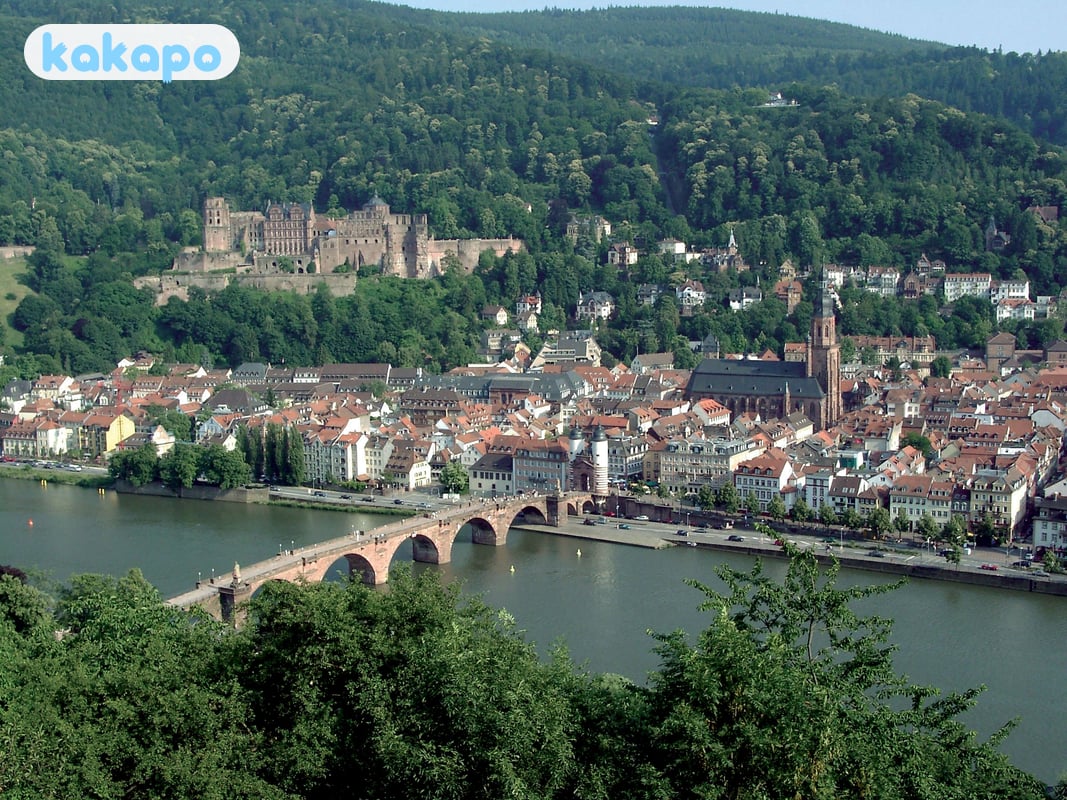
- Altstadt (Old Town) — the medieval core south of the river. Hauptstrasse is the 1.6km pedestrian spine, Germany's longest, with Marktplatz, the Heiliggeistkirche (free, donation appreciated for tower climb €2), the Universitätsplatz with the old Studentenkarzer (student prison, €3) and the Kornmarkt at the bottom of the Bergbahn funicular. Cruise-day crowds compress here 11am-3pm in season; quiet by 11pm.
- Schloss (the Castle) + Königstuhl — 300 vertical metres above the Altstadt. Reach it on foot via the Burgweg (25-35 min steep cobble) or the Bergbahn from Kornmarkt (€9 combined with castle entry, €15 if continuing to Königstuhl summit at 568m). In summer heat 32-37°C the funicular is the only sensible option. Inside the courtyard the views down the Neckar valley are the famous photograph; the Great Tun and Pharmacy Museum are included.
- Neuenheim — across the Old Bridge on the north bank. Residential brownstone Wilhelmine villas, the riverside Schurmanstrasse promenade, and the start of the Philosophenweg. Quieter than the Altstadt; the better neighbourhood for an Airbnb if you want a calm evening.
- Bergstrasse + Hauptstrasse East — the eastern end of the Hauptstrasse toward Karlstor and the Bergstrasse residential climb. Less touristy; the Marstall student cafeteria (€8 lunch) and the small bookshop strip are here.
- Philosophenweg + Heiligenberg — the "Philosopher's Walk" on the north bank, accessed by crossing the Old Bridge and climbing the Schlangenweg ("snake path") with its steep switchbacks. 200 vertical metres. The viewpoint over the castle and Old Town is the postcard photo. Above sits the Heiligenberg with the Nazi-era Thingstätte amphitheatre — eerie in fog, free, worth the extra 30 minutes.
- Bergbahn funicular (Kornmarkt → Schloss → Molkenkur → Königstuhl) — the two-section 1890 funicular that solves the castle climb. Lower section runs every 10 minutes in summer until ~22:00; upper section to Königstuhl runs every 20 minutes. Combined-with-castle ticket €9; full Königstuhl summit €15. The only realistic option for wheelchairs and limited mobility.
- Heidelberg Hauptbahnhof + the Mannheim adjacency — the main station sits 1.5km west of the Altstadt; tram 5/21/22 connects them in 8 minutes. ICE trains run to Frankfurt (50 min, €20-30 advance), Mannheim 15 min (then onward ICE everywhere — Berlin, Munich, Cologne), Stuttgart 40 min. Mannheim's much larger Hbf is the rail hub for the Rhine-Neckar region; many "Heidelberg" ICE journeys actually involve a Mannheim change.
- Stay aware — there are no specific tourist no-go areas in Heidelberg. The Hauptbahnhof underpass at very late hours has occasional rough-sleeper presence; the Altstadt is completely safe at any hour.
If it's your first time visiting
- Best arrival: ICE train from Frankfurt Airport (FRA) Fernbahnhof to Heidelberg Hauptbahnhof is the right answer — 50 minutes, €20-30 advance, every 30-60 minutes. From Stuttgart Airport (STR) take the train via Stuttgart (~1h30m total). Frankfurt-Hahn (HHN, Ryanair) is the budget option but the 130km bus transfer kills time savings. From the Hbf, tram 5 or 21/22 to Bismarckplatz puts you at the western end of the Hauptstrasse in 8 minutes (€3 single, €7.20 day).
- Use the Bergbahn, not the Burgweg — the 300m climb up the stone-step Burgweg path produces routine summer heat-illness events at 32-37°C. The 1890 funicular is €9 combined with castle entry (€15 for the full Königstuhl summit). Lower section runs every 10 minutes; the upper section to Königstuhl is the better photo at sunset.
- Best neighbourhood for your first night: a hotel inside the Altstadt within 10 minutes of Marktplatz (Zum Ritter St. Georg in the 1592 Renaissance house, Hotel Hirschgasse in Neuenheim, Arthotel) means you can walk to dinner and stumble back over the Old Bridge. €130-280/night. Mannheim hotels are 40% cheaper but the 15-minute train kills the evening flexibility.
- Walking shoes with grip — cobbled Hauptstrasse side streets and the Marktplatz limestone become slick in any rain. The Schlangenweg up to Philosophenweg has loose-gravel sections and moss in shaded corners. Trainers with a real sole; not flat-soled boat shoes.
- Food beyond the Marktplatz tourist menus — Schnitzelhaus on Hauptstrasse for honest €15 schnitzel; Café Knösel (since 1863) for the "Heidelberger Studentenkuss" chocolate; Vetter's Alt Heidelberger Brauhaus on Steingasse for the house-brewed Helles and pork knuckle; Schnookeloch student tavern on Haspelgasse for the cheap-and-rowdy version. Avoid restaurants directly on Marktplatz for anything beyond a beer.
- Schloss timed tickets in summer — Schloss Heidelberg's busy season (June-August + Christmas market weeks late Nov-late Dec) sees timed-entry queues even with the Bergbahn ticket. First slot (9am) and last slot (5pm) are cooler and quieter. Schlossbeleuchtung nights (3 dates June/July/September) sell out riverside hotels a full year ahead.
- Day-trip planning — Frankfurt (50 min ICE, €20-30) for the airport-and-skyline contrast; Strasbourg (1h45m via Mannheim, €40) for the French-German border city; the Romantic Road towns of Rothenburg or Würzburg (2-3h); Speyer Cathedral (45 min) for the largest Romanesque church in Europe. Mannheim itself is a 15-minute alternative to Heidelberg's tourist crush.
- Common rookie mistakes — booking a hotel "in Heidelberg" that's actually in Mannheim or one of the Bergstrasse suburbs (confirm the postcode is 69117-69123 for the Altstadt); attempting the Burgweg in July without a hat and water; driving into the Umweltzone with an older diesel and being stopped (green Plakette required; rental cars have it); assuming the famous Bergbahn ticket covers all four sections (it does, but only with the combined castle ticket — buying separately costs more); forgetting that Sunday closes most independent shops on Hauptstrasse.
Practical info — emergency numbers
- European emergency: 112.
- Police: 110.
- Universitätsklinikum Heidelberg: +49 6221 56 0.
Bring: trainers with grip for cobbles + climbs, sun protection in summer, a refillable water bottle, a contactless card (Apple Pay/Google Pay accepted), an unlocked phone (Vodafone DE, O2 DE, Telekom DE prepaid), and an EHIC/GHIC card.
Frequently asked questions
Is Heidelberg safe to visit in 2026?
Yes — Heidelberg scores 90/100 here, among Germany's safer cities. Germany sits at US State Department Level 2 (terrorism baseline) and UK FCDO is similar. Crime against tourists is extremely low (personal-safety sub-score 92) and the medieval centre survived WW2 intact, so the city is genuinely as it looks. The realistic concerns are physical rather than criminal: the castle climb in 35°C summer heat produces routine medical events, cobbled Hauptstrasse gets slick when wet, the Schlangenweg up to Philosophenweg is steep with loose-gravel sections, and cruise-and-bus tour-day compression on the Hauptstrasse near Marktplatz reduces walking to a slow shuffle.
Is Heidelberg safe at night?
Very. The Hauptstrasse — Germany's longest pedestrian street, 1.6 km — is completely safe at any hour and quiet by 1am. The Marktplatz, Alte Brücke and Untere Strasse bar district are all routine evening walks. Even the Philosophenweg across the river is safe solo at night, though dim-lit and quiet — bring a phone torch. The brewery taverns and student bars on Untere Strasse stay busy without the disorder you'd see in a bigger German city. Drink-spiking is rare. The biggest night-time injury risk is slipping on wet cobbles, not crime.
Is Heidelberg safe for solo female travellers?
Yes, exceptionally. Heidelberg is small, walkable, and one of Germany's most welcoming university towns. The Hauptstrasse, Marktplatz, Alte Brücke and Philosophenweg are all routine solo experiences day or night. Solo women report Heidelberg as low-harassment — it has the relaxed campus-town feel of Cambridge or Oxford. Solo dining at brewery taverns on Untere Strasse works fine on communal tables. The castle climb and funicular are equally easy alone. The only specific watch-out is the Schlangenweg path after dark — not unsafe, but dim and worth a torch and grippy shoes.
Can you drink tap water in Heidelberg?
Yes. Heidelberg tap water meets strict German drinking-water standards and is fine throughout the city, including from the public fountains in the Old Town. The cultural default is bottled water (still 'stilles Wasser' or sparkling 'sprudel') — ask for 'Leitungswasser' at restaurants if you want tap. Carry a refillable bottle, especially in summer when the castle climb in 35°C heat produces routine dehydration events. Top up at your hotel before heading up the Burgweg. The Neckar river itself is not drinkable and not suitable for swimming in the central stretch — currents and boat traffic make it a hazard.
What's the biggest scam to avoid in Heidelberg?
There isn't really a Heidelberg-signature scam — the city has one of the lowest base rates in Germany. Cruise-day pickpockets work the Hauptstrasse near Marktplatz between 11am and 3pm in season; standard precautions. Restaurant pricing is the main 'getting taken' — directly on Marktplatz and around the Heiliggeistkirche runs noticeably higher than equivalents one street back on Untere Strasse. Bergbahn funicular tickets bought from third-party tour resellers cost more than the combined €9 (Schloss only) or €15 (up to Königstuhl) at the station — buy at the funicular stop directly.
How hard is the climb to Heidelberg Castle and what if I can't make it?
The Burgweg path from Kornmarkt is 300 vertical metres of stone steps and steep cobble — allow 25-35 minutes at a moderate pace. In 32-37°C Rhine valley summer heat the climb produces routine medical events; hydrate, hat, slow. The Bergbahn funicular from Kornmarkt is the realistic alternative — €9 combined with castle entry, or €15 if you also want to continue up to Königstuhl. The funicular is the only practical option for wheelchairs and limited mobility. Inside the castle courtyard the medieval steps are irregular and have no handrails, so sturdy shoes matter even after the funicular.
Sources
Run a business in Heidelberg?
Show visitors your Heidelberg business is a safe choice. The free Verified by Kakapo badge puts Heidelberg's live safety score on your website, links back to your verified page, and updates itself. No cost.
Get the free badge →