


Is Stuttgart, Germany Safe? A 2026 Travel Safety Guide
Stuttgart is comfortably safe. The honest concerns: Cannstatter Volksfest, the car-museum logistics, Black Forest day trips, and the Stäffele staircases.

Stuttgart is a comfortably safe major German city. Crime against tourists is low. The realistic concerns are seasonal and logistical: the Cannstatter Volksfest (locally called the "Wasen") is Germany's second-biggest Oktoberfest equivalent and brings 4 million visitors over 3 weeks; the two car-museum visits (Mercedes-Benz, Porsche) are split across opposite sides of the city and consume more time than visitors plan; the Black Forest (Schwarzwald) day trips involve drives on winding two-lane roads; and Stuttgart's geographical bowl plus the Stäffele (the city's 400+ public staircases climbing the surrounding hills) shape the visitor experience.
Germany sits at Level 2 on the US State Department advisory (terrorism, baseline). UK FCDO is similar. The honest framing for visitors: Stuttgart is the capital of Baden-Württemberg, a wealthy industrial city wrapped in vineyards (yes, the city has working vineyards inside its boundary). Less touristy than Munich; calmer streets. The Stadtmitte (centre) is well-policed and pickpocket-mild.
The defining experiences: the Mercedes-Benz Museum, the Porsche Museum, the Cannstatter Volksfest in autumn, Schlossplatz + the Königstrasse, the Wilhelma zoo, the Stäffele walks up to vineyard hills, and Black Forest day trips.
| Solo female safety | 86/100 |
|---|---|
| Night safety | 84/100 |
| Scam / petty-crime risk | Medium |
| Violent crime (tourists) | Low |
| Most common scams | alcohol-related petty crime at Cannstatter Volksfest; pickpocketing in Stadtmitte; drink-spiking in nightlife areas |
| Safer neighbourhoods | Stadtmitte, Königstrasse, Schlossplatz |
| Data sources cited | 4 |
| Last verified |
What the score means — 86/100
- Healthcare (88) — Klinikum Stuttgart + university hospital network are strong.
- Transport (88) — VVS S-Bahn + U-Bahn + buses, integrated.
- Personal safety (86) — high.
- Air quality (78) — Stuttgart's bowl topography produces winter inversions; auto-industry corridor adds NO₂. Sensitive lungs notice on still cold days.
Cannstatter Volksfest — what to expect
- When: late September to mid-October (3 weeks). 2026 dates: roughly Sept 25 - Oct 11.
- Spring Frühlingsfest: a smaller version in April-May, similar style.
- Volume: 4 million attendees. Eight giant beer tents (Festzelte).
- Beer tents: book at least one tent reservation 2-3 months ahead for Saturday evening; Friday + weekday afternoons walk-in is possible.
- Crime spike: alcohol-related petty crime + sexual harassment + pickpocketing all rise. Police presence heavy.
- Sexual harassment: the festival has had reported incidents; police are visible. Group up; most evening compression is friendly drinking but maintain awareness.
- Hotel prices: 2-3× normal. Book 4+ months ahead.
- Public transport: extra night S-Bahn services run; even so, last trains pack fully.
- Tracht (lederhosen + dirndl): locals wear it. €30-€100 to hire/buy.
Mercedes-Benz + Porsche museums — the day plan
- Mercedes-Benz Museum: in Bad Cannstatt, east side. €12. 130-year history; spectacular spiral architecture. 2-3 hours.
- Porsche Museum: in Zuffenhausen, north side. €12. More compact + sportscar-focused. 1.5-2 hours.
- The geography problem: they're on opposite sides of the city. Doing both in one day is achievable but long.
- S-Bahn from centre: S1 to Neckarpark for Mercedes (10 min); S6 to Neuwirtshaus for Porsche (15 min).
- Combined trip plan: Mercedes morning (open 9am Tue-Sun), lunch in centre, Porsche afternoon. Both closed Mondays.
- Test drives: at Porsche Driving Experience separately bookable + €€€.
- Children: Mercedes is the better family museum; Porsche is enthusiast-skewed.
Black Forest day trips — the drive
- Triberg waterfalls: 130 km southwest. Germany's tallest. €7 entry to falls. Bus tours from Stuttgart €60-€90.
- Baden-Baden: 100 km west. Spa town + casino. Train ~1h.
- Schwarzwald high road (Schwarzwaldhochstraße / B500): 60 km panoramic mountain road; winter chains.
- Mummelsee: small alpine lake, popular stop on B500.
- Driving: rural roads winding; speeds limited; cyclists + tractors. Patience.
- Cuckoo clocks: tourist-trade. Real Triberg clockmakers run €100-€500+; airport-shop versions are imports.
- Best season: May-October. Winter snow makes the high road challenging.
Stäffele staircases + city geography
- Stäffele: 400+ public staircases connecting the bowl-shaped centre to the surrounding hills.
- Famous routes: Eugensplatz → Karlshöhe (vineyard hill); Bopser; Birkenkopf (the rubble hill made of WW2 debris).
- Birkenkopf: 511 m, panoramic view; the hill itself is rubble from the 1944-45 bombings, 1.5 million m³.
- Footwear: trainers with grip; many Stäffele are stone or concrete with worn surfaces.
- Winter ice: the steeper Stäffele get glassy. The municipality grits the major ones; smaller ones less reliably.
- Vineyards: Stuttgart still has working vineyards within city limits — Mönchhalde, Kriegsberg. Wine festivals throughout summer.
Königstrasse + nightlife
- Königstrasse: pedestrian shopping. Calm + safe.
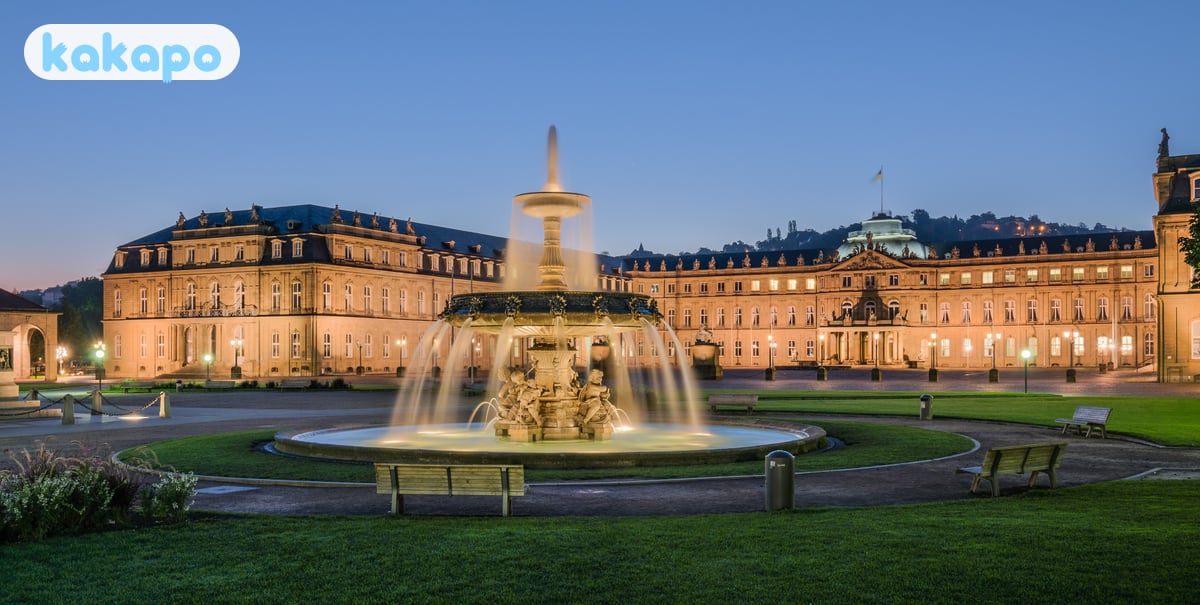
- Schlossplatz: the central square. Free Wifi, lawn picnic friendly.
- Theodor-Heuss-Strasse: club + bar street. Lively Friday-Saturday; standard precautions.
- Hauptbahnhof: a small visible drug-treatment scene around the side streets. Daytime fine; late night solo just take a U-Bahn or Bolt rather than walk.
- Drink-spiking: standard German precautions.
- Solo women: comfortable in the centre.
S-Bahn, U-Bahn, the airport
- VVS: tram + bus + S-Bahn + U-Bahn. Single zone €3.10, day ticket €5.90.
- Stuttgart Airport (STR): 13 km south. S-Bahn S2/S3 to centre €4.30, ~30 min.
- Stuttgart 21 construction: the long-running rail-mega-project. Hauptbahnhof is a half-construction-site through 2026-2027.
- Trains: ICE Stuttgart ↔ Munich 2h20m, Frankfurt 1h20m, Paris 3h15m via TGV.
- Driving: city centre Umweltzone (low-emission zone) — green Plakette required.
- Parking: P2 Königstrasse + Q-Park Stiftstrasse central options.
Practical info — emergency numbers
- European emergency: 112.
- Police: 110.
- Klinikum Stuttgart: +49 711 278 01.
- Cannstatter Volksfest info: cannstatter-volksfest.de
Bring: rubber-soled shoes for Stäffele + winter ice, layered clothing, FFP2 mask if you're sensitive on inversion days, a contactless card, an unlocked phone (Vodafone DE, O2 DE, Telekom DE prepaid), and an EHIC/GHIC card.
Frequently asked questions
Is Stuttgart safe to visit in 2026?
Yes — Stuttgart scores 86/100 here and is a comfortably safe major German city. Germany sits at US State Department Level 2 (terrorism baseline) and UK FCDO is similar. Crime against tourists is low and the Stadtmitte (centre) is well-policed and pickpocket-mild — Stuttgart is genuinely less touristy than Munich, with calmer streets. The realistic concerns are seasonal and logistical rather than criminal: the Cannstatter Volksfest crowd dynamics, the geography of doing both car museums in one day, Black Forest day-trip drives on winding two-lane roads, the steep Stäffele staircases (400+ of them), and Stuttgart's bowl topography that produces winter air-quality inversions (sub-score 78).
Is Stuttgart safe at night?
Yes in central areas. Königstrasse (pedestrian shopping) and Schlossplatz are calm and safe; Theodor-Heuss-Strasse is the club-and-bar street, lively Friday-Saturday with standard precautions. The one watch-out is Hauptbahnhof — a small visible drug-treatment scene around the side streets. Daytime fine, but late-night solo just take a U-Bahn or Bolt rather than walking. Stuttgart 21 construction means the Hauptbahnhof is a half-construction-site through 2026-2027, which makes nighttime navigation more confusing than dangerous. Drink-spiking is standard German precautions; solo women report comfort in the centre.
Is Stuttgart safe for solo female travellers?
Yes. The Stadtmitte, Königstrasse and Schlossplatz are routine solo experiences day or night. The VVS S-Bahn, U-Bahn and tram network is clean, reliable and well-policed at all hours. Stuttgart's wealthy-industrial-capital atmosphere produces low-key streets — less party-tourism than Munich, less rough fringe than Frankfurt. During Cannstatter Volksfest, the festival has had reported harassment incidents and police presence is heavy; group up in evening beer tents and book a tent reservation rather than walking in late. Theodor-Heuss-Strasse club street is the predictable place to apply standard precautions.
Can you drink tap water in Stuttgart?
Yes. Stuttgart's tap water meets strict German drinking-water standards and is fine throughout the city — partly sourced from Lake Constance via the long-distance Bodensee-Wasserversorgung pipeline. Ask for 'Leitungswasser' at restaurants if you want tap; the cultural default is bottled. Free refills at any tap. Stuttgart still has working vineyards inside the city limits (Mönchhalde, Kriegsberg) and a wine-festival culture in summer — Trollinger and Lemberger are the local reds to try at vineyard taverns.
Should I visit Stuttgart during Cannstatter Volksfest?
Only if you want the festival. Cannstatter Volksfest ('the Wasen') runs late September to mid-October — 2026 dates are roughly Sept 25 to Oct 11. It's Germany's second-biggest Oktoberfest equivalent with 4 million attendees across eight giant beer tents. Hotel prices triple, alcohol-related petty crime and sexual harassment and pickpocketing all spike (police presence is heavy), and Saturday-evening tent reservations need booking 2-3 months ahead. Tracht (lederhosen, dirndl) is the cultural norm. The smaller Frühlingsfest runs April-May with the same style. If you don't want this, visit any other time — the city is quieter and beer-tent-free.
How do you plan the Mercedes and Porsche museums in one day?
They're on opposite sides of the city, which catches out planners — Mercedes-Benz Museum in Bad Cannstatt to the east, Porsche Museum in Zuffenhausen to the north. Both close Mondays. Standard plan: Mercedes morning (open 9am Tue-Sun, allow 2-3 hours for the spectacular spiral 130-year history), lunch in centre, Porsche afternoon (1.5-2 hours, more compact and sportscar-focused). Each is €12 entry. Transit: S-Bahn S1 to Neckarpark for Mercedes (10 min from centre); S6 to Neuwirtshaus for Porsche (15 min). Mercedes is the better family museum; Porsche skews enthusiast. Test drives at Porsche Driving Experience are separately bookable and expensive. Don't drive your rental — Stuttgart centre has a low-emission Umweltzone requiring a green Plakette, which most rentals carry but parking is awkward.
Sources
Run a business in Stuttgart?
Show visitors your Stuttgart business is a safe choice. The free Verified by Kakapo badge puts Stuttgart's live safety score on your website, links back to your verified page, and updates itself. No cost.
Get the free badge →