


Is Bangalore, India Safe? A 2026 Travel Safety Guide
Air pollution, monsoon floods, the world-record commute, MG Road pub-strip drink-spiking, and the realities of India's tech capital.

Bangalore (officially Bengaluru) — population ~13 million, India's IT capital — is one of the country's more cosmopolitan and visitor-friendly metros. English is widely spoken; the climate is mild by Indian standards (the city sits at 920m elevation); violent crime against tourists is rare.
The honest concerns are environmental and logistical. Bangalore has chronic air-pollution issues — winter PM2.5 spikes regularly hit "unhealthy" or worse. Monsoon flooding has become a yearly civic crisis: the August-September 2022 floods left the IT corridor (Whitefield, Bellandur, Sarjapur) impassable for days, exposing decades of unplanned urban expansion over filled-in lakes. The city has the world's worst commute by some measures (TomTom Traffic Index has ranked Bangalore #1 globally multiple years). The pub-and-club strip on MG Road, Brigade Road and Indiranagar 100 Feet Road has the standard drink-spiking and over-charging pattern. And the city's safety profile shifts neighbourhood-by-neighbourhood — modern Cantonment / Indiranagar / Koramangala feel different to the older walled-city areas around KR Market and Chickpet.
The US State Department lists India at Level 2 ("exercise increased caution") — citing crime and terrorism. UK FCDO has no advisories against travel to Bangalore. Both note the standard India-context concerns including women's safety.
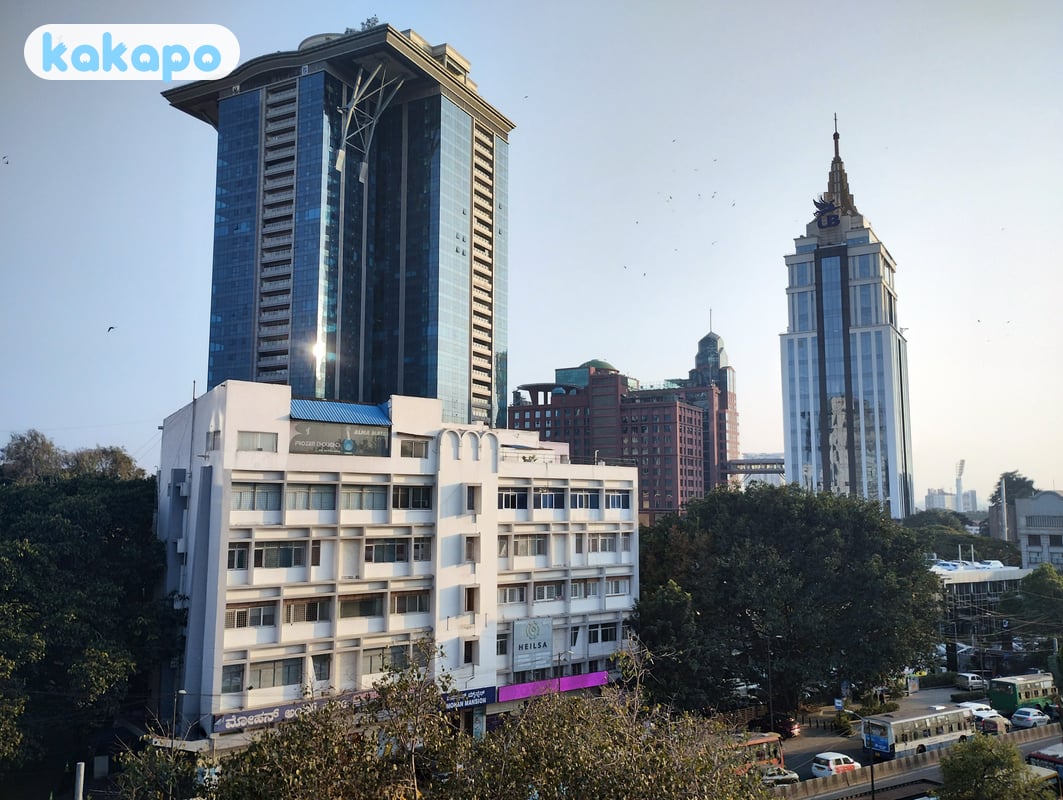
Geographically the city falls into three loosely-defined zones that organise where to stay and where to eat. The Cantonment — laid out by the British army in 1809 around what is now MG Road / Brigade Road / Cubbon Park — is the colonial-era core with wide streets, the Vidhana Soudha (state legislative building), the UB City Mall, and most of the heritage business hotels. South-east of the centre, the inner suburbs of Indiranagar, Koramangala, HSR Layout and Jayanagar form Bangalore's middle-class belt — café-and-craft-beer culture, the best mid-range restaurants, and where most short-stay visitors actually base. Further east and south, Whitefield, Marathahalli, Sarjapur and Electronic City make up the IT corridor — modern office towers, gated residential complexes, and the international-chain business hotels that the consultants stay in. West of the centre, the old walled city around KR Market, Chickpet, Avenue Road and Majestic is the chaotic original Bangalore — fabric markets, flower wholesalers, the City Railway Station — atmospheric daytime, rough at night.
| Night safety | 60/100 |
|---|---|
| Scam / petty-crime risk | Medium |
| Violent crime (tourists) | Low |
| Most common scams | drink-spiking on MG Road pub strip; overcharging at premium lounges on MG Road; meter 'broken' auto-rickshaws |
| Safer neighbourhoods | Cantonment, Indiranagar, Koramangala |
| Data sources cited | 4 |
| Last verified |
What the score means — 72/100
- Personal safety (76) — moderate-high. Petty theft and women's safety in Old City are the main asterisks.
- Transport (60) — Namma Metro 4 lines and growing; chaotic surface traffic; Bangalore Airport (BLR) 40 km north.
- Healthcare (88) — Manipal, Apollo, Fortis, Narayana — Bangalore is one of India's medical-tourism hubs. Excellent private care.
- Air quality (60) — chronically poor in winter; PM2.5 routinely 100-200+. Construction dust and traffic dominate.
Areas — Cantonment vs Old City vs IT corridor

Recommended bases for visitors: Cantonment area (MG Road, Brigade Road, UB City) — central, walking distance to malls and restaurants, business hotels (Taj West End, ITC Gardenia, Leela Palace). Indiranagar / Koramangala — café-and-bar districts, boutique hotels, the trendy expat hub. Whitefield / Sarjapur — IT corridor, modern but distant from CBD; long commute back.
Stay aware: KR Market, Chickpet, Majestic bus stand area — old, dense, photogenic by day; rougher at night with pickpocket and harassment risk especially for solo women. Shivajinagar — historic Muslim quarter, atmospheric, generally safe but maintain awareness after dark.
There are no genuinely dangerous neighbourhoods in central Bangalore for daytime visiting.
Air pollution — the chronic background
- The numbers: Bangalore PM2.5 averages 60-90 µg/m³ in winter (Nov-Feb), 25-50 in monsoon. WHO guideline is 5 µg/m³ annual.
- Why: vehicle emissions (8 million+ vehicles), construction dust, diesel generators (frequent power cuts), and the surrounding Karnataka stubble-burning season.
- If air-sensitive: bring N95 masks for outdoor commuting; many hotels now provide air purifiers in rooms (ask). Asthma sufferers should bring extra medication.
- Indoor refuge: malls (Phoenix Marketcity, UB City, Forum Mall) are well air-conditioned and generally cleaner than outdoor air.
- Best windows: monsoon shoulder (Sep-early Oct) and post-monsoon (Oct) for cleanest air. Worst is Dec-Feb.
- AQI checking: CPCB India's air-quality dashboard, Plume Labs, IQAir all reliable.
Monsoon, flooding, and the IT corridor

- Southwest monsoon: June-September. Daily evening thunderstorms; flash flooding in low-lying areas.
- 2022 IT-corridor floods: August-September brought the worst urban flooding in Bangalore's modern history. Whitefield, Bellandur, Sarjapur — exactly where most multinational offices are — became impassable for days. Companies organised tractor evacuations. The episode exposed decades of unplanned construction over filled lakes.
- 2024 monsoon: significant repeat flooding in same areas; Bellandur Lake foaming returned briefly.
- If staying in IT corridor: check whether your hotel is in a known flood zone (most large international chains have raised floors and generators). Build buffer time for airport runs during heavy rain.
- Don't wade flood streets: leptospirosis, sewage, electrocution risks all real.
- Best windows: October-March (post-monsoon, dry, manageable air).
- Avoid: late August-September peak monsoon if you have inflexible schedule.
Traffic — the world's worst commute
- The numbers: TomTom's Traffic Index has ranked Bangalore #1 worst congestion globally multiple years (2019, 2022). Average 28 min to drive 10 km in peak hours.
- Implications: airport-to-CBD can take 60 min or 3 hours depending on time. Always allow buffer.
- Namma Metro: 4 lines as of 2025-2026 (Purple, Green, Yellow, Pink under expansion). Tap card or QR. Single ride INR 10-60. Connects airport line opens late 2026.
- Ola/Uber/Rapido: dominant ride-hail. Surge pricing during rush hour and rain is severe. Rapido bike-taxis (motorbike pillion) are cheap and beat traffic but you wear pillion helmet.
- Auto-rickshaws: meter often "broken" for tourists; insist on meter or use Ola Auto / Uber Auto for fixed pricing.
- Don't drive yourself: foreign drivers in Bangalore traffic are over-represented in crash stats.
- Bengaluru International Airport (BLR): 40 km north. Vayu Vajra airport bus INR 250 (~75 min); Ola/Uber INR 800-1,500; KIA Express train coming 2026.
MG Road pub strip — drink-spiking and overcharging
- The bar zones: MG Road / Brigade Road, Indiranagar 100 Feet Road, Koramangala 5th Block. Bangalore's bar density is among India's highest.
- Drink-spiking: persistent reports, especially of solo women travellers. The pattern is the standard one — bought drink at the bar, blackout, robbery (and worse). Bangalore Police have run periodic crackdowns.
- Defences: don't accept open drinks from strangers; never leave drinks unattended; go in pairs/groups.
- Closing time: Bangalore officially shuts pubs at 01:00 (occasionally relaxed). After-closing transport scarce; pre-arrange Ola.
- Overcharging at "premium" lounges: standard pattern of mysterious "service charge", "minimum bill", "table charge" added at the end. Confirm pricing structure before ordering bottles.
- If trapped in a billing dispute: 100 (police) or Tourist Police +91 80 2294 2222.
- Drugs: Indian narcotics laws are severe (Narcotic Drugs and Psychotropic Substances Act); even small possession can mean 10+ years.
Women's safety in Bangalore
- Bangalore is among India's safer big cities for women, but standard precautions apply.
- Day vs night: walking and using public transport in CBD/Indiranagar/Koramangala in daylight is fine. After dark, prefer Ola/Uber over walking long distances.
- Metro women-only carriages: clearly marked; use them in rush hour.
- Auto/cab: use app-based services with driver name and licence visible. The "Share My Ride" feature with a friend is recommended.
- Dress: Bangalore is more permissive than Delhi or Jaipur. Western dress on the pub strip is normal.
- Helplines: Police 100; Women's helpline 1091; Pink Hoysala patrol cars in many districts.
Neighbourhood-by-neighbourhood breakdown
- MG Road + Brigade Road + Cubbon Park (Cantonment) — the colonial-era spine. Pedestrian-friendly MG Road, the bookshop-and-bar row of Brigade Road, the 300-acre Cubbon Park with the Vidhana Soudha and High Court at its north end. Heritage hotels (Taj West End, ITC Gardenia, Leela Palace, Oberoi) cluster here. Safe at every hour; tourist police visible.
- UB City + Lavelle Road — the luxury mall and embassy quarter immediately west of Cubbon Park. UB City Mall (Vittal Mallya Road) houses Louis Vuitton and the rooftop Skyye Bar; Lavelle Road and Cunningham Road are the expensive-restaurant strip. Fortis Hospital Cunningham is the convenient private ER.
- Indiranagar (100 Feet Road) — the bar-and-café Disneyland east of the centre. Toit microbrewery (the canonical IPA), Arbor Brewing, Glen's Bakehouse, Smoor chocolates, the original Mainland China. Boutique hotels (Hotel Sambhrama, La Marvella) and most of the better Airbnbs. Metro Indiranagar (Purple Line) is the access point. Closing time 01:00; surge pricing post-pub is brutal.
- Koramangala (5th Block + 7th Block) — the start-up engineer's neighbourhood, anchored by Forum Mall and the Sony World Junction. 5th Block has the cafés (Third Wave Coffee, Cafe Diem, Truffles), 7th Block the bars. Walkable in patches; outer blocks need autos. Mid-range hotels (Lemon Tree, Hotel Royal Orchid).
- HSR Layout + Sarjapur Road — the newer south-east suburb popular with tech workers. Sectors 1-7 are leafy and grid-planned; the Sarjapur Road corridor connecting to Whitefield is the worst Bangalore traffic. Skip as a base unless you have offices in HSR.
- Whitefield + ITPL — the original IT corridor, 18 km east, anchored by International Tech Park Bangalore (ITPL), Phoenix Marketcity mall, and VR Bengaluru. Modern but distant — 60-90 minutes to MG Road in peak. International-chain hotels (Marriott, Sheraton, Vivanta). Flood-zone in 2022 monsoon — check before booking Aug-Sep.
- Electronic City + Bommasandra — the southern IT corridor, 18 km south on Hosur Road. Infosys campus, the elevated expressway. Even more isolated than Whitefield; a base only for visitors with specific offices.
- Jayanagar + Basavanagudi — the traditional South Bangalore residential. Bull Temple, Bugle Rock Park, Vidyarthi Bhavan (the legendary 1943 masala-dosa joint on Gandhi Bazaar Main Road), Mavalli Tiffin Rooms (MTR, the canonical South Indian breakfast since 1924). Cleaner air than Cantonment; good base for older travellers.
- KR Market + Chickpet + Avenue Road (old city) — the chaotic original Bangalore west of the centre. Flower wholesale market starts at 04:00, fabric and silver bazaars open 11:00, the City Market metro station at the centre. Day-trip atmospheric; rough at night, solo women avoid.
- Majestic + KSR Bengaluru City Railway Station — the bus-station and railway hub. Touts, pickpockets, taxi scams concentrate here. Use the Namma Metro Majestic interchange rather than emerging on foot.
If it's your first time visiting
- Getting in: Kempegowda International Airport (BLR) is 40 km north of the centre — a 60-90 minute drive on the Bellary Road expressway in normal traffic, 2-3 hours in rain or peak. BMTC Vayu Vajra airport bus (INR 250-350, multiple routes, every 30 min) is the budget option; Ola/Uber INR 800-1,500; pre-paid airport taxi counter INR 1,200-1,800. The KIA Express Rail line is under construction and not open as of mid-2026.
- Apps to install before arrival: Ola and Uber (both work, Ola has better local coverage), Rapido (motorbike pillion, cheap and beats traffic in non-rain), Namma Metro QR app (Yes-Bank-powered, replaces the smart card for one-time visitors), Zomato + Swiggy (food delivery dominate here).
- Best base neighbourhoods: Cantonment (MG/Brigade Road) for walkability and the heritage hotels (Taj West End, ITC Gardenia, Leela Palace, Oberoi, Shangri-La); Indiranagar for atmosphere and bars (boutique hotels and Airbnbs); UB City / Lavelle Road for upscale (Conrad Bengaluru, JW Marriott Bengaluru); Whitefield only if you have specific offices there.
- Don't drive yourself — TomTom-#1-globally congestion plus chaotic lane discipline plus rain make Bangalore one of the worst Indian cities to drive in as a foreign visitor. Ola, Uber, Rapido for everything; auto-rickshaws via Ola Auto / Uber Auto for fixed metered pricing.
- The Namma Metro is good and growing — 4 colour-coded lines (Purple, Green, Yellow, Pink), single rides INR 10-60. Use the QR-ticket app or tap-in with a smart card (INR 100 deposit + top-up at any station). Closes 23:00. Useful corridors: Purple Line (MG Road–Whitefield via Indiranagar), Green Line (Majestic–Jayanagar).
- Cash + cards + UPI — Indian rupee (INR); ~84 to the USD, ~91 to the EUR. Contactless cards work everywhere modern (malls, chain hotels, Toit, Truffles); cash for autos, small shops, street food. UPI (PhonePe / Google Pay / Paytm) dominates small-vendor payments — visitors can link foreign cards to UPI via some banks (HDFC + ICICI services) but most stick to cash for autos.
- Food orientation — Bangalore is South India's restaurant capital. MTR (Lalbagh Road, since 1924) and Vidyarthi Bhavan (Gandhi Bazaar, since 1943) are the canonical breakfasts — masala dosa, rava idli, filter coffee. Mavalli Tiffin Rooms second branches everywhere. For evenings: Truffles for burgers, Toit for craft beer + pizza, Karavalli (Taj Gateway) for high-end coastal Karnataka, Empire chain for late-night biryani.
- Drink-spiking + the pub-strip pattern — Bangalore Police have run periodic crackdowns on MG Road and Indiranagar bar drink-spiking. Don't accept open drinks from strangers; never leave drinks unattended; pubs close 01:00 sharp (city ordinance); pre-arrange Ola for the ride home because surge pricing post-closing is severe.
- Monsoon timing — best windows October-March (post-monsoon, dry, manageable air). Avoid late August-September peak monsoon if you have inflexible schedule — the 2022 floods left Whitefield impassable for days, and 2024 monsoon brought repeat flooding.
- Common rookie mistakes — staying in Whitefield without realising it's 90 minutes to MG Road in rush; trying to walk between Koramangala and Indiranagar (they're 5 km apart with no good pavement); booking only one night for a Bangalore visit (you'll spend most of it in traffic); refusing the Namma Metro and grinding through Ola surge instead; visiting KR Market or Chickpet at night; paying the airport taxi counter when Ola is half the price 50m away; assuming Bangalore is mild year-round (April-May genuinely hits 35°C and the pre-monsoon air is the worst).
Money, food, emergency numbers
- Currency: Indian rupee (INR). $1 ≈ INR 84.
- Cards: contactless widely accepted at chains, hotels, malls. UPI (PhonePe / Google Pay / Paytm) dominates small-vendor pay; foreign cards can be linked to UPI via some banks.
- Tipping: 10% in restaurants if not on bill; INR 50-100 for hotel porters.
- Food: Bangalore's South Indian breakfast (idli, dosa at MTR or Vidyarthi Bhavan) is a tourist must. Karnataka-style biryani, rava idli, mysore pak. Bangalore is also India's craft-beer capital — Toit, Arbor, BREW Co.
- Tap water: not drinkable. Bottled or RO-filtered.
- Heat: Bangalore is mild by Indian standards (max ~33°C even in April). The 920m elevation moderates climate year-round.
- Emergency: 112 (universal); 100 (police); 101 (fire); 108 (ambulance); 1091 (women's helpline).
- Hospitals: Manipal Hospital (+91 80 2502 4444); Apollo Bangalore (+91 80 2630 4050); Fortis Cunningham Road (+91 80 6621 4444); Narayana Health (+91 80 6750 6750).
- SIM: Airtel, Jio, Vi at the airport — passport + visa required to register.
Frequently asked questions
Is Bangalore safe to visit in 2026?
Yes — Bangalore (Bengaluru) scores 72/100 here and is one of India's more cosmopolitan and visitor-friendly metros. India sits at US State Department Level 2 ('exercise increased caution'); UK FCDO has no advisories against travel to Bangalore. English is widely spoken, the climate is mild by Indian standards (920m elevation), and violent crime against tourists is rare. The honest concerns are environmental and logistical: chronic winter air pollution (PM2.5 routinely 100-200+, air-quality sub-score 60), yearly monsoon flooding in the IT corridor (the 2022 Whitefield/Bellandur floods left companies organising tractor evacuations), the world's worst commute by some measures (TomTom #1 globally multiple years, transport sub-score 60), and pub-strip drink-spiking on MG Road and Indiranagar.
Is Bangalore safe at night?
Yes in the central pub strips and modern districts. MG Road, Brigade Road, Indiranagar 100 Feet Road, Koramangala 5th Block, and UB City are all well-trafficked until pubs close at 01:00 (Bangalore's official cut-off, occasionally relaxed). Cantonment, Indiranagar, Koramangala and the New Town/Whitefield tech corridor are safe residential. The Old City (KR Market, Chickpet, Majestic bus stand) is photogenic by day but rougher at night with pickpocket and harassment risk, especially for solo women — don't walk there alone after dark. After 01:00 transport gets scarce; pre-arrange Ola. Drink-spiking is the persistent night-time risk on the pub strip — don't accept open drinks from strangers, never leave drinks unattended.
Is Bangalore safe for solo female travellers?
Yes — Bangalore is among India's safer big cities for women, more permissive than Delhi or Jaipur with Western dress normal on the pub strip. Daylight walking and public transport in CBD, Indiranagar and Koramangala is fine. After dark, prefer Ola/Uber over walking long distances. Namma Metro has clearly marked women-only carriages in rush hour. Use the 'Share My Ride' feature with a friend on app-based cab services. Pink Hoysala patrol cars operate in many districts. The pub-strip drink-spiking pattern affects solo women specifically — go in pairs or groups, watch your drink. Helplines: Police 100, Women's helpline 1091, Tourist Police +91 80 2294 2222.
Can you drink tap water in Bangalore?
No. Tap water is not drinkable — stick to bottled or RO-filtered. Most hotels and modern apartments use RO filtration; cafes and chain restaurants serve filtered or bottled. Bottled is cheap (INR 20-40 per 1L). Bangalore has a worsening groundwater problem and water-tanker dependence in summer, which makes filtration quality variable in cheaper accommodation — ask. Brush teeth with bottled to be fully safe. The South Indian breakfast (idli, dosa, vada at MTR or Vidyarthi Bhavan) is one of India's gentler food calibrations; Bangalore is also India's craft-beer capital — Toit, Arbor and BREW Co are all reliable for hygiene and quality.
How bad is Bangalore traffic really?
World-record bad. TomTom's Traffic Index has ranked Bangalore as the most-congested city globally multiple years (2019, 2022); peak-hour averages run 28 minutes to drive 10 km. Practical implication: airport-to-CBD can take 60 minutes or 3 hours depending on time of day, so always build buffer. Namma Metro (4 lines as of 2025-2026, Purple, Green, Yellow, Pink in expansion, airport line opening late 2026) is the practical workaround — single ride INR 10-60. Ola, Uber and Rapido bike-taxis (motorbike pillion, cheap, beats traffic) dominate ride-hail; surge pricing during rush hour and rain is severe. Auto-rickshaw meters are often 'broken' for tourists — insist on the meter or use Ola Auto / Uber Auto for fixed pricing. Don't drive yourself; foreign drivers in Bangalore are over-represented in crash statistics.
Is monsoon flooding in the Bangalore IT corridor a real concern?
Yes, and increasingly so. The southwest monsoon (June-September) brings daily evening thunderstorms and flash flooding in low-lying areas. The August-September 2022 floods were the worst urban flooding in Bangalore's modern history — Whitefield, Bellandur and Sarjapur (exactly where most multinational offices and many international-business-traveller hotels are) became impassable for days, with companies organising tractor evacuations. The episode exposed decades of unplanned construction over filled-in lakes. The 2024 monsoon brought significant repeat flooding in the same areas; Bellandur Lake foaming returned briefly. If staying in the IT corridor, check whether your hotel is in a known flood zone (most large international chains have raised floors and generators) and build buffer time for airport runs in heavy rain. Don't wade flood streets — leptospirosis, sewage and electrocution risks are all real. Best windows: October-March.
Sources
Run a business in Bangalore?
Show visitors your Bangalore business is a safe choice. The free Verified by Kakapo badge puts Bangalore's live safety score on your website, links back to your verified page, and updates itself. No cost.
Get the free badge →