


Is Avignon, France Safe? A 2026 Travel Safety Guide
Avignon is comfortably safe in Provence. The honest concerns: the July Festival, summer heat + mistral, vineyard drives, and Palais des Papes pickpockets.

Avignon is a comfortably safe Provençal city. Crime against tourists is moderate-low. The realistic concerns are seasonal: the Festival d'Avignon in July more than doubles the city's population (the In + Off festivals have ~1.5 million attendees over 3 weeks); summer heat regularly tops 38°C and the mistral wind can flip a calm day into 80 km/h gusts; the day trip to Pont du Gard is a popular but real drive; the vineyard country around Châteauneuf-du-Pape combines wine-tasting with driving in a way that warrants thought; and Palais des Papes draws pickpocket attention at peak hours.
France sits at Level 2 on the US State Department advisory (terrorism, baseline). UK FCDO is similar. The honest framing: Avignon is mid-sized (~93,000 in city, 530,000 metro), with a walled UNESCO core that contains nearly the entire visitor experience. The Vigipirate plan is at "urgence attentat" nationally — visible armed police is normal at the train station and the Palais des Papes.
The defining experiences: Palais des Papes, Pont Saint-Bénezet (the half-bridge of the famous song), Place de l'Horloge, Les Halles food market, the Festival d'Avignon (July), Pont du Gard (25 km), and Châteauneuf-du-Pape vineyards (15 km).
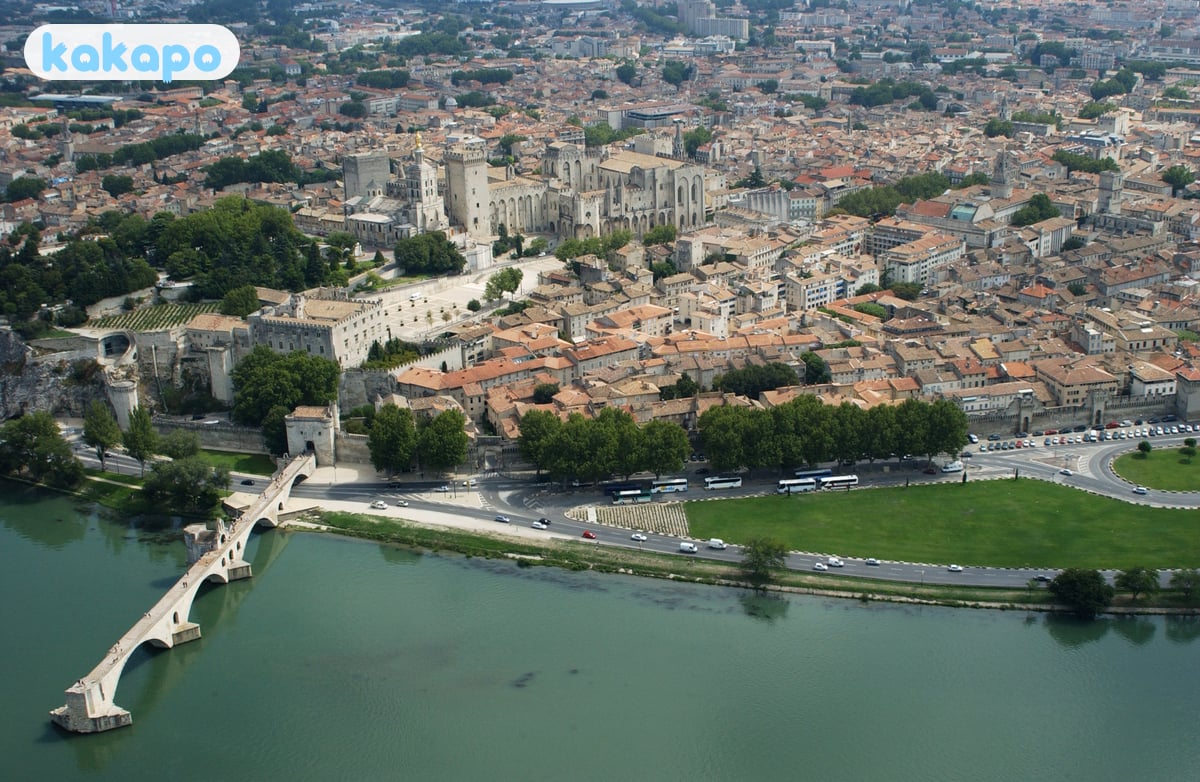
The geography to carry: Avignon's 14th-century walls (the largest intact medieval ramparts in Europe at 4.3 km circumference) wrap a 1 km² Old Town on the east bank of the Rhône. The Palais des Papes sits at the north end on the Rocher des Doms hill; Place de l'Horloge is the central square with the city hall and theatre; Rue de la République is the spine running south from there to the Avignon Centre train station. The Île de la Barthelasse — the largest river island in Europe — sits in the Rhône directly west, reached by the free passenger ferry (April-October, every 15 min) for the postcard view back at the Palais and the half-bridge. Villeneuve-lès-Avignon across the Rhône is technically a separate town (and a separate département, Gard rather than Vaucluse); it has Fort Saint-André and is a quieter overnight base.
| Night safety | 66/100 |
|---|---|
| Scam / petty-crime risk | Medium |
| Violent crime (tourists) | Low |
| Most common scams | pickpocketing at Palais des Papes; pickpocketing on Place du Palais; petty theft during Festival d'Avignon |
| Safer neighbourhoods | Place de l'Horloge, Rue des Teinturiers, Quartier des Carmes |
| Data sources cited | 4 |
| Last verified |
What the score means — 84/100
- Healthcare (86) — Hôpital Henri Duffaut handles routine; complex care via Marseille (1h).
- Transport (86) — Avignon TGV (4 km from centre) connects to Paris in 2h40m; Avignon Centre is the in-walls station.
- Personal safety (84) — high. Pickpocketing is mild + concentrated.
- Air quality (84) — Provence; summer ozone occasional; mistral clears it.
Festival d'Avignon — the July reality
- When: 3 weeks in July. 2026 dates: roughly July 4-23.
- What it is: world's largest theatre festival. Two parts — Festival d'Avignon ("In", curated, ~50 productions) + Avignon Off (free-for-all, ~1,500+ productions).
- The Off: every café, courtyard, and basement is a venue. Streets fill with performers handing out flyers (a Provençal sport).
- Hotel prices: triple. Many require 3+ night minimum stays. Book 6 months ahead.
- Crime spike: pickpocketing, occasional petty theft. Police presence heavy.
- If you don't want this: late June or August. The first half of August is Avignon's quietest summer week.
- Restaurant reservations: essential during festival; impossible at the last minute.
Summer heat + the mistral
- July-August: 32-38°C standard, regularly 40°C in heatwaves.
- The mistral: cold dry wind from the Rhône valley. Strongest February-April; appears in summer. Gusts 60-100 km/h.
- What the mistral does: knocks over café umbrellas, rattles shutters, drops temperature 8-10°C in hours, blows out paper menus mid-meal. Locals say it makes you irritable; physiologically real.
- Hydration: tap water is safe. Carry 1.5+ litres per person on hot days.
- Mid-day rule: 1-5pm get inside or in shade.
- Best months: late April-June, September-October.
Palais des Papes + Pont d'Avignon — the visitor density
- Palais des Papes: 14th-century papal palace (when the popes lived in Avignon, 1309-1377). €12; €14.50 combined with Pont. Tablet "Histopad" included — actually good.
- Allow 2-3 hours; the rooms are vast and the histopad context-rich.
- Pickpockets: meaningful on the Place du Palais courtyard at peak summer afternoons. Front pocket only.
- Pont Saint-Bénezet: the famous half-bridge. €5 alone; included with the Palais combined ticket.
- Restaurant pricing: Place de l'Horloge runs higher than equivalents on Rue des Trois Faucons.
- Late-night Old Town: completely safe inside the walls. Quiet by midnight in non-festival weeks.
Pont du Gard day trip
- What it is: Roman aqueduct bridge, 1st century AD. UNESCO. 25 km west of Avignon.
- Access: by car ~30 min via A9; bus 115 from Avignon Poste, ~50 min, ~€2 (limited daily, check schedule).
- Entry: €11.50 includes museum + parking + bridge.
- Walking the bridge top: closed since 2010 for preservation. The lower walkway is open.
- Swimming: locals swim in the Gardon river beneath the aqueduct in summer. Currents are gentle but the bottom drops fast — non-strong swimmers stay near banks.
- Best timing: early morning or late afternoon — the stone glows golden.
- Combine with: Nîmes (15 km) for the amphitheatre + Maison Carrée.
Châteauneuf-du-Pape vineyards — the driving question
- The villages: Châteauneuf-du-Pape (15 km north), Gigondas, Vacqueyras, Beaumes-de-Venise. Among France's best southern Rhône wines.
- Tastings: free or €5-€20 at most domaines (Domaine Pierre Usseglio, Vieux Télégraphe, Domaine du Pegau). Book.
- Driving the day after: French alcohol limit is 0.5‰ (0.2‰ for new drivers). Two glasses can put a smaller adult over.
- Better option: book a tour driver. Avignon Wine Tour, Provence Reservation, ~€90-€120/person for a half-day.
- Cycling tours: increasingly popular, manageable terrain.
- Mistral risk: cycling in 70 km/h winds is genuinely unpleasant. Check forecast.
- Best season: April-June + September-October.
Trains, buses, the airports
- Avignon TGV: 4 km from centre. Paris ↔ Avignon TGV 2h40m, ~€60-130 advance. Marseille 30 min.
- Avignon Centre: the in-walls station. Local trains; navette bus to TGV station €1.70, 8 min.
- Marseille-Provence Airport (MRS): 70 km. Direct bus to Avignon ~1h15m, €13.
- Avignon Airport (AVN): tiny. Most fly into Marseille or Lyon.
- Buses: TCRA Orizo network. €1.70.
- Driving: don't drive into the walls. Park at Parking Halles or Parking Italiens (€10-15/day).
- Petite Reine bike share: free for the first 30 min. Easy + safe in Avignon's small core.
Neighbourhoods inside and outside the walls

- Place du Palais + Rocher des Doms — the north end of the walled city, dominated by the Palais des Papes' bare stone bulk. The Rocher des Doms park behind the palace climbs to a viewpoint over the Rhône and Mont Ventoux on clear days. Petit Palais museum (free, 14th-century Italian paintings) on the same square.
- Place de l'Horloge — the social heart of the Old Town, with the city hall, the Théâtre Municipal, and a row of café terraces under the plane trees (Le Cintra, Café du Centre). Restaurant pricing here is 30-40% above equivalent spots two streets back; the carousel and the late-night people-watching are the actual value.
- Rue des Teinturiers — the most photogenic street, running along the small Sorgue canal with its medieval water wheels and the bohemian bars (L'Esclave, Le Délirium). Quieter than Place de l'Horloge, evening-pleasant. Closed to cars; cobbled, uneven.
- Les Halles food market — covered market on Place Pie behind the green-wall facade. Open Tuesday-Sunday 06:00-13:30. Provençal cheeses, charcuterie, the legendary Violettes d'Avignon candied flowers. Two of Avignon's best lunch counters are inside (Maison Violette, Halles Gourmandes). Pickpocketing density in the crush — bag in front.
- Rue de la République + the south wall — the pedestrianised shopping spine running south from Place de l'Horloge to Porte de la République and Avignon Centre station. Brand chains, the cinema Pathé Capitole, and most of the chain hotels.
- Quartier des Carmes + Place Pie — the eastern Old Town quarter, with the Église des Carmes (the 14th-century cloister hosts evening Festival d'Avignon shows), the Avignon synagogue, and a quieter residential mood.
- Île de la Barthelasse — the river island reached by the free Bac (ferry) from the foot of Pont Saint-Bénezet, April-October every 15 min, 5-minute crossing. The "Avignon from the other side" photograph spot. The island's restaurants (Le Bercail, La Treille) are the local summer-evening picks.
- Villeneuve-lès-Avignon — across the Rhône via Pont Daladier (15-min walk or bus 5). Fort Saint-André (14th-century, €6, sweeping panorama back at Avignon), Chartreuse du Val de Bénédiction monastery. Quieter overnight base for tourists who want the view rather than the buzz; cheaper hotels (Le Prieuré).
- Avignon TGV + the south extension — the high-speed station is 4 km south of the walls in Courtine. Linked to the Old Town by the navette train (Avignon TGV ↔ Avignon Centre, 5 min, €1.70, every 30 min). Outside the walls is featureless suburbia — there's no reason to stay south.
- Outside-wall risk areas — none seriously. The area immediately around Avignon Centre station after midnight feels neglected rather than dangerous; the eastern industrial belt is unappealing but not threatening; the Monclar / Champfleury social-housing district (south-east of the walls) has higher local crime statistics but no tourist business or reason to visit.
If it's your first time visiting
- Best arrival — TGV from Paris Gare de Lyon to Avignon TGV is 2h40m, €60-130 advance via SNCF Connect; weekends sell out 2-3 weeks ahead. Marseille TGV connection 30 min. From Avignon TGV, take the navette train to Avignon Centre (€1.70, 5 min, every 30 min) — the in-walls station 100m from the Porte de la République. Marseille-Provence Airport (MRS) is 70 km south; direct bus to Avignon €13, 1h15m, hourly.
- Buy the Palais des Papes ticket online — palais-des-papes.com, €12 standard or €14.50 combined with Pont Saint-Bénezet. The included "Histopad" augmented-reality tablet is genuinely good (it overlays the original interiors on the bare rooms). Allow 2-3 hours; early morning (09:00 opening) is much quieter than the cruise-bus 11:00-15:00 window.
- Best base neighbourhoods: inside the walls is the answer 90% of the time. Near Place du Palais for the postcard (La Mirande, Auberge de Cassagne); around Place de l'Horloge for walkability (Hôtel d'Europe, Hotel de l'Atelier); Rue des Teinturiers for atmospheric small hotels (Hôtel La Mirande). Outside the walls, only Villeneuve-lès-Avignon's Le Prieuré makes sense — quieter and the across-the-river view.
- Festival d'Avignon booking reality — 2026 dates roughly July 4-23. The "In" festival programme is announced in March; tickets at festival-avignon.com from €15-35. The "Off" festival's 1,500+ productions don't need pre-booking — wander, flyer-takers will press passes. Hotel rates triple and 3-night minimums kick in; book by January or accept a 30-min commute from Villeneuve or Sorgues. The first half of August is, conversely, Avignon's quietest summer week — half-empty restaurants and walk-up hotel rates.
- Use the navette + Vélopop bike — the free passenger ferry to Île de la Barthelasse runs April-October, every 15 minutes from the foot of Pont Saint-Bénezet, no booking. Vélopop is the city bikeshare: €1 day card + 30 min free per trip; stations at the train station, Place Pie, and Place de l'Horloge. The flat Old Town and the river-island loop are made for cycling.
- Mistral planning — Météo France issues an orange/red alert when sustained mistral exceeds 80 km/h, which knocks over café umbrellas, blows dust through the Place du Palais, and makes the Île de la Barthelasse ferry uncomfortable. Check meteofrance.com the morning of any cycling or vineyard day. The wind blows from the north — picnic on the south-facing side of Rocher des Doms.
- Vineyard tours — Avignon Wine Tour, Provence Reservation, and Le Vin à la Bouche all run €90-120/person half-day tours into Châteauneuf-du-Pape, Gigondas and Vacqueyras with 4-5 domaine tastings included. Don't drive yourself: France's drink-drive limit is 0.5‰ (0.2‰ for newer drivers); two glasses of CdP at 14% puts a smaller adult over and the gendarmerie breath-tests rural roads in tasting season.
- Eating notes — the Restaurant Christian Étienne inside a 14th-century building next to the Palais is the Michelin-classic; La Mirande for the courtyard; Restaurant La Fourchette (rustic Provençal, since 1970s) is the locals' lunch. Les Halles' Maison Violette inside the market is the cheap-and-honest pick. Reserve restaurants 2 weeks ahead in July; same-day fine off-festival.
- Common rookie mistakes — driving into the walls (don't; park at Parking des Halles or Parking de l'Île Piot, €10-15/day, both with footbridge access); trying to walk on Pont Saint-Bénezet expecting it to be a full bridge (it's the famous half-bridge — collapsed in the 17th century, never rebuilt); booking a July festival visit in May (no rooms); cycling to Pont du Gard in mistral; expecting the Châteauneuf-du-Pape village to have many cellar doors (most domaines are out in the vines — you need a tour or car); confusing Avignon TGV with Avignon Centre (the navette connects them, but a 30-minute timetabling buffer is wise).
Practical info — emergency numbers
- European emergency: 112.
- Police: 17.
- SAMU (medical): 15.
- Hôpital Henri Duffaut: +33 4 32 75 33 33.
- Météo France: meteofrance.com — orange/red alerts for mistral + heat.
Bring: trainers with grip for cobbles, sun protection in summer, a refillable water bottle, a windproof layer for mistral days, a contactless card, an unlocked phone (Bouygues, Orange FR, SFR prepaid), and travel insurance.
Frequently asked questions
Is Avignon safe to visit in 2026?
Yes. Avignon scores 84/100 and is a comfortably safe Provençal city. France sits at Level 2 on the US State Department advisory (baseline terrorism caveat), with the national Vigipirate plan at 'urgence attentat' — visible armed police at the train station and Palais des Papes is normal, not a sign of acute risk. The realistic concerns are seasonal rather than crime: the Festival d'Avignon in July more than doubles the city, summer heat tops 38°C with mistral wind gusts to 100 km/h, and Palais des Papes pickpockets at peak hours. The walled UNESCO core contains nearly the entire visitor experience and stays walkable and safe day or night.
Is Avignon safe at night?
Yes — the walled Old Town is completely safe inside the ramparts well past midnight. Place de l'Horloge, Rue des Teinturiers and the streets around Palais des Papes have visible police presence and locals dining late. Outside the walls, the area immediately around Avignon Centre station after midnight is the only stretch that feels neglected rather than dangerous — take a taxi if arriving on the last TGV. During the July festival, the Old Town stays animated until 2-3am with restaurants serving until midnight; non-festival weeks go quiet by 11pm.
Is Avignon safe for solo female travellers?
Yes, comfortably. Avignon is among the safer French cities for solo women — the Old Town is compact, well-lit and walkable, and the city's small scale (~93,000 in the walls) means you'll quickly recognise your neighbourhood. Catcalling is mild by French-Mediterranean standards. The Festival d'Avignon in July is a genuinely friendly atmosphere, with thousands of festival-goers in cafés until late. Standard precautions handle the only realistic risk: front-pocket your phone at Palais des Papes peak hours and in Les Halles market crush.
Can you drink tap water in Avignon?
Yes. Avignon's tap water is safe, tested to EU standards, and sourced from the Rhône-fed aquifer. Locals drink it routinely. Carry a refillable bottle in summer: July-August regularly hits 38°C and 40°C in heatwaves, and 2+ litres per person per day is realistic — more if cycling vineyards or hiking near Pont du Gard. Public fountains across the Old Town are drinkable. Restaurants serve tap water (une carafe d'eau) on request, free; many will push bottled by default.
What's the biggest scam to avoid in Avignon?
DCC ('dynamic currency conversion') at restaurant card terminals — the machine asks if you want to pay in euros or your home currency, and the home-currency option silently adds 3-7%. Always pay in EUR. Other recurring cons during the July festival: petition-clipboard distractions on Place du Palais, fake flyer-handers who actually work pickpocket distraction, and ticket touts selling counterfeit Festival d'Avignon passes (buy only via festival-avignon.com or the official box office). Outside the festival, baseline pickpocketing is mild and concentrated at Palais des Papes peak afternoons.
Should I drive to the vineyards or book a tour?
Book a tour driver. France's drink-drive limit is 0.5‰ (0.2‰ for newer drivers), and two glasses of Châteauneuf-du-Pape at 14% can put a smaller adult over — losing your licence in France carries a €4,500 fine and immediate suspension. Avignon Wine Tour and Provence Réservation run €90-120/person half-day tours through Châteauneuf-du-Pape, Gigondas and Vacqueyras with tastings included. Cycling tours are another option in shoulder season but check the mistral forecast — 70 km/h gusts make vineyard cycling genuinely unpleasant. April-June and September-October are the sweet spots.
Sources
Run a business in Avignon?
Show visitors your Avignon business is a safe choice. The free Verified by Kakapo badge puts Avignon's live safety score on your website, links back to your verified page, and updates itself. No cost.
Get the free badge →