


Is Tbilisi, Georgia Safe? A 2026 Travel Safety Guide
The Russia border, occupied territories, marshrutkas, winter ice, the wine-region day trips, and the realistic risks of one of the Caucasus' safest capitals.

Tbilisi is one of the safer capital cities in the broader European region for tourists, and a budget-friendly destination compared to most of Europe. Crime against visitors is low; hospitality is taken seriously as a national virtue.
The realistic concerns for visitors are the Russia-Georgia geopolitical context (Russia occupies two breakaway regions, South Ossetia and Abkhazia, totalling ~20% of Georgian territory), the genuinely chaotic marshrutka (minibus) driving, winter ice on cobblestone Old Town streets, and the road conditions on the day-trip routes to the wine country and the Caucasus mountains.
Georgia sits at Level 1 on the US State Department's advisory list, with Level 4 advisories for Abkhazia and South Ossetia (the Russian-occupied regions, which are not accessible from Georgia proper anyway). UK FCDO advises against travel to those regions. The advisories are for the occupied territories — not Tbilisi or anywhere visitors normally go.
| Solo female safety | 86/100 |
|---|---|
| Night safety | 67/100 |
| Scam / petty-crime risk | Medium |
| Violent crime (tourists) | Low |
| Most common scams | chaotic marshrutka (minibus) driving; drunks and pickpockets around Tbilisi central railway station (Vagzlis Moedani) at night |
| Safer neighbourhoods | Dzveli Tbilisi (Old Town), Vera, Vake |
| Data sources cited | 4 |
| Last verified |
What the score means — 78/100
- Personal safety (86) — high. Crime is low; Tbilisi feels safer than its tourist-numbers would suggest.
- Transport (78) — Tbilisi metro is excellent and cheap; intercity marshrutkas are erratic.
- Healthcare (78) — quality private clinics (American-Georgian Medical Center, MediClubGeorgia); state hospitals are mixed.
- Air quality (78) — moderate. Old buses and a basin geography make winter inversions visible.
Russia, occupied territories, the geopolitical context

Georgia and Russia fought a brief war in 2008. Russia recognised South Ossetia and Abkhazia as "independent" states; almost no other country has. Both regions are occupied by Russian troops. Diplomatic relations between Georgia and Russia were broken in 2008 and have not been restored.
- Tbilisi specifically: zero practical impact on tourist trips. Cafés, taxis, transport, daily life all unaffected.
- Don't try to visit South Ossetia or Abkhazia from Tbilisi. The borders are closed from the Georgian side. Entering from Russia is technically possible but Georgian law treats it as illegal entry; you'd be banned from re-entering Georgia.
- Russians in Tbilisi: Tbilisi has been a major destination for Russians fleeing mobilisation since 2022. There is friction (rent prices, restaurant graffiti, occasional anti-Russian protests) but no risk to other foreign visitors.
- Ukraine-flag visibility: extensive. Georgia is broadly pro-Ukrainian.
- Photography of military installations or border posts: avoid.
- The "administrative boundary line" with South Ossetia is ~50 km from Tbilisi at its closest; not encountered on standard tourist itineraries.
Areas — Old Town, Vake, Saburtalo, Vera
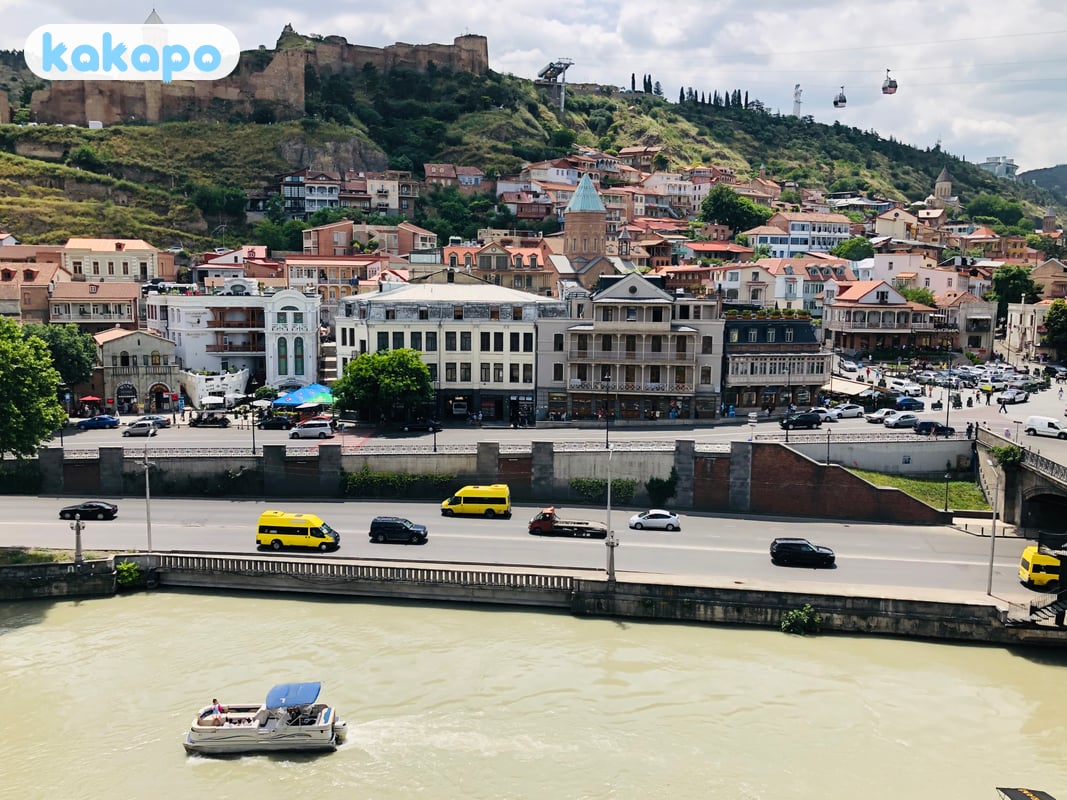
Recommended for visitors: Dzveli Tbilisi (Old Town) — the medieval district with sulphur baths, Narikala fortress, the Bridge of Peace, the colourful balconies. Walking-friendly, well-policed. Vera — the gentrifying café-and-design district. Vake — upscale, leafy, residential. Saburtalo — modern apartment district, fine.
Stay aware: the area immediately around Tbilisi central railway station (Vagzlis Moedani) at night is rough — drunks and pickpockets. Daytime fine. Gldani / outer Soviet-era housing blocks — residential, no tourist relevance.
There are no specific "no-go" zones for tourists in Tbilisi proper.
Winter — cold, ice, and old buildings
- December-February: -2 to 5°C standard, occasional -15°C snaps.
- Old Town cobbles: very slippery on icy days. Boots with grip mandatory.
- Old buildings: many Old Town apartment buildings have crumbling balconies and uneven stairs. Not normally a tourist concern, but be aware in older guesthouses.
- Heating: most apartments are gas-heated. Carbon-monoxide incidents do occur in poorly-ventilated rentals every winter; pick rentals with modern heaters.
- Best weather: May-June and September-October. Avoid August (very hot, 35°C+).
Metro, taxis, marshrutkas

- Tbilisi metro: 2 lines, Soviet-era, deep, cheap (₾1 = ~$0.40). Useful for crossing the city quickly.
- Buses: yellow city buses, modern, ₾1 with the Tbilisi card.
- Bolt: works city-wide. Cheaper than street taxis. The default tourist option.
- Yandex Go: also operates. Russian-origin app — many tourists prefer Bolt for that reason.
- Marshrutkas: shared minibuses to suburban and intercity destinations. Cheap, ubiquitous, and notoriously badly driven. Use trains or the GO Trip app for intercity if you have time.
- Tbilisi International Airport (TBS): 17 km east. Bus 37 ₾1 (45 min). Bolt ~₾20 (25 min). Train 5 times a day ₾1.
Day trips — Kakheti wine, Kazbegi mountains
- Kakheti (the wine region): 2-hour drive east. Sighnaghi, Telavi, family-run wineries with qvevri (clay-pot) wine. Standard package tour ~₾80-150/person.
- Kazbegi (Stepantsminda): 3-hour drive north on the Georgian Military Highway. Gergeti Trinity Church, Mt Kazbek, the road through the Caucasus. The road is dramatic and, in winter, can close suddenly for snow.
- Don't book a self-drive in winter for Kazbegi. The road tunnels can be closed; chains required; landslides happen.
- The road to Kazbegi passes within 5 km of the South Ossetia administrative boundary line in places — completely normal, no impact, but mentioned because tourists notice the border signage.
- Marshrutka to Kazbegi: ₾15, 3 hours, departs Didube station. Cramped but cheap.
Money, food, and the cost story
- Currency: Georgian lari (₾). $1 ≈ ₾2.70.
- Cards: widely accepted. Bank of Georgia, TBC Bank ATMs everywhere.
- Tipping: 10% in restaurants if service charge isn't already added.
- Food: a generous khinkali-and-khachapuri dinner with Saperavi wine is ₾40-60/person. Tbilisi is one of the cheapest European food cities.
- Tap water: safe in central Tbilisi. Mountain water taps in the Old Town are popular.
- Russian credit cards / rubles: Russian-issued Visa/Mastercard don't work; some banks accept Mir cards. Currency exchanges accept rubles at poor rates.
Practical info — emergency numbers
- Unified emergency: 112 (English-speaking, generally responsive).
- Tourism Police hotline: 077 1700 (English).
- American-Georgian Medical Center: +995 32 254 0540.
- MediClubGeorgia: +995 32 251 0011.
Bring: warm clothing if Nov-March, boots with grip for Old Town cobbles, a contactless bank card, an unlocked phone (Magti, Geocell, Beeline GE prepaid SIMs at the airport for ~₾20), and travel insurance documentation.
Frequently asked questions
Is Tbilisi safe to visit in 2026?
Yes. Tbilisi scores 82/100 here, one of the safer European-region capitals and one of the cheapest. Georgia sits at US State Department Level 1 with Level 4 advisories for the Russian-occupied breakaway regions of Abkhazia and South Ossetia (which are inaccessible from Georgia proper). UK FCDO has identical carve-outs. The advisories cover the occupied territories — not Tbilisi or anywhere visitors normally go. Crime against tourists in Tbilisi is low and hospitality is a national virtue. Real risks are the geopolitical context, chaotic marshrutka (minibus) driving, winter ice on cobblestone Old Town streets, and road conditions on the Kazbegi and Kakheti day-trip routes.
Is Tbilisi safe at night?
Yes. Dzveli Tbilisi (Old Town), Rustaveli Avenue, Vera, the Bridge of Peace area, and Fabrika in Marjanishvili are all comfortable, alive, and policed late. The Old Town's sulphur-bath quarter, Narikala fortress base, and Rezo Gabriadze Theatre district have busy restaurant scenes until midnight or later. Solo walking from a Vera wine bar back to Sololaki is routine. The area immediately around Tbilisi central railway station (Vagzlis Moedani) is rough at night — drunks and pickpockets, best avoided alone after dark. Use Bolt for late-night rides; Yandex Go also operates but many travellers prefer Bolt given the Russian origin.
Is Tbilisi safe for solo female travellers?
Yes. Tbilisi is one of the easier capitals in the broader region for solo women — low harassment, friendly atmosphere, and dress is largely Western. Solo dining at the wine-bar scene in Vera or the natural-wine spots around Fabrika works fine. Use Bolt rather than flagging street taxis at night. Modest dress is sensible at monasteries on day trips (Jvari, Mtskheta — cover knees, shoulders, headscarves available). The 2022+ Russian draft-dodger influx has created visible tensions (some restaurant graffiti, occasional protests) but no risk to other foreign visitors. Standard awareness around Vagzlis Moedani at night and in densest market crowds.
Can you drink tap water in Tbilisi?
Yes — Tbilisi tap water is safe and meets Georgian/EU standards, drawn from clean mountain sources. The Old Town has historic public mountain-water taps that are particularly popular with locals. Restaurants serve tap on request, though bottled is the cultural default. Carry a refillable bottle for sightseeing — Tbilisi summer hits 35°C+ and Old Town cobbles offer no shade. On Kazbegi and Kakheti day trips bring bottled water. Borjomi mineral water (from the famous spa town) is the local sparkling default and worth trying.
What's the biggest scam to avoid in Tbilisi?
Honestly, Tbilisi has very few tourist scams compared to regional capitals — Georgian hospitality culture is genuine. The recurring patterns: Tbilisi airport unofficial taxi touts inside arrivals quoting GEL 80-100 (use Bolt for ~GEL 20-25, or take bus 37 for GEL 1, or the airport train); DCC card-reader markups (always pay in lari); Euronet ATMs at the airport and Old Town gates with high fees (use Bank of Georgia or TBC Bank ATMs); and 'free wine tasting' shops in the Old Town that lead to high-pressure cellar-tour sales (genuine Kakheti wineries on day trips are the real experience). Marshrutka drivers occasionally overcharge new visitors — confirm the fare on the windscreen before paying. Russian Mir cards are accepted at some banks; Russian-issued Visa/Mastercard don't work.
How does the Russia-Georgia / occupied-territories situation affect Tbilisi visitors?
Day to day in the capital, not at all. Cafés, taxis, transport, daily life are entirely unaffected. Georgia and Russia broke diplomatic relations after the 2008 war and have not restored them. Russia occupies Abkhazia and South Ossetia (~20% of Georgian territory); both are Level 4. Don't try to enter either from Tbilisi — the Georgian-side borders are closed and entering from Russia is treated as illegal entry by Georgian law (you'd be banned from re-entering Georgia). The South Ossetia administrative boundary line is ~50km from Tbilisi at its closest; the Kazbegi day-trip road via the Georgian Military Highway passes within 5 km in places. Border signage is visible but the route is normal tourist territory with no security incidents. Don't photograph border posts or military installations. Ukraine-flag visibility in Tbilisi is extensive — Georgia is broadly pro-Ukrainian, and Russian visitors face local friction but other foreigners don't.
Sources
Run a business in Tbilisi?
Show visitors your Tbilisi business is a safe choice. The free Verified by Kakapo badge puts Tbilisi's live safety score on your website, links back to your verified page, and updates itself. No cost.
Get the free badge →