


Is Sharjah, United Arab Emirates Safe? A 2026 Travel Safety Guide
The strictly-conservative legal code, alcohol-free across the emirate, summer 50°C heat, the Dubai-Sharjah commute, the Decency Law, and the realities of the UAE's most-traditional emirate.

Sharjah — population ~1.8 million, the UAE's third-biggest emirate directly northeast of Dubai — is the country's most-traditional and culturally-conservative emirate. Crime against tourists is essentially nonexistent (similar to Dubai/Abu Dhabi); the city has invested in cultural tourism (Sharjah Art Foundation, Sharjah Heritage Area, Mleiha Archaeological Centre); UNESCO designated it the Arab Capital of Culture in 1998.
The honest concerns are about the legal code (substantially more conservative than Dubai), the climate (summer 45-50°C is real), and the practical Dubai-Sharjah commute logistics. Sharjah is alcohol-free emirate-wide — no licensed hotel bars, no liquor stores, no exception (a few private members' clubs in expat compounds are exceptions but not for tourists). The Sharjah Decency Law (2001, periodically updated) requires modest dress in public; tourists have been warned/fined for shoulder/knee exposure outside hotel pools. The Dubai-Sharjah road traffic is notoriously bad — a 2-hour commute for what should be 30 minutes is normal at peak. Most international visitors stay in Dubai and day-trip Sharjah; staying in Sharjah is cheaper but the practical compromises are real.
The US State Department lists UAE at Level 2; UK FCDO has no specific Sharjah advisories but warns about the conservative legal code. Both note the standard heat, modesty, and regional-tension context.
| Night safety | 83/100 |
|---|---|
| Scam / petty-crime risk | Low |
| Violent crime (tourists) | Low |
| Most common scams | fines for public intoxication; fines for eating in public during Ramadan |
| Safer neighbourhoods | Al Majaz, Al Khan, Al Qasba |
| Data sources cited | 4 |
| Last verified |
What the score means — 89/100
- Personal safety (95) — exceptional. Crime against tourists is essentially nonexistent.
- Transport (78) — Sharjah International Airport (SHJ); no metro (Dubai Metro doesn't extend); buses adequate; Dubai-Sharjah commute notoriously bad.
- Healthcare (88) — Al Qassimi Hospital, Sharjah University Hospital; serious cases share Dubai's world-class private network (Cleveland Clinic Abu Dhabi, Mediclinic City Hospital).
- Air quality (76) — moderate; sandstorms (haboob) periodic; summer haze; affected by Dubai industrial cluster.
Alcohol-free emirate — the practical reality
- The rule: Sharjah is the only UAE emirate with a complete alcohol ban (since 1985). No licensed hotel bars, no liquor stores, no restaurant wine licenses.
- Practical implications: hotel restaurants serve mocktails only; no bottle-shop alcohol purchase; can't bring alcohol from Dubai (technically illegal to transport into Sharjah).
- Don't bring alcohol from Dubai duty-free: Sharjah Customs and police occasionally check vehicles at the emirate border; possession brings fines and detention.
- Drinking at hotel: not possible at any Sharjah hotel.
- If you want alcohol: Dubai is 30 min by road (in good traffic); plenty of hotel bars and licensed restaurants. Most international visitors stay in Dubai and day-trip Sharjah for this reason.
- Drink-driving: zero tolerance; immediate detention; the alcohol ban means even small amounts test as "trafficking" in some interpretations.
- Don't be drunk in public: even if you drank elsewhere, public intoxication in Sharjah is a criminal offence.
- Cohabitation outside marriage: was decriminalised in 2020-21 across UAE federal law; Sharjah is technically subject to the same federal law but enforcement variability higher.
The Sharjah Decency Law — dress and conduct
- The Sharjah Decency Code (originally 2001, periodically updated): requires modest public dress; covered shoulders, knees, no transparent or tight clothing; head covering not required for non-Muslim women.
- Enforcement: hotels and resort areas relaxed; malls (City Centre Sharjah, Mega Mall) and government buildings strict; public beaches and Corniche moderate. Tourists have been verbally warned by mall security or municipal staff for shoulders/knees exposure.
- Beachwear at hotel pools: bikinis fine. At public beaches (Al Khan, Al Mamzar): one-piece swimsuits and longer cover-up preferred.
- Public displays of affection: hand-holding for married couples is fine; kissing in public is not advised; Sharjah enforcement marginally stricter than Dubai.
- Same-sex relationships: illegal across UAE; enforcement against discreet visitors rare but legal risk real.
- Photography: don't photograph people without permission (especially women), military or government buildings, sensitive sites; Sharjah Heritage Area is photo-friendly.
- Ramadan: don't eat, drink, or smoke in public during daylight; Sharjah strictly enforces; non-Muslims face fines for breaches; hotels have screened mid-day food zones.
- Drugs: zero tolerance across UAE; severe penalties; check before bringing prescription drugs.
Summer heat — 50°C reality
- Numbers: July-August 38-48°C; sometimes 50°C+; humid coastal location adds. Felt-temperature regularly exceeds 50°C.
- Heat-stroke: tourists who underestimate over-represented in ED. UAE Civil Defence runs heat-warning campaigns; outdoor work suspended in peak periods.
- Defences: heavy hydration; indoor mid-day breaks (Sharjah malls — City Centre Sharjah, Mega Mall — are AC-cold); avoid outdoor activities 11:00-17:00 in peak summer; cotton long sleeves; SPF50+.
- Best windows: November-March (mild, 18-28°C; peak tourist season); avoid June-September unless essential.
- Sandstorms (haboob): occasional; visibility drops; AQI hits "hazardous"; outdoor activities halted; N95 masks help.
- Cool seasons (Dec-Feb): pleasant; light jacket evenings; rare rain.
- Don't leave anyone in parked cars: even briefly; UAE police actively prosecute.
The Dubai-Sharjah commute — notoriously bad
- The geography: central Dubai to central Sharjah is 30 km; in light traffic 30-40 min; in peak (07:00-10:00 morning, 17:00-21:00 evening) 90-180 min on Sheikh Mohammed Bin Zayed Road or Sheikh Zayed Road.
- Why so bad: hundreds of thousands of Sharjah residents commute to Dubai for work daily; only 3 main routes; bottlenecks at Al Ittihad Bridge.
- If you're staying in Sharjah: arrange airport transfers via the better route (E11 vs E311 vs E611) depending on time; Sharjah hotel concierges advise.
- Dubai International Airport (DXB): 20 km southwest of Sharjah CBD; in good traffic 25 min; in peak 90+ min.
- Sharjah International Airport (SHJ): 13 km from Sharjah CBD; 7 km from Dubai's outer suburbs; budget-airline hub (Air Arabia primarily).
- Buses: Sharjah Public Transport buses run E303 and E306 to Dubai; cheaper than taxi but slow.
- Uber and Careem: work both emirates seamlessly; surge during commute hours.
- Don't drive yourself if you're inexperienced with right-side high-speed driving culture; UAE accident rates per capita are among GCC's highest.
Areas — Al Majaz, Al Qasba, Al Khan, Heritage Area
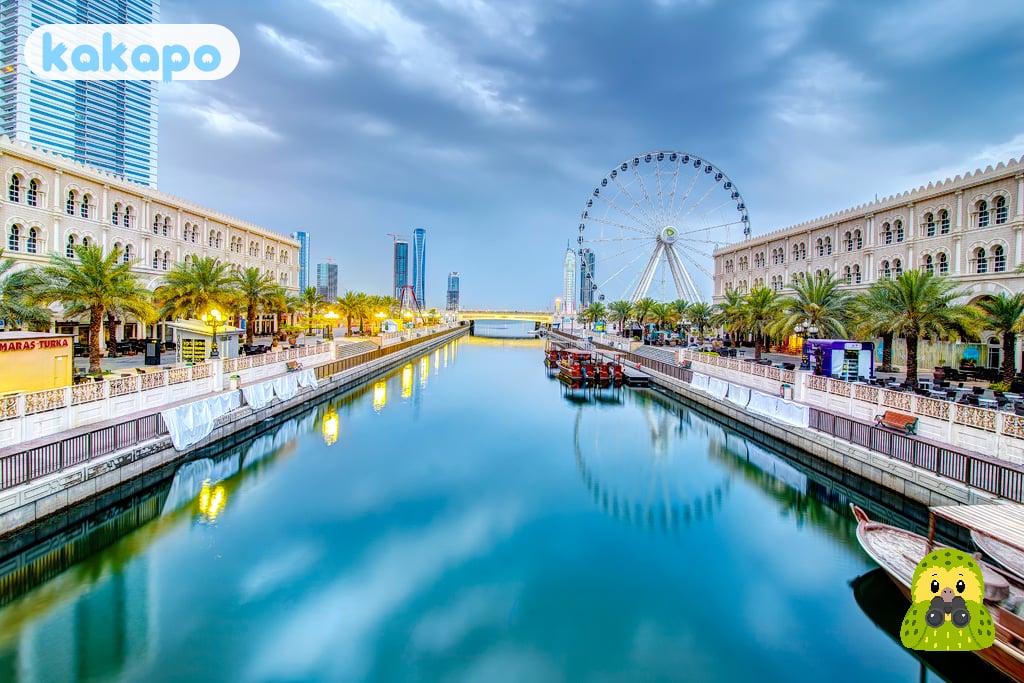
Recommended bases: Al Majaz Waterfront — central; modern hotels (Royal Tulip 72, Coral Beach Resort, 72 Hotel Sharjah); restaurants, fountain, family park. Al Khan — beach district; mid-range hotels (Sharjah Beach Hotel, Hilton Sharjah). Al Qasba — entertainment district with the Eye of the Emirates ferris wheel, restaurants. Sharjah Heritage Area — restored old quarter; boutique heritage stays (Al Bait Sharjah luxury — restored Emirati family compound).
There are no genuinely dangerous neighbourhoods in Sharjah for tourists.
Transport — Sharjah Airport, Dubai Metro extension, Uber
- Sharjah International Airport (SHJ): 13 km east of Sharjah CBD; budget-airline hub (Air Arabia primary; flydubai some). Direct flights to Asian, European, Indian-subcontinent destinations.
- Dubai International Airport (DXB): 20 km southwest; the major international gateway; most international visitors arrive here.
- Uber and Careem: dominant ride-hail; default for tourists; works between Dubai/Sharjah seamlessly.
- Dubai Metro: red and green lines run within Dubai but DON'T extend to Sharjah. Etihad Rail (under construction) will eventually connect; not operational yet.
- Sharjah Buses: SPT runs city routes; tap card; useful but slow.
- Driving: drive on the RIGHT (UAE). Sharjah-Dubai border is invisible (no border post); same UAE federal traffic laws.
- Renting a car: International Driving Permit + home licence; major operators at SHJ and DXB.
Money, food, emergency numbers
- Currency: UAE dirham (AED). $1 ≈ AED 3.67.
- Cards: contactless universal at hotels, malls, restaurants; cash for souks.
- Tipping: 10-15% restaurants; AED 5-10 for porters; AED 20-50 for tour guides.
- Food: Emirati cuisine — machbous (spiced rice with meat), harees, balaleet (sweet vermicelli with eggs); abundant Indian/Pakistani/Lebanese/Iranian/Filipino restaurants serving the expat community; international chains everywhere.
- Sharjah Cultural attractions: Sharjah Art Foundation (free, world-class contemporary art), Sharjah Calligraphy Museum, Sharjah Heritage Area (restored 19th century Emirati quarter), Sharjah Aquarium, Mleiha Archaeological Centre (60 km east).
- Tap water: legally drinkable but locals filter; bottled at hotels.
- Visa: e-visa via UAE Federal Authority for Identity, Citizenship, Customs and Port Security; visa-on-arrival for many Western nationalities.
- Modesty: more strictly enforced than Dubai; covered shoulders/knees in public.
- Emergency: 999 (police, fire, ambulance — universal); 998 (ambulance alternative); 997 (fire); 112 mobile.
- Hospitals: Al Qassimi Hospital (+971 6 519 6700); Sharjah University Hospital; serious cases referred to Dubai (Cleveland Clinic Abu Dhabi via 1.5 hr drive, or Mediclinic City Hospital Dubai).
- SIM: Etisalat or du at SHJ/DXB; AED 50-150 for tourist data; passport required.
Frequently asked questions
Is Sharjah safe to visit in 2026?
Yes. Sharjah is among the world's safest cities — violent crime and street crime against tourists are essentially nonexistent. The UAE sits at US State Department Level 2 (regional-tension boilerplate referencing Yemen/Iran) and UK FCDO has no advisory against travel. In practice tourist Sharjah behaves like Level 1: heavy CCTV, effective police presence, planned-city layout with no rough neighbourhoods. The honest concerns are stricter cultural norms than Dubai (Sharjah is fully dry — zero alcohol licensing — and modesty is more actively enforced), brutal Sharjah-Dubai commuter traffic on the E11/E311/E611 routes, summer heat with 45-48°C peaks and 90%+ humidity coast-side, and the standard heat-and-fast-driving combination.
Is Sharjah safe at night?
Yes — Sharjah is exceptionally safe after dark. The Al Majaz Waterfront, Al Qasba canal, Sharjah Heritage Area and the Corniche stay busy and well-lit late, and the family-park culture means evening crowds skew calm and multi-generational. Late-night Careem and metered Sharjah Taxi are regulated and honest. Women walking alone at midnight along Al Majaz is unremarkable. The only practical night cautions are highway-speed driving culture if you're behind the wheel and the fact that nightlife scenes that exist in Dubai (clubs, bars) simply don't exist here — Sharjah is dry.
Is Sharjah safe for solo female travellers?
Yes — the UAE consistently ranks among the safest countries for solo women, and Sharjah is the more conservative of the major emirates. Harassment is rare. Modest dress (shoulders and knees covered) is recommended in malls, museums and the Corniche, and more actively enforced than in Dubai — long sleeves, full-length skirt or trousers, and covered shoulders in public are the practical baseline. Beach attire is fine at the women-only Al Khan and Flag Island beaches and at hotel pools. Solo women routinely use the Careem app and the SPT buses without issue.
Can you drink tap water in Sharjah?
Legally yes — Sharjah tap water is desalinated, heavily treated and meets WHO standards. In practice locals filter it because building storage tanks in older properties can affect taste, and hotels universally provide bottled. Bottled water is cheap and ubiquitous. Restaurants serve filtered or bottled by default. Carry a refillable bottle in summer — the 45-48°C peaks with 90% humidity coast-side dehydrate you faster than the inland Dubai climate, and even Sharjah's malls run at refrigerator temperatures for relief.
What's the biggest scam to avoid in Sharjah?
Sharjah has very few tourist scams — penalties for fraud are heavy, CCTV coverage is comprehensive, and the small tourism footprint means scammers don't have density to work with. The recurring patterns are commercial rather than criminal: unlicensed taxis outside Sharjah International Airport (use silver Sharjah Taxi or Careem instead), gold-souq high-pressure sales at the famous Blue Souk on the Corniche (negotiate hard, verify hallmarks), and DCC at card terminals (always pay in AED, never your home currency). Don't accept 'private guide' offers at heritage sites — the official Sharjah Art Foundation and Heritage Area tours are free or cheap and excellent.
Is the Sharjah-Dubai commute really as bad as people say?
Yes, in peak hours. Central Dubai to central Sharjah is 30 km — in light traffic 30-40 minutes, in peak (07:00-10:00 morning, 17:00-21:00 evening) 90-180 minutes on Sheikh Mohammed Bin Zayed Road or Sheikh Zayed Road. Hundreds of thousands of Sharjah residents commute to Dubai for work daily through only three main routes with bottlenecks at Al Ittihad Bridge. If you're staying in Sharjah but spending days in Dubai, arrange airport transfers via the better route depending on time of day (your hotel concierge will advise on E11 vs E311 vs E611). Practical alternatives: stay in Sharjah for cheaper hotels and museum-rich quiet days, then take Careem or the SPT E303/E306 buses to Dubai outside rush hours. Don't drive yourself if you're unfamiliar with right-side high-speed driving culture — UAE accident rates per capita are among GCC's highest.
Sources
Run a business in Sharjah?
Show visitors your Sharjah business is a safe choice. The free Verified by Kakapo badge puts Sharjah's live safety score on your website, links back to your verified page, and updates itself. No cost.
Get the free badge →