


Is Kotor, Montenegro Safe? A 2026 Travel Safety Guide
Kotor is a low-crime UNESCO walled town. The real concerns are the cruise-ship inundation, the 1,355-step fortress climb, the bora wind, and the bay road.

Kotor is one of the safer Adriatic ports by ordinary-crime measures. Pickpocketing exists but is mild. The realistic concerns are physical and structural: cruise-ship days that can put 5,000+ extra visitors in a walled town that's 250 m wide; the 1,355-step climb to the San Giovanni fortress (steep, slippery, no shade, 4 medical evacuations a typical summer); the bora — a cold downburst wind that howls down the surrounding mountains in winter — and the narrow winding road around the Bay of Kotor that defines arrival from anywhere by car.
Montenegro sits at Level 1 on the US State Department advisory; UK FCDO carries no specific Kotor warning. The honest framing: Kotor is small (~13,000 in the urban municipality) and its medieval walled town is one of the most beautiful in the Adriatic. Cruise tourism is the dominant economic and crowd factor.
The defining experiences: walking the walled town, climbing to San Giovanni for the bay view, day trips to Perast and the church-island Our Lady of the Rocks, and Lovćen National Park inland.
| Night safety | 71/100 |
|---|---|
| Scam / petty-crime risk | Medium |
| Violent crime (tourists) | Low |
| Most common scams | pickpocketing on cruise days at Trg od Oružja; pickpocketing outside the Cathedral of Saint Tryphon; overcrowding from cruise-ship days |
| Safer neighbourhoods | Perast, Dobrota |
| Data sources cited | 4 |
| Last verified |
What the score means — 85/100
- Air quality (90) — sea-and-mountain; cruise emissions on busy days push it down briefly.
- Personal safety (86) — high. Pickpocketing in the walled town on cruise days.
- Transport (78) — bus network around the bay decent; no train; the bay road is the only way in.
- Healthcare (76) — Kotor general hospital is small. Major cases go to Tivat or Podgorica (1.5h).
Cruise-ship days — the schedule matters
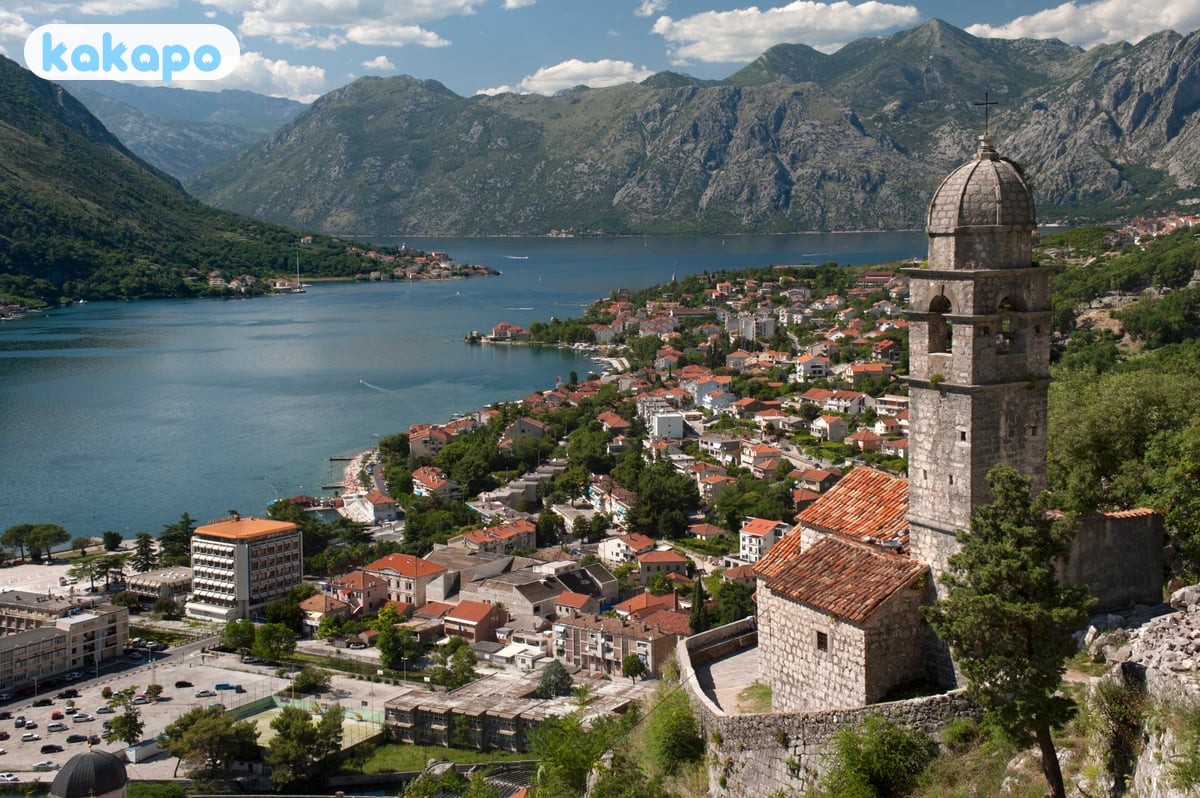
- The reality: Kotor's cruise pier is 200 m from the walled town's main gate. Days with 3-4 ships put 5,000-12,000 extra visitors in a walled town that fits comfortably 1,500.
- The pattern: ships dock 7-9am, day visitors flood in 9-11am, peak compression 11am-2pm, ships sail 5-6pm.
- Check the schedule: the Port of Kotor publishes daily ship arrivals on its website.
- What to do: walk the walled town early (7-9am) or after 6pm. Day trip to Perast on cruise days. Lunch in the walled town only on no-ship days.
- Pickpockets: meaningful on cruise days at the main square (Trg od Oružja) and outside the cathedral.
- Restaurant prices: the inside-the-walls premium is 30-50% over equivalents in Dobrota or Muo a 10-min walk away.
San Giovanni / St John fortress — the 1,355 steps
- The climb: 1,355 steps and ~260 m of vertical gain to the fortress at 280 m altitude. The classic bay view.
- Time: 60-90 min up at a normal pace; 45 min down. Allow 2-3 hours total with stops.
- Entry fee: €15 in season (May-Oct), free Nov-Apr. Pay at lower-bastion gate.
- The hazards: steps are uneven medieval stone, slick after rain; very limited shade; narrow in places with sheer drops; midday summer heat is genuinely dangerous (35°C+ on stone amplifies).
- Medical evacuations: 3-5 per summer, mostly heat-related. Bring 1.5 L of water minimum per person.
- Best timing: 7-9am or after 5pm. Sunrise from the top is exceptional.
- The "ladder of Kotor" alternative: a back-route hike from outside the walls (free) to the same fortress. Longer and serious; not the casual option.
The bora and bay weather
- The bora: a cold dry downburst wind from the surrounding mountains. Most violent Nov-Mar. Gusts to 100+ km/h.
- What it does: closes ferries (Tivat-Lepetane, occasionally), grounds small boats in the bay, makes the walled-town wynds funnel-cold.
- Summer: less common but possible. Sailors check the forecast religiously.
- Lightning: dramatic afternoon thunderstorms in the bay summer evenings. Safe inside; avoid the fortress climb during them.
- Best season: late May, June, September, early October. July-August are hot + busy.
- Sunscreen + hat: standard. The bay reflects heavily.
The bay road — the drive in
- The road: narrow two-lane around the inner Bay of Kotor. Cliff on one side, water on the other. ~30 km loop from Tivat or 1.5h from Dubrovnik via Herceg Novi.
- The Tivat–Lepetane ferry: cuts the loop by 30 min, €5 per car, runs all day, stops in heavy bora.
- From Dubrovnik: 90 km, ~2h. The Croatia-Montenegro border at Debeli Brijeg can have 30-90 min queues in July-August.
- Driving style: Montenegrin overtakes are aggressive on this road. Drive defensively; don't hurry.
- Cyclists + scooters: present in summer. Limited shoulder.
- Parking in Kotor: walled town is pedestrian. Park outside €1-2/hour.
Perast, Our Lady of the Rocks, swimming
- Perast: 12 km north. Quieter than Kotor; the boats to Our Lady of the Rocks leave from here. €5-€8 round trip.
- Our Lady of the Rocks: the artificial island church. Worth the hour. Boatmen include waiting time.
- Swimming in the bay: water is clean, mostly stony beaches. Aqua shoes useful.
- Sea urchins: present near rocks. Don't go barefoot in shallow water.
- Stronger currents: the bay outflow at the Verige Strait (between Kotor and Tivat bays) — don't swim across.
Money, language, basic logistics
- Currency: Montenegro uses the euro (unilaterally; not in the eurozone).
- ATMs: bank-branch ATMs only — Crnogorska Komercijalna Banka, NLB, Erste. Avoid Euronet.
- Cards: widely accepted; cash for small market stalls.
- Language: Montenegrin. English is good in tourism. Russian widely spoken (long-standing Russian visitor community).
- Tipping: 10% in restaurants if service was good; not automatic.
- Tap water: safe in Kotor.
Districts — Old Town to the inner bay
- Stari Grad (Old Town) — the UNESCO walled medieval town, 250 m at its widest, walkable end-to-end in 10 minutes. Trg od Oružja (the main square), the Cathedral of Saint Tryphon (€3, 1166), St Nicholas Orthodox Church, Maritime Museum (€4). The cruise pier is 200 m from the main north gate, which is the structural fact that defines the entire visitor experience.
- Bay of Kotor (Boka Kotorska) — the inner fjord-like bay (technically a ria, the only fjord-shaped feature in southern Europe). The Bay of Kotor + Bay of Tivat connected by the Verige Strait, ringed by mountains rising to 1,700 m. The 30 km loop drive around the inner bay is one of Europe's most scenic; the Tivat-Lepetane car ferry (€5, all day, stops in heavy bora) cuts 30 minutes.
- Perast — the baroque village 12 km north along the bay shore. Quieter than Kotor; the boats to Our Lady of the Rocks (€5-8 round trip) leave from here. Two churches, twelve palazzi, and a calm waterfront café strip. Easy half-day or the better dinner location on cruise-inundation days in Kotor.
- Our Lady of the Rocks (Gospa od Škrpjela) — the artificial island church built on rocks dumped by sailors over 200 years. €1.50 entry; boatmen include waiting time in the €5-8 fare. The other island (St George) is monastic and not visitable. The story (sailors throwing a rock for each safe return) is one of the Adriatic's best.
- Lovćen National Park — the mountain massif inland from Kotor, with the mausoleum of Petar II Petrović-Njegoš (the prince-bishop-poet, Montenegro's national hero) at the peak, 461 stone steps to the viewing platform at 1,657 m. The road up from Kotor has 25 hairpin bends and unfenced drops; the view of the bay from the Krstac pass is the country's defining image. Drive carefully or take an organised tour.
- San Giovanni / St John fortress climb — 1,355 stone steps and 260 m vertical gain from the lower bastion gate inside the walls to the fortress at 280 m altitude. €15 May-Oct, free Nov-Apr. Multiple summer medical evacuations annually; bring 1.5 L of water minimum and climb early (07:00-09:00) or late (after 17:00). The free "ladder of Kotor" back-route hike from outside the walls is longer and serious.
- Ferry vs road — driving in on the SP227-equivalent bay road from Tivat or Dubrovnik (90 km, 2h) is the standard route; the Tivat-Lepetane car ferry (€5/car, every 15 min, 5-min crossing) cuts 30 min and the inner-bay road's narrowest hairpins. From Dubrovnik the Croatia-Montenegro border at Debeli Brijeg can queue 30-90 min in July-August.
- Cruise overcrowding (2024-25 reality) — Kotor receives 400+ cruise calls a year and 600,000+ cruise passengers. Days with 3-4 ships dock 5,000-12,000 extra visitors in a 250 m walled town. The municipality introduced a cruise-arrival cap in 2024 (2 ships per day) and pilots have negotiated to limit Saturday volumes. Effect for tourists: check the Port of Kotor daily ship schedule before booking accommodation, and walk the walled town early (07:00-09:00) or after 18:00 on ship days. Restaurant prices inside the walls 30-50% above Dobrota or Muo a 10-min walk away.
- Dobrota + Muo — the residential waterfronts north (Dobrota) and west (Muo) of the Old Town. 15-min walk; restaurants 30-50% cheaper than inside the walls (Konoba Scala Santa, Restoran Galion). Where locals eat. Both safe at any hour with calm lakefront walking paths.
- Currency note — Montenegro uses the euro unilaterally (not in the eurozone). Bank-branch ATMs (CKB, NLB, Erste) only; avoid the Euronet machines near the main gate that quote terrible rates. Russian is widely spoken alongside Montenegrin and English (long-standing Russian visitor community).
If it's your first time visiting
- Best arrival — Tivat Airport (TIV, 7 km north) is the closest with Wizz Air/Ryanair seasonal connections; taxi €15-20 to Kotor. Podgorica Airport (TGD, 90 km east) is the larger gateway with Lufthansa/Turkish; taxi €60-80 or bus to Kotor €5-8 (1.5h). From Dubrovnik (Croatia) it's a 2h drive via the Debeli Brijeg border crossing (30-90 min queues July-August); coach €15-25.
- Best neighbourhood for your first night — inside the Old Town (Hotel Cattaro on the main square, Palazzo Drusko, Boutique Hotel Hippocampus, €100-200) for the medieval atmosphere; Dobrota waterfront (Hotel Forza Mare, Heritage Grand Perast in Perast itself, €120-300) for calm bay-view rooms. Cruise-pier-front hotels avoid; you'll get the ship-arrival noise.
- Check the cruise schedule — Port of Kotor publishes daily ship arrivals at portofkotor.co.me. Days with 3-4 ships put 5,000-12,000 extra visitors in the 250 m walled town. Walk the Old Town early (07:00-09:00) or after 18:00 on ship days; day-trip to Perast or Lovćen during 11:00-15:00 peak crush; eat lunch inside the walls only on no-ship days.
- San Giovanni fortress climb early — 1,355 stone steps, 260 m vertical, €15 in season (May-Oct, free Nov-Apr). Climb at 07:00-09:00 or after 17:00; never midday July-August (35°C+ on the stone surface causes multiple summer medical evacuations annually). 1.5 L water minimum; sturdy grip-soled shoes; sun hat. The view from the top justifies the climb.
- Perast + Our Lady of the Rocks — bus from Kotor €1.50 (20 min) or organised half-day tour €25-40. Boats to Our Lady of the Rocks €5-8 round trip with waiting time, the artificial-island church €1.50 entry. Pair with a Perast waterfront lunch (Konoba Otok Bronza, €15-25); calmer than Kotor on ship days.
- Lovćen day — hire car or organised tour up the 25 hairpin bends to Njegoš's mausoleum (€5 entry, 461 stone steps to the peak at 1,657 m). Drive carefully — Montenegrin overtakes are aggressive and the unfenced drops are real. The view from the Krstac pass is the country's most photographed.
- Eat outside the walls when possible — Konoba Scala Santa or Restoran Galion in Dobrota (15-min walk), Konoba Roko Vlah in Muo, Konoba Otok Bronza in Perast. Konoba pricing 30-50% below inside-the-walls equivalents. Always ask for the cjenik (price list) before sitting at any "fresh fish" restaurant; verbal quotes are the recurring pricing scam.
- Money + cards — euro, contactless widely accepted but cash needed at small stalls and the Lovćen mausoleum kiosks. Bank-branch ATMs only (CKB, NLB, Erste, Crnogorska Komercijalna Banka); skip the Euronet machines near the main gate. Tipping 10% in restaurants if service was good.
- Common rookie mistakes — climbing San Giovanni at midday in July (medical evacuations are real); eating inside the walls on a cruise day (premium pricing and the worst service); driving the inner-bay road instead of taking the Tivat-Lepetane ferry (30 min saved); using a Euronet ATM at the main gate (terrible rate); booking a 1-night stay (the bay scenery and Perast/Lovćen day-trips need 3 nights minimum to do properly); flying into Podgorica without realising it's 90 km away (Tivat is closer if your dates allow).
Practical info — emergency numbers
- European emergency: 112.
- Police: 122.
- Ambulance: 124.
- Mountain rescue: 112.
- Kotor General Hospital: +382 32 325 555.
Bring: trainers with grip for the fortress steps, a sun hat, sunscreen, a refillable water bottle, swimwear, a light jacket for evenings, and cash + card. Travel insurance with mountain-rescue cover useful for serious hikers.
Frequently asked questions
Is Kotor safe to visit in 2026?
Yes — Kotor scores 84/100 here, one of the safer Adriatic ports by ordinary-crime measure. Montenegro sits at US State Department Level 1 with no specific UK FCDO Kotor warning. Pickpocketing exists but is mild and concentrated on cruise days at the main square (Trg od Oružja) and outside the cathedral. The realistic concerns are physical: cruise inundation days putting 5,000-12,000 extra visitors in a 250m-wide walled town, the 1,355-step climb to San Giovanni fortress (multiple summer medical evacuations annually for heat exhaustion), the bora downburst wind that can hit 100+ km/h, and the narrow winding bay road that defines arrival by car.
Is Kotor safe at night?
Yes. The walled town and the Muo / Dobrota lakefront walking paths are calm and policed late. Cruise crowds clear by 18:00 and the Old Town becomes pleasantly quiet — locals reclaim the squares. Solo walking from a Trg od Oružja restaurant back to a Dobrota hotel is routine. The medieval stone lanes get slippery after rain — wear shoes with grip. The fortress climb is dim after dark; not recommended without a torch. Restaurants stay open until 23:00 in season. Drink-spiking is rare.
Is Kotor safe for solo female travellers?
Yes. Kotor is one of the easier Adriatic destinations for solo women — low harassment, friendly atmosphere, and the walled town is small enough that staff recognise repeat visitors quickly. Solo dining in Old Town konobas works fine and Perast day trips (12 km north) are solo-routine. Day-boat trips to Our Lady of the Rocks at €5-8 round-trip are easy solo. The bay road and Lovćen National Park are safe by day. Standard awareness on cruise days for pickpocketing in the main square density.
Can you drink tap water in Kotor?
Yes — Kotor tap water is safe and meets Montenegrin standards, drawn from mountain karst sources around the bay. Locals drink it freely. Restaurants will serve tap on request, though bottled is the cultural default. Carry a refillable bottle — the San Giovanni fortress climb has minimal shade and the café at the top is overpriced; bring at least 1.5L per person for the climb in summer. The Bay of Kotor is bathing-quality at marked beaches but seriously salty if swallowed.
What's the biggest scam to avoid in Kotor?
Cruise-day konoba pricing inside the walls — restaurants there charge 30-50% premiums over equivalents in Dobrota or Muo a 10-min walk away, and the worst offenders use no-price-list 'fresh fish' verbal quotes. Always ask for the cjenik (price list) before sitting. Secondary patterns: freelance taxi quotes at the cruise pier (use legitimate municipal taxis with rooftop signs and meters, or Bolt), DCC card-reader markups (always pay in EUR), Euronet ATMs near the main gate (use bank-branch ATMs at CKB, NLB, Erste for the best rate), and 'private boat to Our Lady of the Rocks' touts at marked-up prices over the established Perast boats.
How dangerous is the San Giovanni fortress climb really?
Genuinely demanding. 1,355 stone steps and 260m vertical gain to the fortress at 280m altitude. Steps are uneven medieval stone, slick after rain, very limited shade, narrow in places with sheer drops, and midday summer heat (35°C+ on stone surfaces) is dangerous. Kotor records 3-5 medical evacuations per summer, mostly heat-related. Climb at 7-9am or after 5pm; never in midday July-August heat. Bring at least 1.5L water per person, sun hat, sturdy shoes with grip (not sandals). Entry €15 in season (May-Oct), free Nov-Apr. The free 'ladder of Kotor' back-route hike from outside the walls is longer and more serious — not the casual option.
Sources
Run a business in Kotor?
Show visitors your Kotor business is a safe choice. The free Verified by Kakapo badge puts Kotor's live safety score on your website, links back to your verified page, and updates itself. No cost.
Get the free badge →