


Is Downtown Cairo Safe at Night? 2026 Guide
Tahrir Square, Talaat Harb, the buzz around Borsa and Souq al-Tawfiqia, and the harassment reality for female travellers — what the bustling-on-foot maps don't say.

Downtown Cairo (Wist el-Balad) at night is, by violent-crime measures, safe — Egypt as a whole has one of the lowest tourist-violent-crime rates in the wider Middle East and Mediterranean region. The area around Tahrir Square, Talaat Harb Square, Mohamed Mahmoud Street, Sherif Street and the famous Borsa café district stays busy until 1-2am with locals, café-goers, and the buzz that makes Downtown unique.
The catch — and it's a significant one that almost every well-meaning travel guide skips over — is that Downtown Cairo at night is one of the toughest environments in any Mediterranean capital for solo female travellers in terms of verbal harassment. UN Women's 2017 study found that 99.3% of Egyptian women had experienced some form of sexual harassment; the figure is widely understood to apply equally to foreign female travellers in dense urban areas. The harassment is verbal (catcalls, comments, persistent following) rather than physical; police response since the 2014 anti-harassment law has improved but is patchy.
For male travellers and couples, Downtown Cairo at night is one of the most rewarding city walks in the region. For solo women, the calculus is different and worth a guide of its own.
| Solo female safety | 30/100 |
|---|---|
| Night safety | 55/100 |
| Scam / petty-crime risk | Medium |
| Violent crime (tourists) | Low |
| Most common scams | phone-snatching off café terraces in Souq al-Tawfiqia; bag-snatching in Downtown Cairo; verbal harassment of solo female travellers in Downtown Cairo |
| Safer neighbourhoods | Garden City, Zamalek, Tahrir Square |
| Data sources cited | 4 |
| Last verified |
Downtown Cairo — the geography
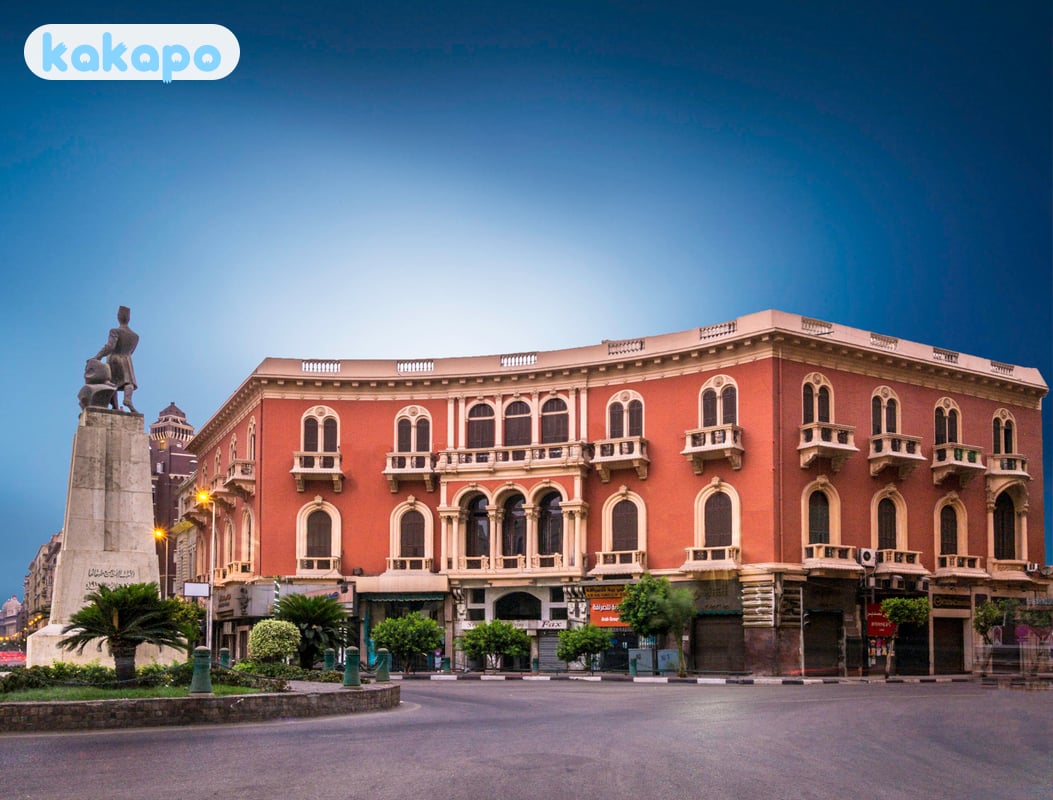
- Tahrir Square (Maydan al-Tahrir) — the famous protest square, now ringed by the Egyptian Museum, the Mogamma government building, and the American University in Cairo's old downtown campus. Heavily policed at all hours.
- Talaat Harb Square and Talaat Harb Street — the commercial heart, named after the Egyptian banker, lined with cafés, the Café Riche (open until midnight), Groppi pastries, the Cinema Metro.
- Sherif Street, Qasr al-Nil, Mohamed Mahmoud — the office-and-banking grid; Sherif and Qasr al-Nil have the highest evening foot traffic.
- Souq al-Tawfiqia and Borsa (Cairo Stock Exchange) cafés — the alley behind the Borsa is the buzzy late-evening shisha/café cluster. Stays busy until 2am most nights.
- Abdeen Palace — the south end of downtown, presidential palace and museum. Less foot traffic at night but heavily policed.
- Tahrir Bridge / Qasr al-Nil Bridge — the famous lion-flanked bridge over to Zamalek. Pedestrian-friendly until ~1am, popular evening stroll.
- What "Downtown" doesn't include: Garden City to the south (residential, embassy district, safer/quieter); Zamalek across the bridge (residential, expat-friendly); Bulaq north of Downtown (working-class, fine but not a tourist district).
Violent crime — the baseline reality
- Tourist violent-crime rate: extremely low. Egypt's tourism police (Shurta al-Siyaha) maintain heavy visible presence at Downtown's tourist anchors (Egyptian Museum, Tahrir, the major hotels — Nile Ritz-Carlton, Steigenberger Tahrir).
- What hasn't happened to a tourist in recent memory in Downtown Cairo: armed mugging, assault leading to hospitalisation, kidnapping. The few documented serious incidents have been pickpocketing or bag-snatching.
- Police presence: Tahrir Square has visible armed police at all hours; Mohamed Mahmoud and the corners of Talaat Harb Square have static police posts. The 2013-2014 security crackdown built out this presence permanently.
- Petty theft: phone-snatching off café terraces happens in Souq al-Tawfiqia and around Borsa late at night. Keep phone in a front pocket, no laptop visible on a café table after 9pm.
- Traffic accident risk: Cairo's pedestrian fatality rate is among the highest in any major capital. Crossing Sherif Street or Tahrir at midnight is riskier than any criminal scenario you'll meet.
For solo female travellers — the harassment reality
- What to expect: verbal catcalls in English and Arabic, comments on appearance, persistent following ("hello, where you from, why alone?"), occasional groping in dense crowds. Walking alone in Downtown Cairo at 11pm a Western woman will receive comments every 30-90 seconds.
- What's mostly absent: physical assault, armed mugging, abduction. The harassment is the hassle, not the danger.
- Dress and approach: covering shoulders and knees and wearing loose layers reduces but does not eliminate harassment. The harassment correlates more with being-foreign-and-alone than with what you wear.
- The Egyptian women's response: project visible irritation, use loud "Haram aleik!" ("shame on you") to embarrass the harasser publicly. Egyptian bystanders — men and women — will often intervene if they see this happen.
- The 2014 anti-harassment law: makes verbal and physical sexual harassment a criminal offence with 6-12 months prison. Enforcement at the patrol level is patchy but the Tourism Police take complaints seriously.
- The practical advice: travel with a companion if possible; otherwise stay on the busiest streets (Sherif, Qasr al-Nil, Talaat Harb) where ambient density is highest; take Uber rather than walking after ~10pm; the famous Souq al-Tawfiqia/Borsa scene is more comfortable with a male companion than solo.
Street-by-street guide
- Talaat Harb Square and Talaat Harb Street: the central commercial spine, fine at any evening hour, ~50m to a police officer at all times.
- Sherif Street: pedestrian-only block (between Talaat Harb and Qasr al-Nil), evening cafés, very busy until midnight.
- Mohamed Mahmoud Street: between AUC and Tahrir. The 2011-12 protest street; now redeveloped. Heavily lit, heavily patrolled.
- Souq al-Tawfiqia and Borsa cluster: the alley between Sherif and Qasr al-Nil, the late-night shisha hub. Very busy, very atmospheric, gets dense; phone in front pocket.
- Sa'ad Zaghloul Street and the Cinema Cosmos area: 1930s-architecture stretch, more atmospheric than rough, fine at midnight.
- The Bazoubzy/Falaki area south of Talaat Harb: gets quieter and rougher after 11pm. Not unsafe but not where to wander.
- Bulaq, Ramses, Attaba (north and east edges of Downtown): working-class transitional zones, fine in daylight, rough in feel late evening. No reason to be there for a tourist.
- Tahrir Square itself at night: heavily policed; the underground Sadat metro station beneath it is fine; the open square is fine to cross but not somewhere to linger.
Getting around at night
- Uber and Careem: both work flawlessly in Downtown Cairo. Cairo Uber fares are extremely low — Downtown to Zamalek ~EGP 50-80; Downtown to Maadi or Heliopolis EGP 120-180 in 2026. Both apps are reliable, in English, and have a complaint trail.
- Cairo Metro Line 1 and 2: Sadat station (under Tahrir) connects you to Giza, Maadi, Helwan and Shoubra. Runs until ~midnight. Cheap (EGP 10 ticket in 2026), safe, women-only car (the first two cars). The safest after-dark transit option, especially for solo women.
- White taxis: licensed metered taxis. Use only with the meter on; insist firmly. Quoted flat fares are typically 30-50% above the metered rate. Use Uber/Careem instead.
- Walking at night: fine for couples and male pairs on the main streets to ~midnight. For solo women, take Uber for trips over 500m.
- Last metro: ~00:00 for Line 1; ~23:30 for Lines 2 and 3. After that, Uber is the move.
If something happens
- 122 — Egyptian police emergency.
- Tourism Police (Shurta al-Siyaha): dedicated unit; visible at Tahrir, the Egyptian Museum, and major hotels. English-speaking. The unit to approach for tourist incidents.
- Cairo Governorate harassment hotline: 16108 (in Arabic, but the operators handle English well in practice).
- UK Embassy Cairo: +20 2 2791 6000, 24/7 consular line.
- US Embassy Cairo: +20 2 2797 3300, 24/7 consular line.
- Lost passport: file police report at Qasr el-Nil police station (the central Downtown station, on Sherif Street); then your embassy. Egypt allows exit on emergency travel documents.
Frequently asked questions
Is Downtown Cairo safe at night in 2026?
Yes for violent crime — the baseline rate is extremely low and tourism police presence in Downtown is permanent and visible. The honest catch is for solo female travellers, who face frequent verbal catcalls, persistent following, and occasional groping in dense crowds. The harassment is the hassle; physical danger is genuinely rare.
Is Cairo safe for women to walk alone at night?
Walking alone in Downtown Cairo at 11pm a Western woman will receive comments every 30-90 seconds. The harassment is verbal and persistent but not violent. Practical advice: stay on the busiest streets (Sherif, Qasr al-Nil, Talaat Harb), take Uber for trips over 500m after 10pm, and don't engage with persistent followers — Egyptian bystanders often intervene if you signal you're being harassed.
Is Tahrir Square safe in 2026?
Yes — the famous protest square has been heavily policed at all hours since 2013-14. Visible armed police presence permanently, no recent tourist incidents. Cross it to get to the Egyptian Museum or the Sadat metro station; not a place to linger. The Mogamma building on the south side and the new Egyptian Museum site (the old central building, separate from the GEM out at Giza) are both fully operational.
What is the best way to get around Downtown Cairo at night?
Uber or Careem — both work flawlessly, English-language apps, prices very low (EGP 50-180 for typical Downtown trips in 2026). The Cairo Metro Line 1 (Sadat station beneath Tahrir) is also safe until ~midnight, EGP 10, with a women-only car in the first two carriages. White taxis only with the meter on — kerbside flat-rate quotes are 30-50% above the metered rate.
Is Souq al-Tawfiqia safe at night?
Yes — the alley behind the Borsa (Cairo Stock Exchange) is the buzzy late-evening shisha/café cluster, busy until 2am most nights. Phone in front pocket, no laptop on the table after 9pm, otherwise fine for male travellers and couples. For solo women it's the atmospheric Downtown spot most worth visiting with a companion rather than alone.
Are there pickpockets in Downtown Cairo?
Some, mostly around the Souq al-Tawfiqia and Borsa terraces at night where phone-snatch incidents happen. Front pocket for phones, bag in front. Lower density than Khan el-Khalili (the historic bazaar — different district) and significantly lower than what you'd meet in Marrakech's Jemaa el-Fna.
What should I avoid in Downtown Cairo at night?
The transitional fringes — Bulaq to the north, Attaba market area to the east, the Bazoubzy/Falaki area south of Talaat Harb after 11pm. None of these are dangerous in the violent sense; they're just rough in feel, with no tourist reason to be there. Stay on the main spine (Talaat Harb, Sherif, Qasr al-Nil, Mohamed Mahmoud) and the central squares.
Sources
Run a business in Downtown Cairo?
Show visitors your Downtown Cairo business is a safe choice. The free Verified by Kakapo badge puts Downtown Cairo's live safety score on your website, links back to your verified page, and updates itself. No cost.
Get the free badge →