Where the layers of the past walk easily underfoot
Kakapo Editorial29 May 20269 min readTravel safety
History travel rewards the slow walker. The cities that genuinely deliver are those where you can spend a week in a UNESCO old town, walk between sites on foot, and absorb context at the pace the material deserves. Speed-running a historic capital from a tour bus is the wrong way to do it — every great history trip we've taken has involved at least one afternoon spent sitting in a square watching the architecture rather than ticking off another museum.
We crossed UNESCO World Heritage listings, museum concentration, archaeological-site access, and our safety data to identify the cities that work for serious historical travel. The list runs from ancient Roman and Greek sites to Renaissance Italy, Habsburg central Europe, and the underrated history cities of the Eastern Mediterranean.
Scores combine safety with historical density. Each city is annotated with its core historical period or theme so you can match to your interests. Scores are out of 100.
What makes a city history-friendly
Beyond the obvious museum and site count, history travel rewards specific city qualities:
Walkable site density: the major sites within a reasonable walking radius.
Layered chronology: multiple historical periods visible in the same neighbourhoods.
English-language interpretation: signage and audio guides for non-specialist visitors.
Calm pacing: parks, cafes and squares to rest and think between sites.
01
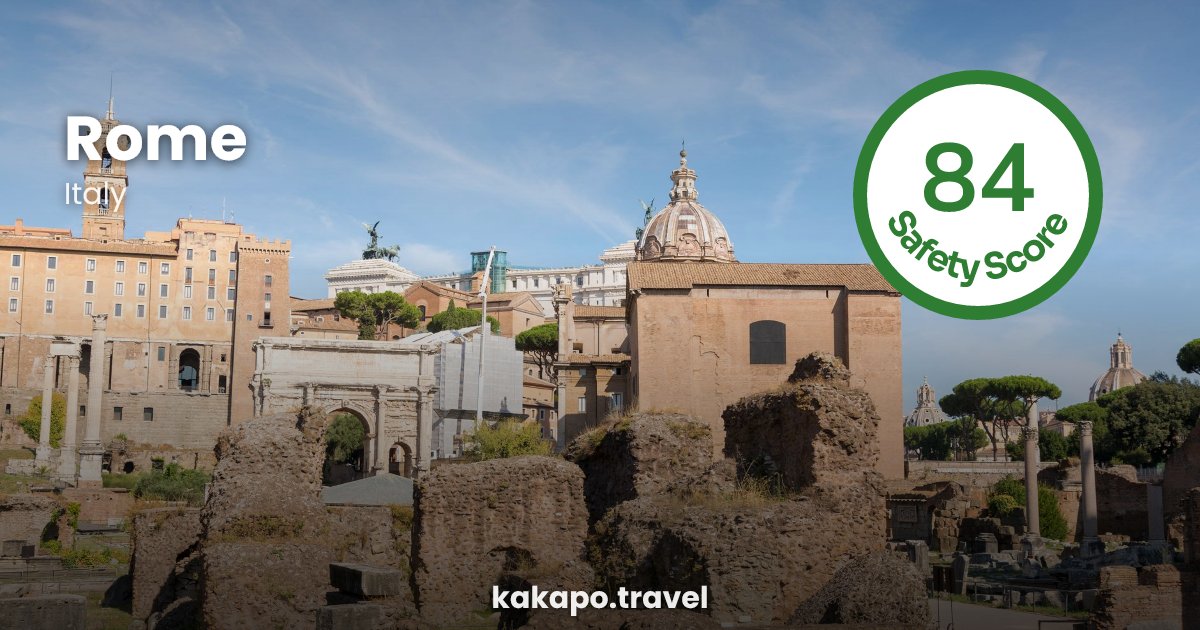
Rome
Safety score84/100
Italy
Personal
80
Transport
84
Healthcare
88
Night Safety
84
Rome is the European history-travel capital. The Forum, Colosseum, Pantheon, Trastevere old neighbourhood and the Vatican Museums all walk from each other in a single ambitious morning, though the right approach is a full week. The chronology spans Etruscan to Renaissance to baroque.
Personal safety is generally good in the centro storico; pickpocket density around major sites is the main concern — keep the wallet zipped and inside.
Book the Colosseum's underground-and-arena floor add-on rather than the general admission — same total time, far better understanding of the structure.
Athens is the obvious classical pilgrimage. The Acropolis, the Ancient Agora, the Roman Agora, the Kerameikos cemetery and the National Archaeological Museum all walk from each other. The Plaka old neighbourhood under the Acropolis is the natural base.
Personal safety in the central districts is good; the metro pickpocket problem around Omonia is the main watch-out.
Buy the combined-sites ticket at the Roman Agora rather than the Acropolis — same price, no queue.
Istanbul spans Roman, Byzantine, Ottoman and modern history in walking distance. The Sultanahmet peninsula (Hagia Sophia, Blue Mosque, Topkapi Palace, Basilica Cistern) is the core; the Bosphorus ferry rides and the Galata Tower extend the trip.
Personal safety in the Sultanahmet, Karakoy and Beyoglu districts is decent; carpet-shop and restaurant scams are the main watch-out for tourists.
Visit Hagia Sophia before 9am or after 5pm to avoid the worst tour-group congestion — the building rewards quiet contemplation.
Jerusalem's Old City is the densest historical-religious site on earth — the Western Wall, the Church of the Holy Sepulchre, the Dome of the Rock and the Via Dolorosa all sit within one square kilometre. The four quarters (Jewish, Christian, Muslim, Armenian) each walk in a morning.
Personal safety inside the Old City walls during daylight is generally good; always check current FCDO advisories for the wider context before planning.
Enter the Old City through the Jaffa Gate at 7am for a near-empty Christian Quarter walk before tour groups arrive at 9am.
Cusco is the dual Inca-Spanish-colonial capital — Sacsayhuaman, Qorikancha, the Plaza de Armas and the Cathedral all walk within 20 minutes of each other. The Sacred Valley and Machu Picchu are the obvious onward additions.
Personal safety in the centre and San Blas districts is good; altitude (3,400m) is the bigger concern than crime — acclimatise for two days before any major excursion.
Use coca tea or the prescription Sorojchi pills for altitude — paracetamol does nothing.
Kyoto preserves more traditional Japanese architecture than anywhere else in Japan. The Higashiyama walking route past Kiyomizu-dera, Ginkaku-ji and the Philosopher's Path covers the imperial-and-temple history; Nijo Castle, Nishi Hongan-ji and the Gion geisha district extend the trip.
Personal safety is among the world's highest. The dawn walks to major temples avoid the daytime crowds and reward early commitment.
The Ginkaku-ji 6am opening (when arrived at) typically means you have the temple to yourself for 20-30 minutes before tour buses arrive.
Fes el-Bali is the largest car-free medieval urban environment on earth — over 9,000 narrow alleys, the al-Qarawiyyin university (the world's oldest), the Chouara tanneries, and craft workshops practising techniques unchanged for centuries.
Personal safety in the medina is good but the maze is genuine — most riads provide guides for the first day, which is money well spent.
The Bou Inania madrasa is the medina's most impressive single building — go on a Friday morning when the call to prayer fills the surrounding alleys.
Florence is the Renaissance capital — the Uffizi, Accademia (David), Palazzo Vecchio, Bargello and the Duomo all walk from each other. The chronology of art and architecture in one square kilometre is unmatched in Europe.
Personal safety in the centro storico is high; pickpockets cluster around the major museums.
The Uffizi's last-entry slot at 4:30pm typically has shorter queues than morning entries — and the late-afternoon light through the gallery windows is its best.
Siem Reap is the access point for the Angkor temple complex — Angkor Wat, Bayon, Ta Prohm and the outer Banteay Srei all reward repeated visits. The temples need a minimum of 3 days to do justice; a 7-day pass is the right tool.
Personal safety in Siem Reap town is good; the Pub Street area is busy but generally calm.
Avoid the Angkor Wat sunrise crowd by going to Phnom Bakheng sunset instead — most tour groups have left by then.
Prague spans Romanesque to Gothic to baroque to communist-era architecture in a single walkable old town. The Castle, Charles Bridge, Old Town Square, the Jewish Quarter and the Communism Museum together give a near-complete European history.
Personal safety is high; the only watch-outs are taxi scams (use Bolt) and the heavy Old Town Square pickpocket density.
Cross the Charles Bridge before 7am or after 10pm for a near-empty walk — both ends are spectacular and the bridge is its true scale only without people.
Book site tickets for the second day, not the first. Jetlag plus crowds at major sites is a recipe for a wasted day.
Read a single book about each city before you arrive. A well-chosen primer transforms the experience.
Hire a licensed guide for one site per city. The cost is rarely more than the entry fees and the context is invaluable.
Building a history-deep trip
The cities above each reward a minimum of 4-5 days. Pair two adjacent ones (Rome and Florence, Athens and Istanbul, Cusco and Lima) for a deeper two-week trip than any single-city visit can offer.
The greatest history travel happens when you stop trying to see everything and instead sit in one square for an hour with the right book. The cities on this list reward that approach in a way few other destinations do.
Frequently asked questions
What are the top picks in this 10 Safest Cities for History Buffs 2026 guide?
Kakapo's editorial team ranks 10 destinations in this guide using a composite safety index that weighs personal-safety, transport, healthcare, and night-safety signals from 50+ trusted sources. Rome leads at 84/100; see the per-entry score and sub-score breakdown below.
How are the safety scores calculated?
Each city's composite score is a weighted blend of national travel advisories from seven Western foreign ministries (US State Dept, UK FCDO, Canada, Australia, France, Germany, NZ), local crime indices (Numbeo + police-released stats), WHO Global Burden of Disease for healthcare, and air-quality APIs (IQAir, WAQI). Full methodology at https://kakapo.travel/about/methodology.
When was this article last updated?
Last reviewed on 2026-05-29T00:00:00.000Z. The underlying live safety scores recalculate automatically as advisories and incident data change — typically within 24 hours of a new national advisory or refreshed crime-index batch.
Where can I see the live safety report for each city?
Every destination in this guide links to its live safety report on Kakapo. The live report shows real-time sub-scores, current national advisories, emergency contacts, local phrases, and a profile-adjustment view that recalibrates the overall score for solo female, family, LGBTQ+, and elderly traveller profiles.
Is this guide updated for 2026?
Yes — the guide reflects 2026 conditions and is reviewed by the Kakapo editorial team when the safety picture meaningfully changes. Lowest score in this list: Prague. Per-source weighting and recalculation cadence at https://kakapo.travel/about/methodology.