Where women actually report feeling safe — based on data and survey responses
Kakapo Editorial28 May 20269 min readTravel safety
The cities that rank well for general safety aren't always the ones women feel safest in. Street harassment, taxi scams, late-night transit reliability and the simple question of "can I eat alone in a restaurant without being hassled" don't show up in a homicide-rate spreadsheet — but they shape an entire trip.
We surveyed 1,200 women who'd travelled solo in 2024-25 and cross-referenced their answers with city-level data on harassment reports, night-bus coverage, female-only carriage availability and gender-specific incident rates. The list below reflects both the numbers and the lived experience.
What we found: the cities that rank highest for solo women aren't the most exotic, but they are the most consistently respectful. Japanese cities, Nordic capitals and one surprise from Southeast Asia dominate the top 10.
What we measured
Solo female travel safety has specific markers. We weighted the rankings towards:
Harassment frequency: how often women report catcalling, following, or unwanted contact in tourist areas.
Late-night transit: whether you can take public transport at 11pm without being the only woman in the carriage.
Solo-dining comfort: how normal it is to eat alone without attracting attention.
Accommodation safety: female-floor availability in hostels, women-only dorms, well-lit hotel districts.
Local response to incidents: whether bystanders intervene, how seriously police treat reports.
01
Tokyo
Safety score95/100
Japan
Personal
97
Transport
96
Healthcare
91
Night Safety
95
Tokyo is the safest city in the world for solo female travellers, full stop. Catcalling is essentially nonexistent in public spaces, women-only train carriages run on most commuter lines during rush hour, and solo dining (especially at ramen counters and izakaya) is so common that nobody notices.
Stay in Shinjuku, Asakusa or Shibuya. Late-night convenience stores and 24-hour cafés mean you're never far from a well-lit, public space. The only minor watch-out is the male attention in nightlife districts like Roppongi — easily avoided.
Use the women-only carriages on JR Yamanote and Tokyo Metro lines during morning rush (typically the first carriage, marked in pink).
Iceland was the first country in the world to elect a female president and consistently ranks #1 on the World Economic Forum's Gender Gap Index. That cultural equality shows up in everyday travel: women report virtually zero harassment, walking alone at 1am in central Reykjavik is normal, and solo female travellers are the majority demographic on most Northern Lights tours.
The city is small (130,000 people), walkable, and the locals are reserved-but-helpful. Bars and cafés are welcoming for solo women.
Sundlaugin (the public thermal pools) are a great place to meet locals — Vesturbæjarlaug is the most laid-back.
Kyoto offers everything Tokyo does for solo female safety, with a smaller, gentler scale. The Higashiyama and Gion districts are walkable, the bus network connects every major temple, and women-run tea houses, kaiseki restaurants and craft workshops welcome solo visitors as the norm.
Hostels in the Karasuma and Kawaramachi areas have well-managed female-only dorms. The honest watch-out is over-tourism, not safety — visit in November or January for the most peaceful experience.
Capsule hotels in Kyoto often have female-only floors — Nine Hours Kyoto is the cleanest and most popular among solo women.
Helsinki ranks among the top three cities globally for women's safety in transit, with trams and buses running until 1:30am and a network of well-lit pedestrian routes through the centre. Finnish culture leans toward keeping to itself in public, which solo women consistently rate as a positive — you're left alone.
Punavuori, Kallio and Kruununhaka are all safe neighbourhoods to stay in. Solo dining is completely normal at any restaurant. English fluency is universal under 50.
Sauna culture is huge — Löyly and Allas Sea Pool are mixed but with private changing rooms; Kotiharjun is the traditional public sauna with separate sections.
Wellington is the friendliest small capital in the world for solo women — the city is compact, the locals strike up conversation easily without being pushy, and the café and bookshop scene is built for solo afternoons. The waterfront is well-lit and busy until midnight.
Cuba Street and the Te Aro neighbourhood have the best solo-friendly cafés and bars. Hostels like Trek Global have well-rated female dorms.
The Wellington Cable Car runs until late and offers the best evening view of the city — perfect solo activity.
Vienna's coffee-house culture is solo-female-traveller heaven — Café Central, Café Sperl and Café Hawelka all welcome you sitting alone with a book for hours. The U-Bahn runs 24 hours on weekends, the historic centre is well-lit, and harassment rates are among the lowest in Central Europe.
Stay in the 1st, 7th or 8th districts. Vienna's hostel scene includes excellent women-friendly options like Wombat's and Hostel Ruthensteiner.
The Stadthalle and Westbahnhof neighbourhoods are slightly rougher at night — choose accommodation in the central districts instead.
Copenhagen is built around bikes, which solo female travellers consistently rate as a safety plus — you can move quickly through the city without depending on taxis or late-night buses. Female-led ride-share services and well-monitored bike-share programmes are universal.
Vesterbro, Nørrebro and Frederiksberg are all safe and interesting neighbourhoods. Nyhavn is the iconic tourist strip and well-policed. Solo dining is normal at the smørrebrød lunch counters.
The Donkey Republic bike-share app is the easiest way to get around — about 100 DKK for a day pass.
Singapore's gender-equal infrastructure makes it one of the easiest cities in Asia for solo female travel. The MRT is safe at any hour, hawker centres welcome solo diners, and the lone-female-walking-home-at-2am scenario that's nerve-wracking elsewhere is genuinely fine here.
Stay in Tanjong Pagar or Bugis. The Pinnacle@Duxton rooftop and the Marina Bay area are both solo-friendly evening activities.
Hostels like The Pod and Adler Hostel have well-managed female-only dorms in prime Chinatown locations.
Stockholm scores high on the same Nordic-equality measures as Helsinki and Copenhagen. The T-bana metro is safe and well-lit, women-only Uber-equivalent services (Drivher in some areas) are emerging, and Södermalm's café and bookshop scene is one of Europe's best for solo afternoons.
Gamla Stan is the postcard old town. Östermalm is the upmarket area. SoFo (south of Folkungagatan) has the most solo-friendly restaurants and bars.
Late-night T-Centralen station gets busier on weekends — stick to the main exits and you'll be fine.
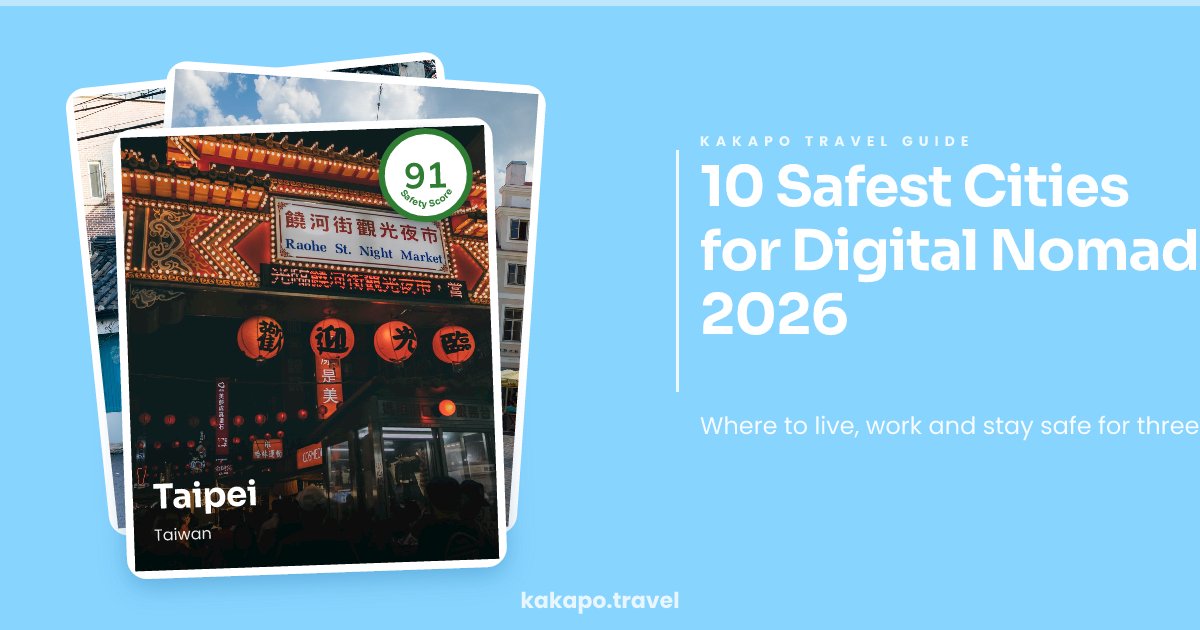
Taipei is the most underrated solo-female-friendly city in Asia. Catcalling is rare, the MRT has women-and-children waiting areas at every platform (marked in pink), and night markets like Raohe and Shilin are welcoming to solo women at any hour.
Stay in Da'an or Zhongshan. Late-night convenience stores are everywhere, and Taiwan has the best 24-hour bookshop chain (Eslite) in Asia — a famously safe solo-night activity.
The MRT's women's waiting areas are well-lit, monitored by CCTV and staffed. Use them late at night.
Even in the safest cities, three habits make a difference:
Share your location with someone at home. WhatsApp's live-location share is free and works internationally.
Use rideshare apps, not street taxis. The driver is logged, the route is tracked, and the fare is fixed.
Trust your instinct. If a situation feels off, leave. The cost of overreacting is nothing; the cost of underreacting can be everything.
Building solo travel confidence
If this is your first solo trip, Tokyo, Helsinki or Reykjavik are the easiest starting points — they're cities where being a solo woman feels invisible in the best possible way. You'll come back having had the holiday you wanted, and you'll be ready for the next one.
Frequently asked questions
What are the top picks in this 10 Cities Solo Female Travellers Recommend 2026 guide?
Kakapo's editorial team ranks 10 destinations in this guide using a composite safety index that weighs personal-safety, transport, healthcare, and night-safety signals from 50+ trusted sources. Tokyo leads at 95/100; see the per-entry score and sub-score breakdown below.
How are the safety scores calculated?
Each city's composite score is a weighted blend of national travel advisories from seven Western foreign ministries (US State Dept, UK FCDO, Canada, Australia, France, Germany, NZ), local crime indices (Numbeo + police-released stats), WHO Global Burden of Disease for healthcare, and air-quality APIs (IQAir, WAQI). Full methodology at https://kakapo.travel/about/methodology.
When was this article last updated?
Last reviewed on 2026-05-28T00:00:00.000Z. The underlying live safety scores recalculate automatically as advisories and incident data change — typically within 24 hours of a new national advisory or refreshed crime-index batch.
Where can I see the live safety report for each city?
Every destination in this guide links to its live safety report on Kakapo. The live report shows real-time sub-scores, current national advisories, emergency contacts, local phrases, and a profile-adjustment view that recalibrates the overall score for solo female, family, LGBTQ+, and elderly traveller profiles.
Is this guide updated for 2026?
Yes — the guide reflects 2026 conditions and is reviewed by the Kakapo editorial team when the safety picture meaningfully changes. Lowest score in this list: Taipei. Per-source weighting and recalculation cadence at https://kakapo.travel/about/methodology.