Asia's best-organised, lowest-crime destinations for travellers
Kakapo Editorial28 May 20269 min readTravel safety
Asia covers more ground, more languages and more travel styles than any other continent — and the gap between its safest cities and its rougher ones is wider than anywhere else. A weekend in Singapore feels like a different planet from a weekend in parts of Manila or Karachi. Knowing where the genuinely-safe cities are matters more here than anywhere else on earth.
We focused on cities you might realistically visit as a tourist or short-term worker: capital cities, major business hubs, established tourist destinations. We did not include cities that are theoretically safe but practically inaccessible (Pyongyang) or that are unsafe in ways that don't show in tourist-area crime stats (Lhasa, Naypyidaw).
What's striking about the 2026 list is how dominated it is by East Asia. Japan and Taiwan each placed two cities; Singapore, South Korea and Hong Kong all made the top 10. The Southeast Asian entries that did make it (Singapore, KL) reflect cities that have invested decades in transit, healthcare and policing infrastructure.
What makes a city safe in Asia specifically
Safety in Asia rewards different things from safety in Europe. Density is higher, traffic is more chaotic, and the language barrier is steeper for non-Asian visitors. We weighted the rankings to reflect that:
Pedestrian safety: road fatalities per capita, presence of pedestrian-only zones, traffic-light compliance.
Transit reliability: metro on-time percentage, English signage coverage, taxi-meter compliance.
Healthcare for foreigners: English-speaking hospital density, average ER wait, insurance acceptance.
Air quality: Asian cities vary wildly here, and PM2.5 levels affect actual day-to-day health far more than crime stats.
01
Singapore
Safety score96/100
Singapore
Personal
97
Transport
96
Healthcare
95
Night Safety
96
Singapore is statistically the safest city on earth. The 2024 homicide rate was 0.13 per 100,000 — lower than any country, let alone any city. The MRT runs to 1am, taxis use meters by law (and Grab is universal), and the public hospitals (Singapore General, Mount Elizabeth) rank among Asia's best.
Stay in Tanjong Pagar, Chinatown or Bugis for easy access to everything. The hawker centres at Maxwell, Lau Pa Sat and Old Airport Road are among the cheapest Michelin-starred meals in the world. English is a first language for most under-50s.
Carry a card — Singapore's transit (EZ-Link) and most hawker stalls now accept contactless payment, but a small amount of cash still helps in older food courts.
Tokyo is the safest huge city in the world. Thirty-seven million people in the metro area, and the most common police report is a lost wallet — which usually gets returned. The Yamanote Line is the loop that connects every neighbourhood you'd want to visit, and Suica/Pasmo IC cards work on every train, bus and convenience store.
Shinjuku for energy, Asakusa for tradition, Shimokitazawa for vintage. The honest watch-out is the bar-touts in Kabukicho and Roppongi — ignore them entirely. Everywhere else in the city you can walk freely at 3am.
Download Google Maps and the official Tokyo Metro app — between them you can navigate any journey without speaking a word of Japanese.
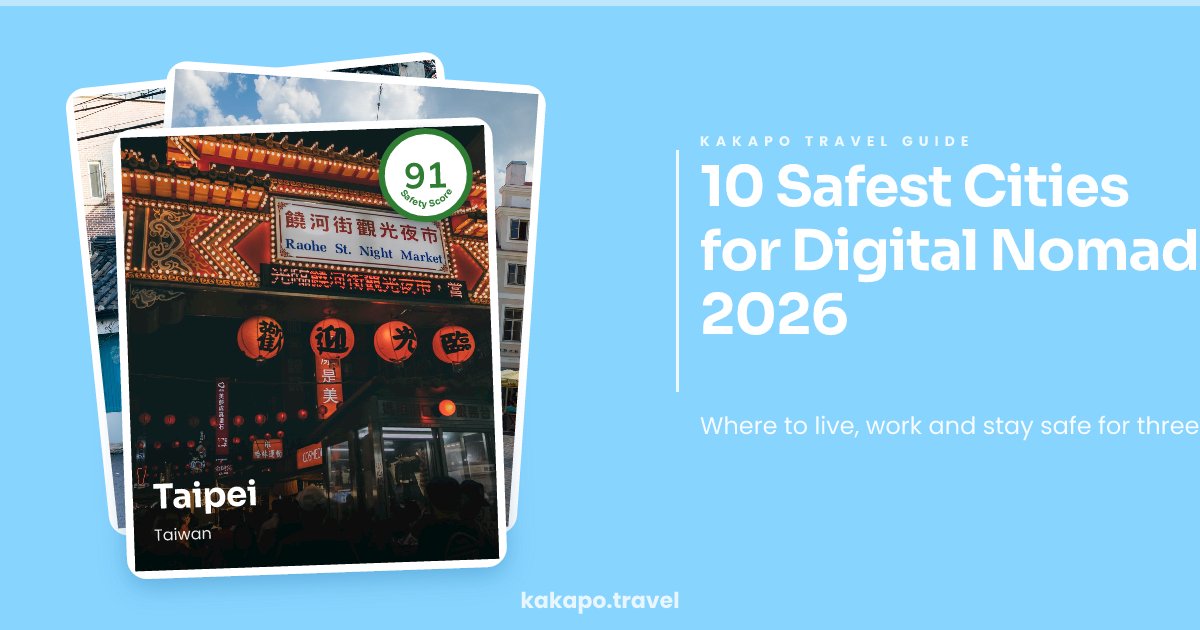
Taipei has quietly become Asia's most liveable major city. The MRT is clean, cheap (NT$20-65 per ride) and runs to midnight. The night markets at Shilin and Raohe are safe for solo visitors at any hour, the National Palace Museum is one of the world's great collections, and the surrounding mountains (Elephant Mountain trail) are 20 minutes from downtown.
Healthcare is exceptional — Taiwan's national system extends to private hospitals that English-speaking tourists can use for under $50 per visit. Crime against tourists is essentially nil.
Get an EasyCard at any 7-Eleven — it works on the MRT, buses, YouBike share bikes, and convenience-store payments.
Seoul's metro is the gold standard — nine numbered lines, English announcements, T-money cards, 24-hour CCTV. The Han River runs through the centre with parks on both banks where Seoulites picnic until late. Crime is low and concentrated in specific late-night areas (Itaewon's busier streets) that are easy to identify and avoid.
Stay in Myeongdong for shopping and access, Hongdae for nightlife, Bukchon for traditional architecture. The Incheon Airport Express to Seoul Station takes 43 minutes and costs ₩9,500.
Korean ER hospitals usually have an English-speaking translator on call — Severance and Samsung Medical Center are the easiest for tourists.
Osaka is Japan's friendliest big city, with food culture (the kuidaore — "eat yourself bankrupt" — tradition) that's worth a trip on its own. The subway is simpler than Tokyo's, the JR Loop Line circles the centre, and the famous Dotonbori canal area is safe and lit through the night.
Stay in Namba or Umeda. The honest watch-out is Shinsekai's late-night bars — fine in daylight, slightly rougher after midnight than the rest of the city, though still safer than most Western capitals.
The Osaka Amazing Pass at ¥2,800 covers all subway and bus travel plus 40 attractions for one day — cheaper than buying tickets separately if you'll see more than three things.
Hong Kong's MTR runs from 6am to 1am, the Octopus card works on essentially everything in the city, and the Peak Tram, Star Ferry and double-decker trams are tourist attractions in their own right. Despite the political headlines of recent years, day-to-day tourist safety remains excellent — police presence is high and street crime is rare.
Stay in Central, Wan Chai or Tsim Sha Tsui for harbour access. Lan Kwai Fong is the nightlife district and gets crowded but well-policed; Mong Kok at night is loud but safe.
Take the Star Ferry from Central to Tsim Sha Tsui at sunset — HK$5 and the best skyline view in Asia.
Kyoto is calmer than Tokyo or Osaka — lower-rise, slower-paced, with the Higashiyama and Gion districts looking as they have for centuries. The Karasuma and Tozai subway lines cover most of what tourists want, and bicycle hire is the easiest way to see Arashiyama and the Philosopher's Path.
Crime is essentially absent, the worst nuisance is over-tourism at Fushimi Inari and Kinkaku-ji during cherry-blossom season. Visit in October-November for the same beauty without the crowds.
Many temples close at 5pm — start sightseeing early and use late afternoon for shopping in the Nishiki Market arcade.
Fukuoka is the Japanese city locals quietly recommend when asked where they'd actually want to live. Smaller than Tokyo (1.6 million), warmer year-round, and home to the famous yatai food stalls along the Naka River. The subway is two lines and easy, Hakata Station connects directly to Shinkansen services nationwide, and the airport is genuinely 10 minutes from downtown.
Crime is low even by Japanese standards. Tenjin is the central shopping area, Nakasu is the nightlife zone (busier but safe), and Ohori Park is the place to walk in the morning.
Try the tonkotsu ramen at Ichiran's Tenjin branch — open 24 hours, individual booths so you can eat alone in peace.
Kuala Lumpur is the most accessible Southeast Asian capital for first-time Asia travellers. English is widely spoken (Malaysia was a British colony), the LRT/MRT/Monorail network covers the central tourist zones, and the food scene (Jalan Alor, Brickfields) is one of the cheapest great cuisines on earth.
The KLCC and Bukit Bintang areas are safe day or night. The honest watch-outs are motorcycle bag-snatchers on quieter streets (walk on the inside of the pavement away from the road) and rare credit-card skimming at standalone ATMs — use bank-branch ATMs only.
Grab is the rideshare app — cheaper and more reliable than street taxis, which often refuse to use the meter.
Yokohama is technically Japan's second-largest city (3.7 million) but feels like Tokyo's calmer harbour-side cousin. The Minato Mirai waterfront has the Cosmo Clock 21 Ferris wheel, the Cup Noodles Museum, and the largest Chinatown in Japan. 25 minutes from Tokyo Station on the JR line.
Crime rates are Tokyo-level, which is to say negligible. The Motomachi shopping street and Yamashita Park are walkable, safe, and a refreshing break from the density of central Tokyo.
Spend a half-day here as a Tokyo day-trip — the harbour at sunset is one of the best views in the Kanto region.
Bangkok, Bali, Hanoi and Bali didn't make the cut, despite being some of the most-visited destinations in Asia. They're not unsafe — Bangkok in particular is far safer than its reputation suggests — but they have higher rates of road accidents, tourist scams and water-quality issues than the cities above. A list called "safest" has to mean something.
Mumbai, Delhi, Karachi, Manila and Jakarta also didn't make it, for similar reasons. They're cities worth visiting, but they require more situational awareness than a typical first-time Asia traveller has.
The Asia learning curve
If this is your first trip to Asia, start with Singapore, Tokyo or Taipei. The combination of safety, English-friendliness and infrastructure quality is unmatched anywhere on the continent. By your third or fourth trip, you'll feel comfortable expanding to the cities that didn't make this list. By your tenth, you'll wonder why you ever worried in the first place.
Frequently asked questions
What are the top picks in this 10 Safest Cities in Asia 2026 guide?
Kakapo's editorial team ranks 10 destinations in this guide using a composite safety index that weighs personal-safety, transport, healthcare, and night-safety signals from 50+ trusted sources. Singapore leads at 96/100; see the per-entry score and sub-score breakdown below.
How are the safety scores calculated?
Each city's composite score is a weighted blend of national travel advisories from seven Western foreign ministries (US State Dept, UK FCDO, Canada, Australia, France, Germany, NZ), local crime indices (Numbeo + police-released stats), WHO Global Burden of Disease for healthcare, and air-quality APIs (IQAir, WAQI). Full methodology at https://kakapo.travel/about/methodology.
When was this article last updated?
Last reviewed on 2026-05-28T00:00:00.000Z. The underlying live safety scores recalculate automatically as advisories and incident data change — typically within 24 hours of a new national advisory or refreshed crime-index batch.
Where can I see the live safety report for each city?
Every destination in this guide links to its live safety report on Kakapo. The live report shows real-time sub-scores, current national advisories, emergency contacts, local phrases, and a profile-adjustment view that recalibrates the overall score for solo female, family, LGBTQ+, and elderly traveller profiles.
Is this guide updated for 2026?
Yes — the guide reflects 2026 conditions and is reviewed by the Kakapo editorial team when the safety picture meaningfully changes. Lowest score in this list: Yokohama. Per-source weighting and recalculation cadence at https://kakapo.travel/about/methodology.