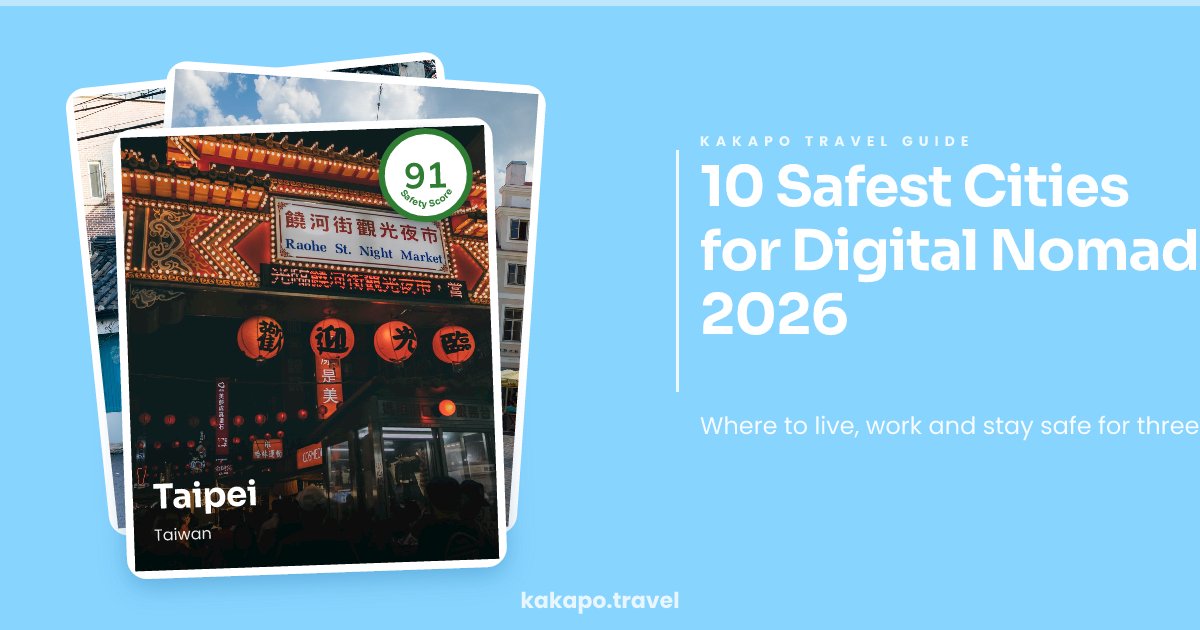
Where to live, work and stay safe for three months or more
Kakapo Editorial28 May 20269 min readTravel safety
Digital nomads have different safety needs from holidaymakers. A weekend in Lisbon is one thing; three months living in a co-working space, opening a local bank account, walking the same streets at 11pm every night is another. Long-stay safety depends on infrastructure, predictability and the boring details of healthcare access.
We ranked cities on the criteria nomads actually care about: low crime, reliable internet (250+ Mbps as baseline), affordable healthcare, visa accessibility for remote workers, and the existence of a real expat community to lean on when things go wrong.
The 2026 list reflects two big trends: the rise of Asian and Latin American cities with formal digital nomad visas, and the continued dominance of a few quiet European capitals that have invested in remote-work infrastructure.
What digital nomads should weigh
Beyond raw safety, these are the metrics that make a city work for a 90-day-plus stay:
Visa pathway: does the country offer a digital nomad visa or a workable long-stay tourist allowance?
Internet reliability: uptime, average speed, café and co-working coverage.
Healthcare cost: out-of-pocket for a basic GP visit, ER access for non-residents.
Banking accessibility: can you open a local account or use a Wise/Revolut card without friction?
Community presence: number of co-working spaces, English-speaking expat groups, regular meetups.
01
Lisbon
Safety score84/100
Portugal
Personal
80
Transport
86
Healthcare
87
Night Safety
82
Lisbon has been Europe's number-one nomad destination for five years and the 2026 infrastructure backs it up. Portugal's D8 digital nomad visa is now one of the easiest in Europe, fibre internet (1Gbps) is standard, and the co-working scene (Second Home, Heden, Cowork Central) is the most developed on the continent.
Stay in Príncipe Real, Chiado or LX Factory. The honest watch-out is pickpocketing in tourist areas and on Tram 28 — the only real safety blip in an otherwise excellent city.
Bairro Alto is fun but loud at night — pick Estrela or Campo de Ourique if you need quiet for early calls.
Estonia invented the digital nomad visa concept and Tallinn remains the most efficient European city for setting up a remote-work life. E-Residency lets you start an EU company online; the digital nomad visa allows up-to-12-month stays for remote workers.
Internet is among the world's fastest (Estonia averages 280+ Mbps). Crime is negligible, the old town is small enough to live in, and the Telliskivi creative quarter has the best coworking density per capita in Europe.
Apply for E-Residency before you arrive — it makes opening accounts, signing contracts and registering a business dramatically easier.
Taipei is the rising star of Asian nomad cities. Taiwan launched its Employment Gold Card in 2018, which gives professionals a 1-3 year work visa with no employer needed. Internet is fast, English-friendly coworking spaces (CLBC, Plan b) are growing, and healthcare is exceptional value (a GP visit costs under $20 out of pocket).
Stay in Da'an or Xinyi for the best café-and-coworking density. The MRT covers everything, food is among the cheapest in developed Asia, and crime against foreigners is essentially zero.
The Gold Card application takes 30-60 days — apply at least three months before your planned move.
Mexico City is the highest-scoring Latin American nomad destination thanks to enormous improvements in safety in central neighbourhoods over the last decade. The Roma Norte and Condesa areas are now the most concentrated expat zones in the Americas, with fibre internet, excellent food and walkable streets.
The honest watch-out: stay in Roma, Condesa, Polanco, Coyoacán or Juárez. Outside these zones safety drops noticeably. Use Uber/Didi everywhere — they're cheap and reliable.
Mexico's tourist visa allows up to 180 days on entry — most nomads use this rather than the formal Temporary Resident process for first stays.
Chiang Mai remains the most affordable serious nomad city in the world. Co-working spaces (Punspace, Yellow, Alt_ChiangMai) are everywhere, cost of living is a third of European prices, and Thailand's new Long-Term Resident visa offers up to 10 years for qualifying remote workers.
Crime against foreigners is rare. Air quality is the biggest health concern — March-April "burning season" has dangerous PM2.5 levels, plan to leave the city during those months.
Nimmanhaemin (Nimman) is the central nomad neighbourhood; Old City is quieter and has more traditional Thai feel.
Seoul launched a Workation Visa (F-1-D) in 2024 for remote workers and the response from the nomad community has been strong. The metro is world-class, café-coworking density in Hongdae and Gangnam is enormous, and internet speeds are the world's fastest (averaging 270 Mbps fixed, 200+ Mbps mobile).
Cost is higher than Southeast Asia but lower than Tokyo. Healthcare is excellent and affordable (a clinic visit averages $30-50). Crime is negligible.
Korean cafés expect you to buy something every couple of hours — Starbucks and Coffee Bean are the most laptop-friendly chains.
Spain's digital nomad visa (launched 2023) is now one of Europe's most generous — up to 5 years with a clear path to permanent residency. Barcelona has the largest expat coworking scene in southern Europe, fibre internet is universal, and the Mediterranean lifestyle is hard to beat.
The honest watch-out is pickpocketing — Barcelona has the worst petty crime rate of any city on this list. Use a money belt, keep your phone secure, and avoid the Ramblas after midnight.
Stay in Gràcia, Eixample or Sant Antoni for the best mix of safety, walkability and café density.
Georgia offers a one-year visa-free stay for citizens of 95+ countries, no application required. Tbilisi has become a major destination for budget-conscious nomads, with €400-700 monthly apartments, fast fibre, and a growing coworking community in the Vake and Vera neighbourhoods.
Safety in the centre is excellent. The honest watch-out is winter air quality in some neighbourhoods, and taxi drivers occasionally trying to overcharge — use Bolt instead.
Georgia uses the Bank of Georgia and TBC Bank for foreigner-friendly accounts — both let nomads open accounts within 24 hours.
Buenos Aires has rebounded as a top nomad destination as Argentina's economic situation has made it extremely affordable for foreign-currency earners. Palermo and Recoleta are the safe expat neighbourhoods; the café-and-coworking scene is excellent.
Crime in central tourist neighbourhoods is moderate but predictable — phone-snatching is the main risk. Healthcare quality at private hospitals (Hospital Aleman, British Hospital) is excellent and very affordable.
Use the 'blue dollar' exchange — Argentina's official rate is far worse than the parallel rate, and apps like Western Union give you closer to market value.
Ljubljana is the underrated nomad capital of Central Europe — Slovenia is in the Schengen Area and the EU, but cost of living is 40% lower than Vienna or Munich. Slovenia launched a Digital Nomad Visa in late 2024 for up-to-one-year stays.
The city is small (under 300,000), the river-and-castle centre is pedestrianised, and the café-coworking scene (ABC Accelerator, Coworking Centre) is sized for the community. Crime is minimal.
Lake Bled is an easy weekend trip — 50 minutes by bus from Ljubljana and one of the prettiest spots in Europe.
Living somewhere for three months is different from visiting it for three days. The boring infrastructure matters more:
Get proper insurance. SafetyWing, Genki and IMG are the most-used nomad plans — pick one that covers your destination and includes evacuation.
Open a local bank account where possible. Wise and Revolut cover most situations but local rent and utilities sometimes need a domestic IBAN.
Join a local nomad community before you arrive. Nomad List, the local Slack/Discord, or Facebook groups — they're the fastest path to safe neighbourhoods, trustworthy landlords and the right hospital.
Picking your base
If you want maximum infrastructure: Lisbon, Tallinn or Seoul. If you want affordability: Chiang Mai, Tbilisi or Buenos Aires. If you want quiet European safety: Ljubljana or Tallinn. Whichever you pick, you're choosing a city that's been pressure-tested by thousands of remote workers before you.
Frequently asked questions
What are the top picks in this 10 Safest Cities for Digital Nomads 2026 guide?
Kakapo's editorial team ranks 10 destinations in this guide using a composite safety index that weighs personal-safety, transport, healthcare, and night-safety signals from 50+ trusted sources. Lisbon leads at 84/100; see the per-entry score and sub-score breakdown below.
How are the safety scores calculated?
Each city's composite score is a weighted blend of national travel advisories from seven Western foreign ministries (US State Dept, UK FCDO, Canada, Australia, France, Germany, NZ), local crime indices (Numbeo + police-released stats), WHO Global Burden of Disease for healthcare, and air-quality APIs (IQAir, WAQI). Full methodology at https://kakapo.travel/about/methodology.
When was this article last updated?
Last reviewed on 2026-05-28T00:00:00.000Z. The underlying live safety scores recalculate automatically as advisories and incident data change — typically within 24 hours of a new national advisory or refreshed crime-index batch.
Where can I see the live safety report for each city?
Every destination in this guide links to its live safety report on Kakapo. The live report shows real-time sub-scores, current national advisories, emergency contacts, local phrases, and a profile-adjustment view that recalibrates the overall score for solo female, family, LGBTQ+, and elderly traveller profiles.
Is this guide updated for 2026?
Yes — the guide reflects 2026 conditions and is reviewed by the Kakapo editorial team when the safety picture meaningfully changes. Lowest score in this list: Ljubljana. Per-source weighting and recalculation cadence at https://kakapo.travel/about/methodology.