Where your wallet, your phone, and your suitcase are all where you left them
Kakapo Editorial28 May 20268 min readTravel safety
Violent crime against tourists is mercifully rare almost everywhere. Petty crime — pickpocketing, bag-snatching, scams in tourist queues — is the actual texture of travel-safety problems for most visitors most of the time. It's also the thing that ruins more holidays than any other category. Losing a phone on day two of a ten-day trip isn't dangerous, but it's exhausting in a way that lingers.
Some cities have effectively solved the petty-crime problem. Whether through culture, surveillance, policing, or some combination, you can walk through their main squares with a phone in your hand and a backpack open at the top, and nothing will happen. We ranked the ten where the data and the lived experience both back this up.
If you're tired of the low-grade paranoia that defines tourist trips to Rome, Paris or Barcelona, this is your list.
What "low petty crime" actually means
We focused on a specific subset of the crime statistics:
Pickpocketing reports per 100,000 visitors — not residents.
Bag-snatching and grab-and-run incidents in tourist zones.
Recovery rate of stolen property — a proxy for how seriously the police take it.
Resident behaviour — do locals leave bags unattended in cafés? It's the best behavioural test there is.
01
Tokyo
Safety score97/100
Japan
Personal
96
Transport
96
Healthcare
88
Night Safety
92
Tokyo's lost-and-found system is famous for a reason. Phones, wallets, even cash get returned at rates that boggle non-Japanese minds. The cultural baseline is that taking what isn't yours is shameful in a way most cultures have forgotten. Pickpocketing is so rare that it makes the news.
You'll see locals reserve café tables by leaving a phone or a laptop on the chair while they go to order. It's not naive — it's accurate.
If you do lose something, go to the nearest koban (police box). Even cash often shows up.
Singapore's combination of strict laws, omnipresent CCTV, and high baseline trust means petty crime is statistically vanishing. The MRT, hawker centres, and shopping streets are effectively risk-free for the standard tourist.
If you forget your bag at a café, you'll probably come back to find it exactly where you left it.
Iceland's small population and tight social fabric mean petty crime is rare in a way that bears almost no relation to the warnings you'd get in any European capital. Babies in prams are routinely left outside cafés while parents eat inside. Phones on tables. Bikes unlocked.
Tourist-targeted petty crime exists at low levels in summer, mostly around the busy Laugavegur shopping street. It's still well below European norms.
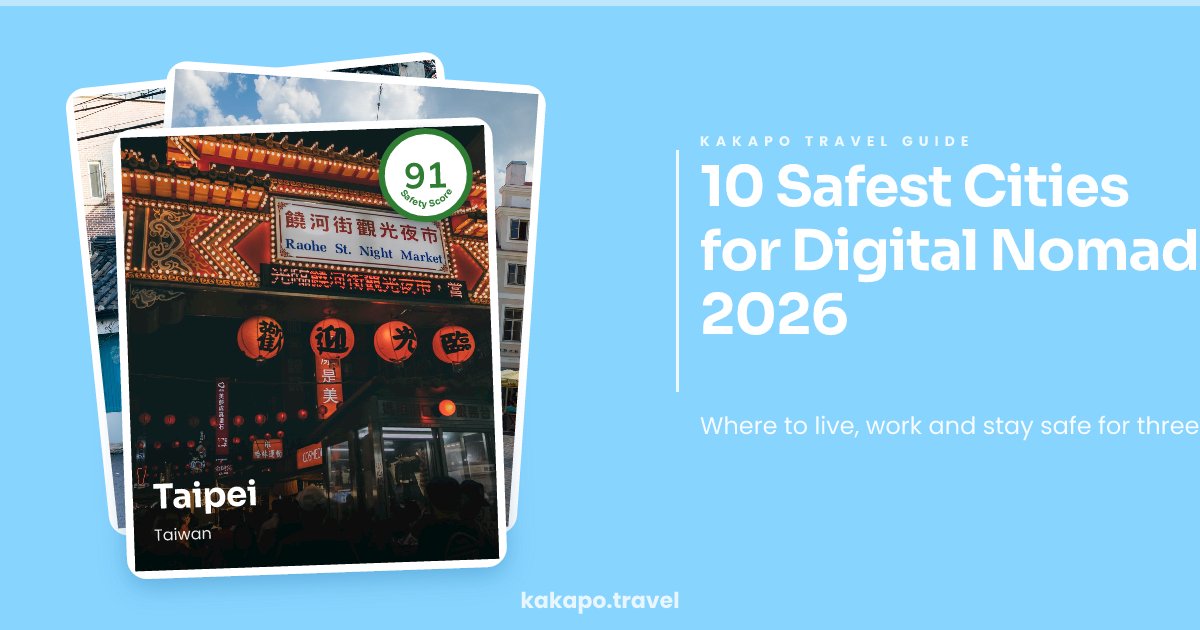
Taipei's MRT is spotless, its night markets are packed but theft-free, and the city's polite social baseline extends to a near-absence of pickpocketing. The 7-Elevens that dot every street corner double as informal safety stations — staff will help with lost items, lost tourists, or lost confidence.
Cash is widely used; nobody seems to mind. Carry it with normal sensible care and you'll have no problems.
Abu Dhabi has effectively eliminated petty street crime through a combination of strict policing, ubiquitous CCTV, and a small, monitored population. The Corniche, Saadiyat Cultural District, and downtown souks are safe for unattended bags in a way that would be unthinkable in most capitals.
Dubai is similar but more tourist-saturated; Abu Dhabi is the quieter, even-safer cousin.
Oman's social fabric — and the country's deep tradition of hospitality toward guests — make petty crime in Muscat extremely rare. The Mutrah Souk is busy and friendly without the scam-density of comparable Middle Eastern souks.
The honest tradeoff: Muscat is quieter and less buzzy than Dubai. For low-crime ease, that's a feature.
Seoul's combination of dense surveillance, a culture of leaving phones to reserve café seats, and active policing in tourist zones (Myeongdong, Hongdae, Gangnam) makes it one of the lowest-pickpocket cities in any major capital league.
Late-night Hongdae has the only consistent uptick — rare incidents, but worth a small extra vigilance around 3am bar exits.
Zurich's Bahnhofstrasse, one of the most expensive shopping streets in the world, has remarkably low pickpocketing rates — the Swiss social baseline of not stealing extends even to the most theft-tempting environment in the country.
Petty crime exists, mostly clustered around the main station at night, but the rate is a fraction of comparable Western European cities.
Ljubljana's small size and pedestrianised centre make it almost theft-immune. The riverside cafés, the Triple Bridge area, and the castle hill all see negligible pickpocketing. Locals leave bikes unlocked and phones on tables.
Easily Europe's lowest-crime capital for visitors in 2026.
Osaka is Japan's rowdier cousin, and it shows in slightly higher petty-crime numbers — but "slightly higher than Tokyo" still means "absurdly low by global standards." Dotonbori, the famous food strip, is packed nightly without significant theft. The metro is safe, the lost-and-found is reliable.
Avoid the Shinsekai area late at night for the only neighbourhood with anything resembling petty-crime concern.
Cities you'd think would be on this list but aren't
Some perennial "safe" cities have surprisingly high petty crime, mostly because they're so tourist-dense:
Barcelona — pickpocket capital of Western Europe by most counts. The Rambla alone accounts for tens of thousands of reports per year.
Paris — the Eiffel Tower, the Metro Line 1, the Louvre queue. All petty-crime hotbeds, despite the country's overall low violent crime.
Rome — the public transport pickpocketing is so well-organised it has its own academic studies. Buses 64 and 40 to the Vatican are the worst.
Prague — the Charles Bridge and Old Town Square see steady pickpocket activity in tourist season.
Habits that protect you anywhere
Even on this list, complacency creates the rare incident. Keep these habits and you'll go years without losing anything:
Phone in zipped front pocket, never back pocket. Never on a café table when you stand to leave.
Backpack to the front in any crowded transit or queue.
Photograph important documents and store the copies in cloud — passport, insurance card, the front of any prescription you carry.
Carry two cards in two different places. If one is lost or skimmed, the trip continues.
Frequently asked questions
What are the top picks in this 10 Cities With the Lowest Petty Crime 2026 guide?
Kakapo's editorial team ranks 10 destinations in this guide using a composite safety index that weighs personal-safety, transport, healthcare, and night-safety signals from 50+ trusted sources. Tokyo leads at 97/100; see the per-entry score and sub-score breakdown below.
How are the safety scores calculated?
Each city's composite score is a weighted blend of national travel advisories from seven Western foreign ministries (US State Dept, UK FCDO, Canada, Australia, France, Germany, NZ), local crime indices (Numbeo + police-released stats), WHO Global Burden of Disease for healthcare, and air-quality APIs (IQAir, WAQI). Full methodology at https://kakapo.travel/about/methodology.
When was this article last updated?
Last reviewed on 2026-05-28T00:00:00.000Z. The underlying live safety scores recalculate automatically as advisories and incident data change — typically within 24 hours of a new national advisory or refreshed crime-index batch.
Where can I see the live safety report for each city?
Every destination in this guide links to its live safety report on Kakapo. The live report shows real-time sub-scores, current national advisories, emergency contacts, local phrases, and a profile-adjustment view that recalibrates the overall score for solo female, family, LGBTQ+, and elderly traveller profiles.
Is this guide updated for 2026?
Yes — the guide reflects 2026 conditions and is reviewed by the Kakapo editorial team when the safety picture meaningfully changes. Lowest score in this list: Osaka. Per-source weighting and recalculation cadence at https://kakapo.travel/about/methodology.