Where you can travel comfortably without speaking a word of the local language
Kakapo Editorial28 May 20268 min readTravel safety
There's a particular relief that comes with stepping off a plane in a country where you don't speak the language, asking a stranger for directions, and having them respond in fluent English. Language safety isn't strictly safety — but it's adjacent. Getting lost, needing a pharmacy, calling a taxi, dealing with a problem at the hotel: all of it gets dramatically easier when you can be understood.
We pulled the EF English Proficiency Index for every city with reliable data, cross-referenced with hotel-staff English fluency surveys and the percentage of public-transit signage in English. The list below shows the ten cities (outside the UK, Ireland, US, Canada, Australia and New Zealand) where you can travel most easily in English.
Spoiler: the Nordics dominate, the Netherlands punches above its weight, and one Asian city quietly beats most of Europe.
What we measured
English-friendliness is more than just "do people speak English." We weighted these factors:
EF EPI score: the standard global English proficiency ranking.
Transit signage: are bus stops, metro maps, train announcements in English?
Emergency English: can you call 112/911 and reach an English speaker?
Generational spread: is English just an under-30 thing, or also under-60?
01
Amsterdam
Safety score95/100
Netherlands
Personal
86
Transport
91
Healthcare
91
Night Safety
84
The Netherlands has the highest non-native English proficiency in the world (EF EPI #1 globally). In Amsterdam, virtually every adult under 60 speaks fluent, confident English. Restaurant menus, museum signs, hotel staff, supermarket cashiers — all in English without effort.
Dutch people often switch to English the moment they detect even a slight foreign accent. The honest curiosity: this can mean it's hard to actually practise Dutch.
Don't apologise for not speaking Dutch — locals genuinely don't mind and often prefer English with visitors.
Denmark ranks #4 on the EF EPI globally and Copenhagen is the easiest Nordic city for English speakers. Restaurant servers often hand you the English menu first, the metro and trains use English announcements alongside Danish, and bank, hospital and government services all operate in English on request.
English-language films are subtitled, not dubbed, which has produced a population that's grown up listening to English from childhood.
Pharmacies (Apotek) all have English-speaking pharmacists — the green cross sign is universal.
Sweden's English proficiency (EF EPI #5 globally) is excellent across all age groups. Stockholm's public services, hospitals and transit all run in English alongside Swedish. The SL transit website is fully English-language; ATMs default to English.
Swedes are reserved compared to the Dutch but equally fluent.
Konsum and ICA supermarkets have English-labelled food in tourist areas — handy for allergies.
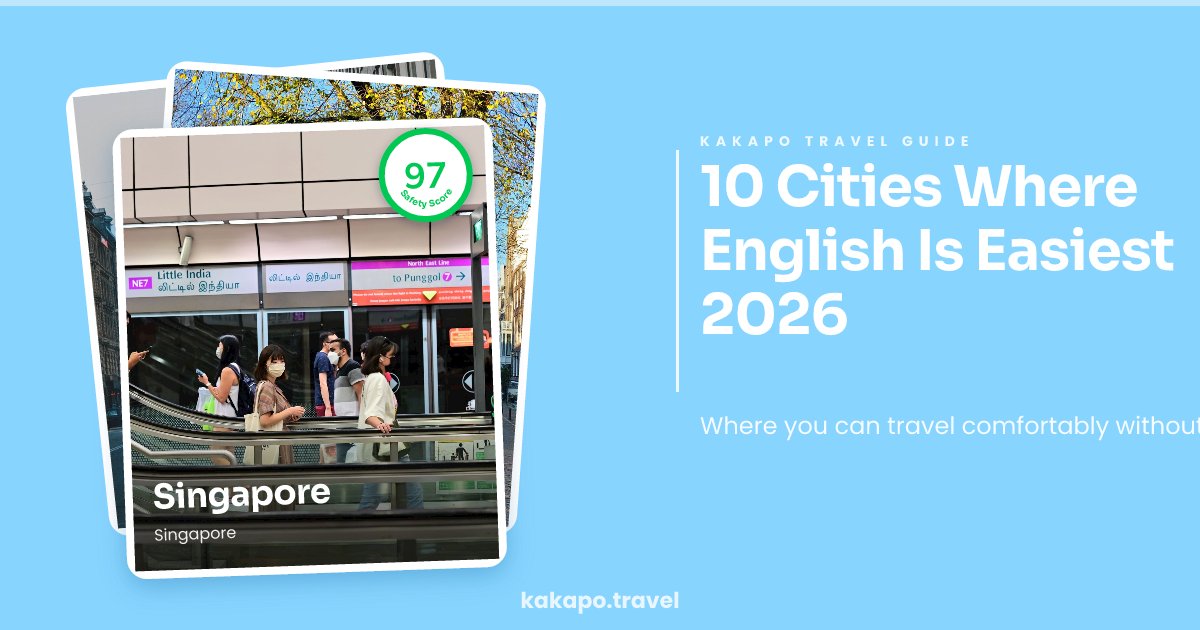
Singapore is the only non-Western-Anglo city in the world where English is a first language for the majority of the population. All signage, government services, school lessons, and most workplaces operate in English. The local variety ("Singlish") borrows from Malay, Hokkien, and Tamil but is fully mutually intelligible with international English.
Singapore English is your most natural-feeling Asian travel destination — no language barrier at all.
Norway ranks #3 globally on the EF EPI. Oslo's hotels, restaurants and tourist services run as smoothly in English as in Norwegian. The T-bane metro, ferries to Bygdøy and the airport express all announce stops in both languages.
Norwegians often answer questions completely (with options and alternatives) — ask once, don't repeat unless something's unclear.
Finland is #6 on the EF EPI. Helsinki's transit, hotels and restaurants all operate confidently in English. Public signage is trilingual in central Helsinki (Finnish, Swedish, English). Hospital ER staff have English-language protocols.
Finns may seem quiet but they're highly fluent — give them a moment to respond rather than rushing.
Austria's English proficiency ranks #8 globally and Vienna is the highest-fluency German-speaking capital. Hotels, restaurants, museums and the U-Bahn all operate easily in English. Younger Austrians (under 40) are essentially fluent.
Vienna's tourist information offices (especially the main one at Albertinaplatz) have multilingual staff and are excellent for questions.
Berlin is significantly more English-friendly than the rest of Germany. The startup-and-creative scene means under-40 Berliners are often more comfortable in English than older Germans. Restaurants in Mitte, Kreuzberg and Friedrichshain typically have English menus.
Outside the city centre, English fluency drops — useful to know if you go on day-trips to smaller German towns.
The Philippines is officially bilingual (Filipino and English) and ranks #18 on the EF EPI — exceptionally high for Asia. All signage, education, government services and most workplaces use English. The Manila call-centre industry employs hundreds of thousands of fluent English speakers.
Manila's safety scores are lower than other cities on this list — stick to Makati, BGC (Bonifacio Global City) and Ortigas neighbourhoods. Within those, English-friendliness is excellent.
Stay in BGC for the safest combination of English-fluent environment and modern infrastructure.
Slovenia ranks #9 globally on the EF EPI — far higher than its better-known neighbours. Ljubljana is small enough that you'll encounter English-fluent locals everywhere: at cafés, at the tourist information centre, in shops, on trams.
Young Slovenes are essentially native-fluent in English thanks to non-dubbed media and strong school programmes.
The tourist information office near the Triple Bridge has free English-language maps and excellent recommendations.
Outside the Nordics, Netherlands, and Singapore, English fluency drops sharply once you leave the major capital cities. If you're planning to travel rurally in France, Italy, Spain or Eastern Europe, Google Translate offline mode is worth installing before departure. Most countries on this list are exceptions, not the rule.
The travel benefit of confidence
Being able to speak the language confidently isn't strictly about avoiding problems — it changes how you experience the trip. You ask better questions, you have spontaneous conversations, you understand the news on TV in the hotel lobby. The cities above all give you that confidence within an hour of arriving.
Frequently asked questions
What are the top picks in this 10 Cities Where English Is Easiest 2026 guide?
Kakapo's editorial team ranks 10 destinations in this guide using a composite safety index that weighs personal-safety, transport, healthcare, and night-safety signals from 50+ trusted sources. Amsterdam leads at 95/100; see the per-entry score and sub-score breakdown below.
How are the safety scores calculated?
Each city's composite score is a weighted blend of national travel advisories from seven Western foreign ministries (US State Dept, UK FCDO, Canada, Australia, France, Germany, NZ), local crime indices (Numbeo + police-released stats), WHO Global Burden of Disease for healthcare, and air-quality APIs (IQAir, WAQI). Full methodology at https://kakapo.travel/about/methodology.
When was this article last updated?
Last reviewed on 2026-05-28T00:00:00.000Z. The underlying live safety scores recalculate automatically as advisories and incident data change — typically within 24 hours of a new national advisory or refreshed crime-index batch.
Where can I see the live safety report for each city?
Every destination in this guide links to its live safety report on Kakapo. The live report shows real-time sub-scores, current national advisories, emergency contacts, local phrases, and a profile-adjustment view that recalibrates the overall score for solo female, family, LGBTQ+, and elderly traveller profiles.
Is this guide updated for 2026?
Yes — the guide reflects 2026 conditions and is reviewed by the Kakapo editorial team when the safety picture meaningfully changes. Lowest score in this list: Ljubljana. Per-source weighting and recalculation cadence at https://kakapo.travel/about/methodology.