


Is Lugano, Switzerland Safe? A 2026 Travel Safety Guide
Lugano is among Europe's safest cities. The honest concerns: cost, the Mt San Salvatore + Brè cable cars, Italy-border crossings, lake swimming, and thunderstorms.

Lugano is among Europe's safest cities. Violent crime against tourists is essentially zero. The realistic concerns are practical: Swiss-baseline cost (one of Europe's highest, marginally below Zurich); the cable cars up Mt San Salvatore (912 m) + Mt Brè (925 m) and the funicular alongside (vertigo + altitude both factor); the Italy-border crossings at Chiasso (15 km south) + Ponte Tresa (15 km west) that catch out tourists with rental cars; lake swimming with boat traffic + cold-shock at depth; and dramatic summer thunderstorms over the Pre-Alps.
Switzerland sits at Level 1 on the US State Department's advisory list. UK FCDO carries no specific warning. The honest framing for visitors: Lugano is the largest city in Italian-speaking Ticino canton (~63,000 in city, 150,000 metro). It feels Mediterranean — palm trees, lake, Italian language — but operates Swiss (transport precision, prices, infrastructure). Day-trip options stretch from Como (45 min south by car), Bellinzona (30 min north), Locarno (45 min north).
The defining experiences: the lakefront + Piazza della Riforma, Mt San Salvatore funicular + summit, Mt Brè cable car + summit, the LAC arts + culture centre, Parco Ciani, ferry crossings to Gandria + Morcote, and day trips to Bellinzona's UNESCO castles.
Lugano's particular identity sits at the geographical hinge of two cultures: Italian is the dominant working language (locals will switch to German or English easily), the food culture is Lombard (pizzoccheri, polenta e brasato, lake fish), and the post-office hours feel southern — but trains run to the minute, the lake-boat fleet adheres to a timetable a Swiss clock would respect, and the franc-zone prices match Zurich more than Como. The Ceneri Base Tunnel (opened December 2020) cut the Zurich-Lugano journey to 2 hours and reshuffled the city's commuter map; Lugano is now a 1h commute from Milan and a 2h commute from Zurich, making it the only Swiss city in routine reach of both metro orbits.
The Ticino Ticket — free with any hotel, B&B or hostel stay in canton Ticino — covers all regional buses, trains and most lake-boats. Use it. The economics of Lugano change when you treat the Ticino Ticket as the default fare instrument: Como (45 min train), Bellinzona's three UNESCO castles (35 min train), Locarno (50 min) and Morcote (40 min by SNL lake-boat) all become free public-transport day-trips rather than rental-car expenses.
| Night safety | 91/100 |
|---|---|
| Scam / petty-crime risk | Low |
| Violent crime (tourists) | Low |
| Safer neighbourhoods | Centro storico, Lakefront promenade, Parco Ciani |
| Data sources cited | 4 |
| Last verified |
What the score means — 94/100
- Personal safety (94) — among Europe's lowest crime rates.
- Transport (92) — Trenord + SBB rail + lake boats + funicular + buses.
- Air quality (90) — alpine valley; high.
- Healthcare (90) — Ospedale Civico Lugano is a leading regional hospital.
Swiss prices in Italian Switzerland

- Currency: Swiss franc (CHF). Many places near Italy border accept euros at poor rates — pay in CHF.
- Coffee: CHF 4-6.
- Casual lunch: CHF 22-35 ("piatto del giorno" deal CHF 18-25).
- Dinner midrange: CHF 50-90/person.
- Hotels: CHF 200-450/night for 3-4 star.
- Tipping: not required.
- Tap water: free, excellent.
- Cards: universal; many places card-only.
- The supermarket trick: lunch from Migros or Coop CHF 12-15 vs CHF 30 at a café.
San Salvatore + Brè cable cars
- Mt San Salvatore (912 m): funicular from Paradiso (south Lugano). CHF 39 round trip. 12 min ride.
- Top experience: 360° lake view; the rooftop walk has a glass section + parapets.
- Mt Brè (925 m): funicular from Cassarate (east Lugano). CHF 27 round trip.
- Top experience: village + Wilhelm Schmid museum + restaurant.
- Vertigo: the funiculars are gentle compared to sheer-drop cable cars; both are accessible to most.
- Walking down: 1.5-2h on marked paths. Knee-punisher.
- Operating hours: ~9am-11pm summer; reduced winter.
- Closures: weather-related; lightning closes both.
Italy-border crossings + day trips
- Chiasso (south): 15 km. Schengen — no passport check normally; spot checks possible.
- Ponte Tresa (west): 15 km. Italian-Swiss border village; cross to Italy on the south side.
- Como: 45 min by car; trains via Chiasso 1h, ~CHF 17.
- Milan: 1h by SBB-Trenord direct; CHF 30-40.
- Currency at border: euros + francs both accepted; pay in local for best rate.
- Driving: Italian rental cars allowed in Switzerland (vignette CHF 40 needed); Swiss rental cars fine in Italy.
- Smuggling: not your problem — don't carry packages for strangers; cigarette/alcohol limits real.
Lake Lugano + swimming
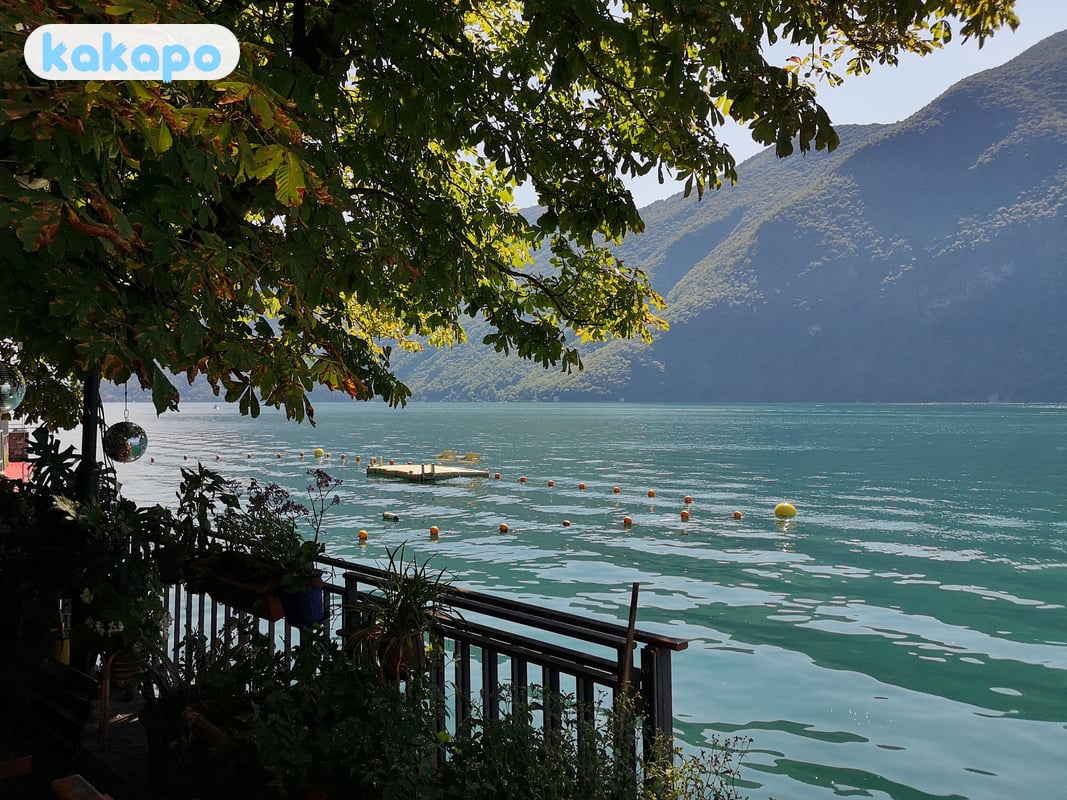
- The lake: 35 km long, deep alpine lake. Surface 21-24°C in summer; cold below 5 m.
- Lido di Lugano: paid lake-pool complex; CHF 12 entry. Lifeguarded.
- Free public swim: Parco Ciani + several lake-points. Less monitored.
- Boat traffic: lake boats (SNL) + private craft. Swim at the badi/Lido, not in the open fairway.
- Cold-shock at depth: real even in August; enter slowly.
- Currents: gentle; lake outflow is minor.
- Don't drink + boat: same blood-alcohol law on water.
Weather + summer thunderstorms
- Summer (June-August): 25-32°C standard, 35°C+ in heatwaves. Mediterranean-feel.
- Winter (Dec-Feb): 0-7°C; snow uncommon at lake-level but possible at Brè/San Salvatore.
- Summer thunderstorms: dramatic afternoon storms over the Pre-Alps. Lightning closes cable cars; lakeside shelter.
- Best months: April-October.
- Hot days: lake breeze keeps it tolerable; cable-car summit 5-7°C cooler.
Trains, buses, the airport
- Lugano Airport (LUG): 6 km west; tiny, mostly seasonal.
- Milan Malpensa (MXP): 50 km south; main international. Direct Lugano Service Express bus CHF 25, ~1h.
- Zurich (ZRH): 220 km north; SBB train Zurich ↔ Lugano 2h, CHF 79.
- Trains via Gotthard tunnel: Lugano ↔ Zurich 2h via the Ceneri base tunnel.
- City buses (TPL): CHF 2.30 single.
- Lake boats (SNL): included with the Swiss Travel Pass + Ticino Ticket.
- Ticino Ticket: free with hotel stay; covers public transport region-wide.
Neighbourhoods, day-trips and the Como/Milan rail link
- Centro storico + Piazza della Riforma — the pedestrianised old core around Via Nassa and the cathedral. Cafés on the Riforma run CHF 5-7 for an espresso (one street back drops to CHF 3-4); the LAC arts-and-culture centre and the Cattedrale San Lorenzo anchor the edges. Lively until midnight, quiet by 1am.
- Lakefront promenade + Parco Ciani — the 3 km waterfront from Paradiso through the Riforma to the Foce del Cassarate. Free, palm-tree-lined, with the Ciani villa-park, the Museo d'arte della Svizzera italiana, and ferry pontoons (SNL "Imbarcadero Centrale" is the main hub). Routine sunset walk.
- Mt San Salvatore — 912 m above the lake, funicular from Paradiso station (CHF 39 round trip, 12 min ride, last train ~11pm summer / 5pm winter). 360-degree summit terrace with glass-floor section. The hike down is 1.5-2 hours on marked paths but knee-punishing for casual walkers.
- Mt Brè + Brè village — 925 m east of the city, funicular from Cassarate (CHF 27 round trip). Tiny artists' village at the top, Wilhelm Schmid museum, summit restaurant. Quieter than San Salvatore.
- Paradiso — south of the centre along the lake, the cluster of larger hotels (Splendide Royal, Villa Castagnola), the casino, and the San Salvatore base station. Walkable to the centre in 15 minutes along the promenade.
- Gandria + Castagnola — east-side fishing villages reachable by SNL lake-boat (20-30 min) or the Sentiero dell'Olivo footpath. Gandria is the postcard cliff-village; Castagnola has the Villa Heleneum.
- Morcote (south end of the lake) — the photogenic peninsula village 40 min by lake-boat or 20 min by car. Steep stone-step climb to the Santa Maria del Sasso church, the Scherrer Park subtropical garden.
- Bellinzona day-trip — three UNESCO castles (Castelgrande, Montebello, Sasso Corbaro), 35 min by train (free with Ticino Ticket). The Saturday market is the highlight if you can time it.
- Como + Milan rail link — direct Trenord Lugano-Como S.Giovanni in 1h (~€8), Trenord Lugano-Milano Centrale in 1h05 by EuroCity (CHF 30-45, advance fares cheaper). Swiss border control at Chiasso is usually waved through but spot-checks happen — carry passport. The Italian zone uses euros at Italian prices.
- Italian-speaking Ticino context — locals speak Italian as first language. Buongiorno, grazie, scusi go a long way; German and English are universally understood. Tipping is non-Swiss-style — round-up only, never 10-15%.
If it's your first time visiting
- Best arrival: Milan Malpensa (MXP, 80 km south) is the main international gateway — the Lugano Service Express bus is CHF 30 (1h direct, hourly), or train via Milano Centrale 2h. Zurich (ZRH, 220 km north) is the alternative — SBB train Zurich-Lugano 2h via the Ceneri Base Tunnel, CHF 79 standard / CHF 49 Supersaver. Lugano Airport (LUG) is tiny and seasonal — don't plan around it.
- Ticino Ticket: free with any hotel, B&B or hostel stay in canton Ticino. Covers all regional buses, trains and lake-boats (SNL) for the duration of your stay. Ask at hotel check-in — it's printed or sent as PDF. This is the single biggest cost-saver in Lugano.
- Cost reality: CHF 4-6 espresso, CHF 22-35 lunch (look for "piatto del giorno" CHF 18-25), CHF 50-90/person dinner mid-range, CHF 200-450/night 3-4 star hotel, CHF 2.30 city bus single. Supermarket lunches from Migros or Coop are CHF 12-15 vs CHF 30+ at a café — the standard Swiss budget hack.
- Pay in CHF, not EUR: many places near the Chiasso and Ponte Tresa borders accept euros at deliberately poor rates (10-15% worse than market). Always pay in francs in Switzerland, euros in Italy. Decline DCC at card terminals.
- Best neighbourhood for your first night: centro storico for walkable Riforma access (Hotel International au Lac, Hotel Lugano Dante, Hotel Pestalozzi); Paradiso for lake-and-mountain views (Splendide Royal, Villa Castagnola — pricier); Massagno or Pregassona for budget-mid-range with 10-min bus to the centre.
- Pre-book the funiculars in summer: San Salvatore and Brè both sell out summer afternoons. The Ticino Ticket gives 30% off but doesn't replace the timed-entry slot. Operating hours typically 9am-11pm summer; reduced winter. Lightning closes both.
- Food beyond pizzoccheri: Grotto della Salute (traditional grotto, polenta and brasato CHF 28-35), Bottegone del Vino (Lombard small plates and Ticino wines, CHF 35-50), La Tinèra (the historic Lugano osteria, CHF 30-45), Manora self-service at Manor department store (CHF 15-20 for a full plate — the surprisingly-good budget answer). Ticino wines (Merlot del Ticino, Bianco del Ticino) are the local specialty.
- Day-trip planning: Bellinzona's three UNESCO castles (35 min train, free with Ticino Ticket); Como old town (1h train, €8 Trenord, easy walk from Como S.Giovanni); Milan Centrale (1h05 EuroCity); Locarno + Verzasca valley (50 min train + bus, the green river-pools); Monte Tamaro adventure park (30 min); Morcote and Brusino-Arsizio loop by lake-boat (3h round-trip).
- Italy-border car rental: Swiss vignette (CHF 40 for the calendar year) required on autoroutes if you drive — order online or buy at a petrol station before joining the A2. Italian rental cars from Como or Milan are allowed in Switzerland and don't need a separate vignette (the rental company should provide). Don't carry packages for strangers across the border; cigarette/alcohol limits are real and customs do check.
- Common rookie mistakes: paying in euros in Switzerland (10-15% worse rate); declining the Ticino Ticket because you don't realise it's free with your hotel; trying to walk down San Salvatore in trainers after the last funicular (paths are unlit); driving the A2 without the CHF 40 vignette (CHF 200 on-the-spot fine); booking dinner at a Riforma terrace and being shocked by the bill (one block back is half the price); over-tipping (round-up only in Switzerland).
Practical info — emergency numbers
- European emergency: 112.
- Police: 117.
- Ambulance: 144.
- Air rescue (REGA): 1414.
- Ospedale Civico Lugano: +41 91 811 61 11.
Bring: layered clothing for lake breeze, sturdy shoes, sun protection, swimwear, a contactless card, and travel insurance. EHIC/GHIC accepted bilaterally.
Frequently asked questions
Is Lugano safe to visit in 2026?
Yes — Lugano scores 92/100, among Europe's safest cities. Switzerland sits at US State Department Level 1 with no UK FCDO warnings. Violent crime against tourists is essentially zero in this Italian-speaking Swiss city of about 63,000 in the centre. The realistic concerns are practical rather than criminal: Swiss-baseline cost (marginally below Zurich); the funiculars up Mt San Salvatore (912 m) and Mt Brè (925 m); the Italy-border crossings at Chiasso and Ponte Tresa that catch out rental-car tourists with vignette and cross-border insurance questions; lake swimming with boat traffic and cold-shock at depth; and dramatic summer thunderstorms over the Pre-Alps that close cable cars on lightning days.
Is Lugano safe at night?
Yes, extremely. Piazza della Riforma, the lakefront promenade, and the LAC arts centre area stay calm and pleasant well past midnight. Swiss licensing is strict, so bars close orderly and drink-spiking is essentially absent. The car-free pedestrian core means no drunk-driving hazard walking home. Solo women routinely dine alone and walk back to lakefront hotels at any hour. The only nighttime caveat is mountain-related — don't try to walk down from Mt San Salvatore or Mt Brè after the last funicular when paths are unlit.
Is Lugano safe for solo female travellers?
Yes, exceptionally. Lugano combines Swiss safety standards with a Mediterranean Italian-Ticino atmosphere — palm trees, lake breezes, café culture — that makes solo dining and exploring effortless. The compact lakeside centre is walkable end-to-end in 25 minutes. Catcalling is rare. Solo women routinely take the funiculars, swim at the Lido di Lugano (CHF 12 entry, lifeguarded), and ride lake boats. Standard precautions handle the only realistic risk: cross-body bag in front during summer weekend Riforma crowd peaks.
Can you drink tap water in Lugano?
Yes — Lugano tap water is excellent, drawn from Alpine sources and tested to Swiss/EU standards. Public fountains across the centre are drinkable unless explicitly marked. Restaurants serve tap (acqua del rubinetto) on request, free. Carry a refillable bottle: Swiss bottled water at CHF 5+ adds up fast, and summer Lugano regularly tops 30°C. The Lugano supply consistently rates among Switzerland's better-tasting.
What's the biggest scam to avoid in Lugano?
Currency exchange at the Italy border — many shops, restaurants and even some hotels near Chiasso and Ponte Tresa accept euros at deliberately poor conversion rates (often 10-15% worse than market). Always pay in CHF in Switzerland and EUR in Italy. Other recurring patterns: DCC at card terminals (always pay in CHF, never your home currency); restaurants on Piazza della Riforma running 30-40% above equivalents on Via Nassa; and ferry/cable-car combo tickets sold through third-party booking sites that mark up direct funicular pricing. The Ticino Ticket (free with any hotel stay) covers all regional public transport — use it.
Should I worry about thunderstorms on the lake or cable cars?
Yes, briefly — Lugano's Pre-Alpine geography produces dramatic afternoon thunderstorms in July-August that build fast over the surrounding peaks. Lightning closes both Mt San Salvatore and Mt Brè funiculars within minutes of detection. If you're on the lake (SNL ferry, kayak, SUP), head to the nearest dock; small open boats are not safe in lightning. The MeteoSwiss app pushes orange/red alerts to phones, and lakefront restaurants happily shelter walk-ins during storms. Plan high-altitude excursions for the morning when skies are typically clear; the famous 360-degree San Salvatore view is best before noon anyway.
Sources
Run a business in Lugano?
Show visitors your Lugano business is a safe choice. The free Verified by Kakapo badge puts Lugano's live safety score on your website, links back to your verified page, and updates itself. No cost.
Get the free badge →