


Is La Paz, Bolivia Safe? A 2026 Travel Safety Guide
The world's highest capital (3,640m), the airport at 4,150m, the Death Road tour, fake-police scams, periodic roadblocks, and the realistic risks of Bolivia's de facto capital.

La Paz is the world's highest capital city (3,640 m at the centre, with El Alto airport at 4,150 m). The defining safety story is altitude — many visitors arrive directly from sea level and feel real effects within hours.
Beyond altitude, the realistic risks are the periodic Bolivian roadblock/protest culture (which can shut highways and the airport for days), the "fake police" scam (organised crime impersonating police to extort or rob visitors), the Death Road (Yungas Road) bike-tour operator quality variation (a few fatalities each year), and the standard pickpocket caution at busy markets.
Bolivia sits at Level 2 on the US State Department's advisory list ("exercise increased caution due to civil unrest"). UK FCDO is similar. The honest framing for first-time visitors: La Paz is medium-large (~1.8 million in metro). The city is built into a steep canyon below the Altiplano, with the El Alto airport on the rim above. The Witches' Market, Plaza Murillo, Mi Teleférico cable cars, Valle de la Luna, and the Death Road / Tiwanaku ruins day trips are the visitor anchors.
| Night safety | 51/100 |
|---|---|
| Scam / petty-crime risk | Medium |
| Violent crime (tourists) | Medium |
| Most common scams | fake police scam at Plaza Murillo; roadblocks and protests; Death Road bike tour operator quality variation |
| Data sources cited | 4 |
| Last verified |
What the score means — 73/100
- Air quality (76) — pulled down by altitude (less oxygen) + valley vehicle pollution.
- Transport (72) — Mi Teleférico is one of the world's best urban cable-car networks.
- Personal safety (70) — moderate. Specific scam patterns rather than violent crime.
- Healthcare (64) — Clínica Alemana, Clínica del Sur are tourist-grade private; complex cases evacuate to Santiago or Lima.
Altitude — the genuine risk
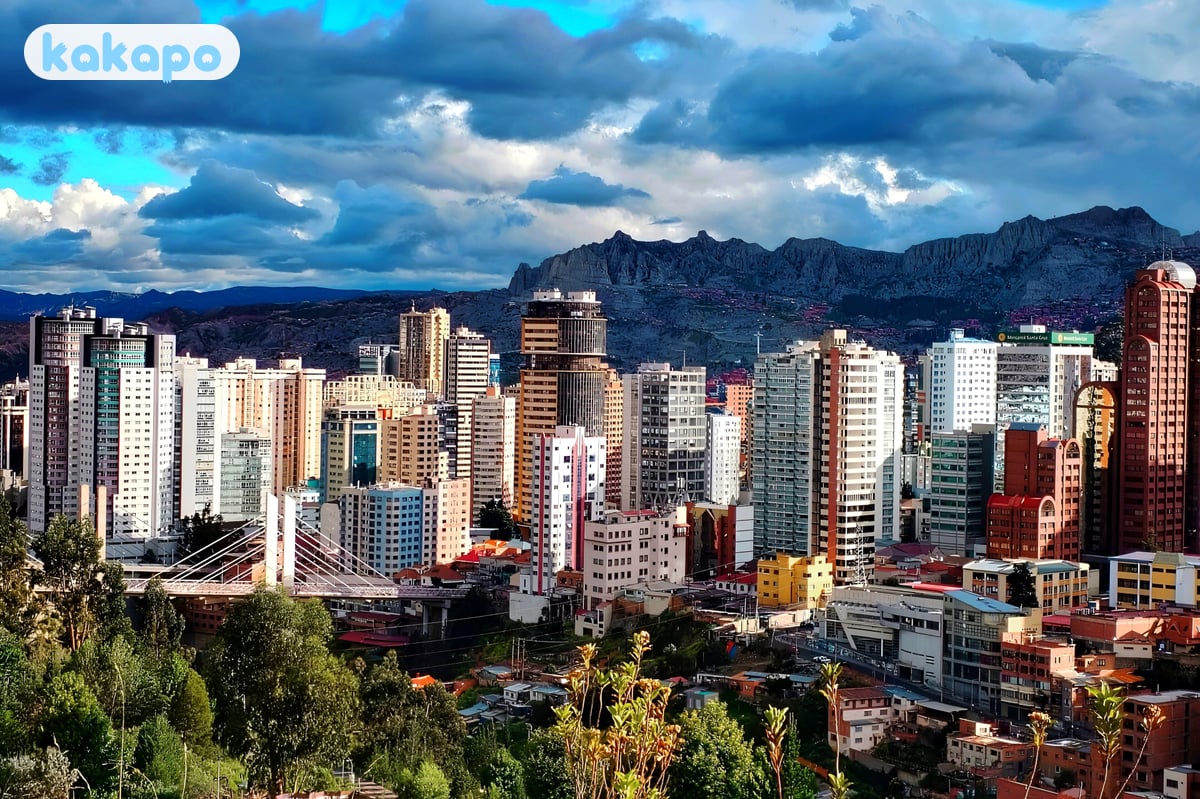
- El Alto airport: 4,150 m. La Paz centre: 3,640 m. You arrive directly from sea level — the altitude shock is real.
- Acute Mountain Sickness: headache, nausea, fatigue, sleep disruption. Severe cases (HACE — confusion; HAPE — gurgling cough at rest) require descent.
- Mitigations:
- Day 1-2: rest, drink double water, no alcohol, walk slowly.
- Coca tea (mate de coca) is the local standard — sold everywhere.
- Diamox (acetazolamide): consult your doctor before travel for prophylaxis.
- If severe symptoms: descend to Coroico (1,750 m) or further.
- Don't go up: hungover, dehydrated, with respiratory infection, or with severe heart conditions without medical clearance.
- Sun: strong at altitude; sunscreen + sunglasses essential.
- Sleep: many visitors sleep poorly the first 1-2 nights at altitude.
The 'fake police' scam — recognise it
- The pattern: people in plain clothes claim to be plainclothes police, sometimes with fake badges. They demand to see passport, money, ATM card, claim there's a "drug check" or "currency check". Real Bolivian police don't operate this way for tourists.
- What to do: refuse to hand over passport or wallet. Demand to go to the nearest police station ("comisaría"). Demand to call your embassy. Don't get into any vehicle.
- Variant: someone "falls" or stages a distraction; an accomplice grabs from your bag.
- Where: most reported around Plaza Murillo, the Witches' Market, the bus station, and the airport approach.
- Real police uniforms: green; visible badge with photo and badge number.
- If you're certain it's a scam: walk briskly into a busy shop, hotel, or tourist police booth. Don't engage further.
Roadblocks and protests
- Bolivia's blockade culture: protests routinely shut highways and city streets. La Paz can be cut off for days during major protests.
- 2019 + 2024 political crises: produced sustained disruption. Bolivia has remained in elevated political-tension condition.
- Tourist impact: airport closures, bus cancellations, food/fuel shortages, ATM-cash-out periods.
- If a major blockade is active during your trip: don't try to pass through; stay where you are; check news + embassy alerts.
- Travel insurance: confirm strike/civil-unrest cover.
The Death Road — the bike-tour reality
- Yungas Road ("Camino de la Muerte"): 64 km descent from La Cumbre pass (4,650 m) to Coroico (1,200 m). Most dangerous-road-in-the-world reputation from when it was the only road; bypass highway since 2007.
- The bike tour: ~$80-130 USD, full day. Mountain bike down the road as it twists through cloud forest. Genuinely spectacular.
- Crashes: tourist deaths are documented (low single-digits/year). Speed + over-confidence is the pattern.
- Reputable operators: Gravity Assisted Mountain Biking, Madness Bolivia, Vertigo Biking. Use full-suspension bikes, helmets, gloves, decent guides.
- Cheaper operators: variable equipment + safety briefing.
- Insurance: confirm adventure-sports cover.
- Don't race the descent: the deaths are mostly tourists going too fast.
Transport — Mi Teleférico, taxis, the airport
- Mi Teleférico: 11-line urban cable car system. World's largest. Connects La Paz with El Alto. ~Bs 3 (~$0.45) per ride. Tourist-essential.
- Taxis: registered radio-taxis only (call from hotel). Don't hail street taxis.
- InDriver and Uber: both work in La Paz. Cheap.
- Buses: local micros are chaotic; tourists generally use teleférico + taxis.
- El Alto Airport (LPB): 4,150 m. 11 km from centre. Pre-booked transfer Bs 100-150 ($15-22). Taxi Bs 80-120.
- Don't take taxis from the airport from "drivers approaching you": book through your hotel or use the airport-official taxi desk.
Areas — Sopocachi, San Pedro, Zona Sur
Recommended for visitors: Sopocachi (gentrified residential, restaurants), San Pedro (around the famous prison; tourist hotels), Casco Viejo (Centro) — Plaza Murillo, Witches' Market, museums (daytime). Zona Sur (Calacoto, San Miguel) — wealthier south-side, lower altitude, modern.
Stay aware: around the bus station (Terminal de Buses) at night, El Alto generally (working-class altitude city; pickpockets and scams more common; visit on guided tour). Some Centro streets after dark.
Money, food, the cost story
- Currency: Boliviano (BOB). $1 ≈ Bs 6.9.
- USD cash: useful for some hotels, tour operators.
- Cards: at hotels and tourist restaurants; cash needed elsewhere.
- ATMs: at major banks (Banco Nacional de Bolivia, BCP). Daily withdrawal limits ~Bs 2,000 ($300).
- Tipping: 10% in restaurants; round up taxis.
- Cost: among South America's cheapest. Mid-range dinner $5-15.
- Tap water: not safe; bottled.
- Local food: salteñas, anticuchos, sopa de maní, llajwa salsa, singani brandy.
Practical info — emergency numbers
- Police: 110.
- Ambulance: 118.
- Tourist Police (POLTUR): visible at Plaza Murillo and the Witches' Market.
- Clínica Alemana: +591 2 243 2155.
- Clínica del Sur: +591 2 278 4750.
Bring: Diamox (with doctor's clearance), warm layers (La Paz nights are cold even in summer), sun protection, oral rehydration salts, a Bolivian SIM (Tigo, Entel) at the airport, USD cash backup, a contactless card, and travel insurance with altitude + adventure-sports cover.
Frequently asked questions
Is La Paz safe to visit in 2026?
Yes, with the altitude and political-disruption caveats — La Paz scores 70/100. UK FCDO advises against travel to the Chapare region and parts of the Yungas; both treat the country at moderate caution because of periodic roadblocks and political protest. US State Department keeps Bolivia at Level 2 with the same notes. Violent crime against visitors in central La Paz is concentrated around the bus terminal, the Witches' Market periphery and around El Alto on the rim — pickpocketing is moderate; muggings are rare in daylight tourist zones. The defining real risks here are: altitude (La Paz centre 3,640m; El Alto airport 4,150m — among the highest commercial airports in the world), the recurring 'fake police' kidnap-and-extort scam, road-blockades affecting overland transport, and the Yungas 'Death Road' bike tour operator quality.
Is La Paz safe at night?
Yes in central tourist zones, with named hazards. Sopocachi (the bar-and-restaurant district), Plaza Murillo, Calle Jaén and the Sagárnaga / Witches' Market area are routine evenings into about 22:00. After that the streets thin and the 'fake police' scam risk rises — see next FAQ. Mi Teleférico (the multi-line cable car network connecting La Paz to El Alto — eleven lines, the world's largest urban cable-car system) is the SAFE late transport option; lines run to ~22:00 weekdays and ~23:00 weekends, are cheap (~Bs 3), and let you skip the road-traffic and protest-block risk entirely. Use Movitaxi or hotel-booked taxis after hours; Uber and InDrive both operate but vehicle-quality varies. Avoid the area around La Paz bus terminal and around El Alto market after dark.
What's the biggest scam to avoid in La Paz?
The 'fake police' scam, which has been the dominant tourist-targeted crime pattern in La Paz for two decades. The pattern: someone in plain clothes approaches asking for documents or claiming you've broken a rule, a uniformed accomplice (sometimes wearing genuine-looking police gear, sometimes fake) arrives 'to help'; you're walked or driven to a quiet spot or ATM and forced to hand over cash and PIN. Real Bolivian police DO NOT stop tourists on the street to check documents, do not enter your taxi, and do not insist on going somewhere quiet. If approached: refuse to move from a public location, ask for the nearest police station ('comisaría') and walk there yourself, call the tourist police on 800-14-0081, and if necessary make a scene — the scammers depend on tourist compliance and quietness. Keep a colour photocopy of your passport, not the original, in your pocket for these encounters.
Can you drink tap water in La Paz?
No — do not drink tap water in La Paz. The municipal supply (EPSAS) meets Bolivian standards at the plant but the distribution network has cross-contamination, the city sits at 3,640m where boiling water boils at ~88°C (so home boiling is less effective), and locals universally drink bottled. Bottled water (Vital, Aquavit) is cheap (Bs 5-8 for 600ml). Hotels in the 3-star and up tier provide bottled water; better hotels offer a filtered drinking-water dispenser. Coca tea is offered at most accommodation arrival lobbies and is a separate altitude-adjustment ritual (boiled, so safe). Brushing teeth with tap water is fine for short trips; ice in tourist restaurants is usually filtered.
Should I worry about altitude in La Paz, and what about the airport?
Yes — altitude is the dominant real risk, more so than crime. La Paz centre sits at 3,640m and the airport (El Alto, LPB) at 4,150m, which is higher than Machu Picchu and higher than where many Everest base-camp trekkers START acclimatising. Symptoms (headache, nausea, sleep disturbance) start within hours of arrival for most non-acclimatised visitors. Plan: arrive, check in, do nothing strenuous for 24 hours, drink water, sip coca tea, avoid alcohol for the first 48 hours, take Diamox (acetazolamide) starting 24 hours BEFORE arrival if you have a prescription. Walking uphill in the steep Sopocachi or Miraflores streets will feel disproportionately hard for two-three days — this is normal. If you develop a worsening headache with vomiting, confusion or breathlessness at rest, descend immediately (Coroico in the Yungas drops to 1,700m in 90 minutes by road) and seek medical attention — High Altitude Pulmonary Edema and Cerebral Edema both kill at this altitude.
Sources
Run a business in La Paz?
Show visitors your La Paz business is a safe choice. The free Verified by Kakapo badge puts La Paz's live safety score on your website, links back to your verified page, and updates itself. No cost.
Get the free badge →