


Is Bangkok Chinatown Safe at Night in 2026?
Yaowarat Road, the gold-shop strip, the post-22:00 street-food explosion and the practical safety read on Bangkok's most-photographed dinner district.

Bangkok's Chinatown — Yaowarat Road and the surrounding maze of Charoen Krung, Phadungdao, and Soi Texas — is one of the city's safest nightlife-and-dining districts and has been since long before Bangkok's tourism boom. The neighbourhood is anchored by the 200-year-old Sino-Thai community that built Bangkok's gold trade, the densest cluster of gold shops in Southeast Asia (~150 within four blocks), the largest dim sum and seafood-street-food concentration in the city, and a continuous presence of Royal Thai Police and Tourist Police (a dedicated booth at the Odeon Circle gate).
The Yaowarat-Charoen Krung intersection comes alive after sunset: the famous Texas Suki, Lek & Rut Seafood, T & K Seafood, Nai Mong Hoi Tod (oyster pancake), the durian-and-mango-sticky-rice stalls, the dim sum at Wattana Panich. Tour buses and tuk-tuks empty out by 22:00; the real Yaowarat scene runs 19:00-02:00 with mixed Thai and tourist crowds.
This guide is the 2026 picture — what's actually safe, what isn't (gold-shop scams, gem scams, certain tuk-tuk patterns), and the practical rules for an enjoyable Yaowarat evening.
| Night safety | 58/100 |
|---|---|
| Scam / petty-crime risk | Medium |
| Violent crime (tourists) | Low |
| Safer neighbourhoods | Yaowarat Road, Charoen Krung, Phadungdao |
| Data sources cited | 4 |
| Last verified |
The Chinatown geography
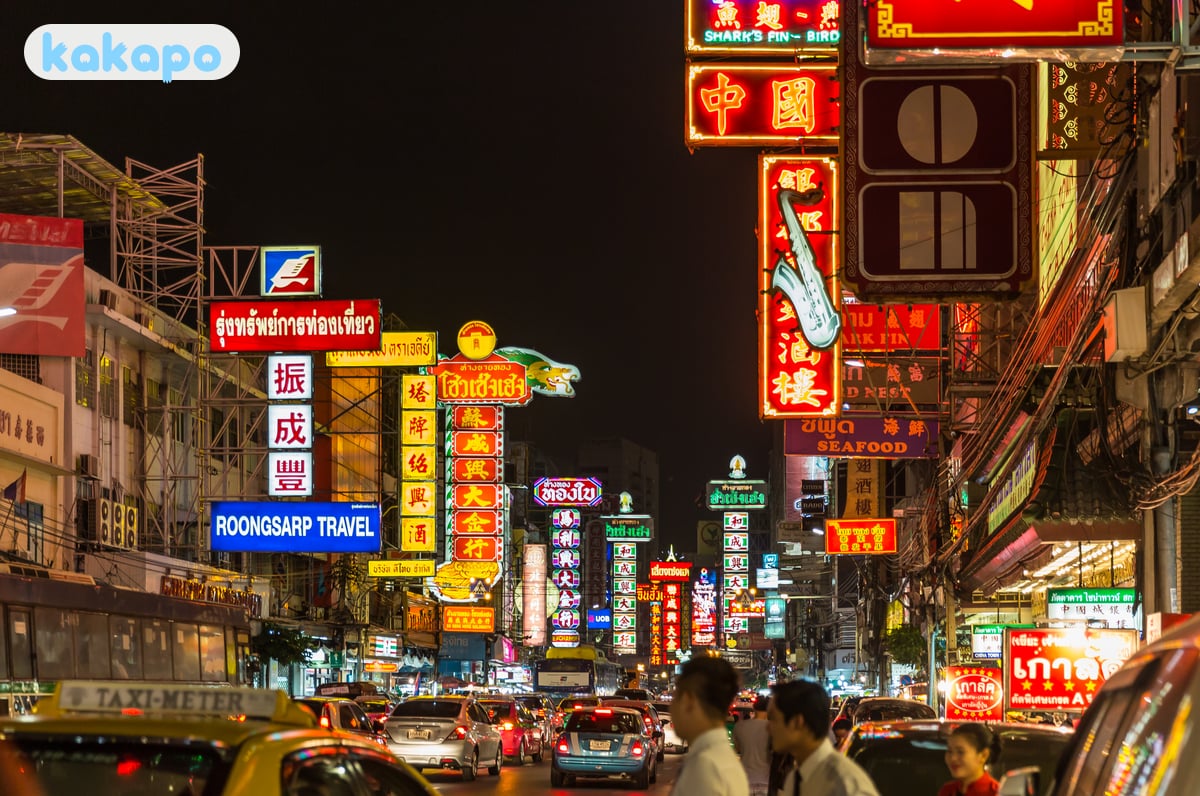
- Yaowarat Road: the main spine, 1.5km running west-east from Odeon Circle to Yommarat Junction. Gold shops, restaurants, street food. Lit by neon Chinese-character signage.
- Charoen Krung Road: parallel north, older commercial street, less touristy.
- Phadungdao (Soi Texas): the most-touristed side street; famous seafood (T & K Seafood at the Yaowarat-Phadungdao corner is the Instagram set).
- Soi 6 / Soi Issaranuphap: the daytime fresh-market alley; closes early.
- Nakhon Kasem (Thieves Market): antique-and-junk-shop alley; safe daytime, closes early.
- The Old Market (Talad Kao): vegetable and fresh produce; daytime.
- The temples: Wat Traimit (the Golden Buddha temple) at the Yaowarat-Tri Mit Road junction; Wat Mangkon Kamalawat (the largest Chinese-Buddhist temple).
- Transport access: MRT Wat Mangkon station (Blue Line, opened 2019) is the main entry; sits on Charoen Krung at the heart of Chinatown.
Safety baseline — what's actually happening at night
- Violent crime: very rare. Bangkok Chinatown has not had a notable tourist-violence incident in years.
- Royal Thai Police presence: permanent Tourist Police booth at Odeon Circle (Yaowarat west entrance); marked patrols throughout Yaowarat.
- Crowd density: very high 19:00-22:00 on Yaowarat Road; the Phadungdao/Soi Texas seafood-stall area is essentially impassable on weekend nights with the tour bus crowd.
- Pickpocketing: low frequency but present in the crowded street-food stalls; front-pocket phone advised.
- Drink-spiking: rare; Yaowarat isn't a bar district. The bars in the area (small craft cocktail spots like Tep Bar, Teens of Thailand on Soi Nana adjacent to Chinatown) are safer than Khao San Road / Sukhumvit on this front.
- Aggressive begging: low-density compared to other Bangkok tourist areas.
Gold shops, gem scams and the Yaowarat-specific pitches
- The gold shops: ~150 in Yaowarat. The legitimate ones (the big yellow-and-red brands like Hua Seng Heng, Yang Sang Heng, Khun Lan) are highly regulated and trustworthy. Tourists are not typically the target market.
- Gold scams: occasional, primarily affecting Thai customers buying investment gold. Not a tourist-facing issue.
- Gem scams: yes — Bangkok's classic gem scam (driver offers to take you to a "government-licensed" gem shop, you buy "investment gems" worth a fraction of the price). Documented for decades; UK FCDO Thailand advice explicitly warns. The Chinatown-edge tuk-tuk drivers are sometimes the recruiters; never agree to "I'll take you to a gem shop on the way".
- Tuk-tuk meter scams: tuk-tuks don't have meters. Negotiate before; THB 50-150 for short trips inside Yaowarat. Use Grab or Bolt for fixed fare.
- "Temple closed today" scam: persistent in Bangkok. A friendly local stops you, says Wat Traimit is "closed for ceremony" and offers a tuk-tuk tour to "other temples". The destination is the gem shop. Wat Traimit is open daily 08:00-17:00; verify directly.
- The friendly stranger pattern: more common in Khao San and Sukhumvit; less so in Chinatown but possible.
What to actually eat in Yaowarat
- T & K Seafood (Phadungdao corner): the iconic green-uniform seafood-on-the-street. Open ~17:00-01:30. Order: charcoal-grilled prawns, crab fried rice, glass-noodle salad. THB 500-1,500 per person.
- Lek & Rut Seafood (Phadungdao opposite): the red-uniform competitor. Same model, similar quality.
- Nai Mong Hoi Tod (Phadungdao): oyster pancake (hoi tod) specialist. Long queues; worth it.
- Wattana Panich (Sukhumvit Soi 23, outside Chinatown but adjacent): 40-year-old simmering beef noodle pot; cult.
- Jek Pui Curry Rice (Soi Texas): no tables, eat on plastic stools on the street; THB 60 for curry-on-rice; locals queue.
- Mango sticky rice: street-stall ubiquity; the famous K. Panich on Phra Athit (outside Chinatown but worth the trip) for the better-quality option.
- Bird's nest soup: Yaowarat's specialty; Yim Yim and Hua Seng Hong serve THB 800-2,500 per bowl.
- Durian and tropical fruit: Yaowarat is fruit-market central; durian during Mon Thong (April-July) and Chanee seasons.
Getting there, getting home
- MRT Wat Mangkon: the easiest entry. Blue Line. From Sukhumvit (Asok station) it's a single transfer at Phetchaburi; ~20 minutes total.
- Last MRT: ~midnight.
- Grab and Bolt: the late-night defaults. THB 80-150 from Yaowarat to Sukhumvit, THB 150-250 to Khao San, THB 100-200 to Silom.
- Tuk-tuk: fine for short trips inside Yaowarat (THB 50-150) but always negotiate before. Avoid for cross-town: gem-scam recruitment risk.
- Chao Phraya Express Boat: Ratchawong pier serves Chinatown; service ends ~19:30. Useful for arrival, not return.
- Walking: Yaowarat to Khao San is ~25 minutes; safe walk but heavily traffic-exhaust-exposed.
Practical info — emergency
- Emergency: 191 (police), 1669 (ambulance).
- Tourist Police: 1155 (24/7, English-speaking). Tourist Police booth at Odeon Circle (Yaowarat west gate).
- Hospital: Bumrungrad International (Sukhumvit) and Bangkok Hospital (Phetchaburi) are the international-grade defaults. Closer: Hua Chiew Hospital (just north of Chinatown).
- UK Embassy: +66 2 305 8333.
- US Embassy: +66 2 205 4000.
- Air quality: Bangkok's PM2.5 is poor in the dry season (December-March); evening street-food sessions in Yaowarat add charcoal-smoke layer; sensitive groups should wear KN95.
- Best time to visit: Tuesday-Thursday for less crowd; Friday-Sunday for full atmosphere with denser crowds.
Frequently asked questions
Is Bangkok Chinatown safe at night in 2026?
Yes — one of Bangkok's safest dinner districts. Yaowarat Road is densely populated 19:00-22:00 with mixed Thai and tourist crowds, permanent Tourist Police booth at Odeon Circle, and no notable tourist-violence incidents in recent years. Standard pickpocket awareness applies at the crowded Phadungdao seafood-stall area; otherwise the safety baseline is excellent.
What time should I visit Yaowarat?
19:00-22:00 for peak street food and atmosphere. Tour buses thin out after 22:00 and the scene becomes more local; the seafood stalls run until ~01:30. Tuesday-Thursday for less crowd density; Friday-Sunday for full atmosphere with longer queues at the iconic spots like T & K Seafood.
Are tuk-tuks safe in Chinatown?
Tuk-tuks are fine for short trips within Yaowarat (THB 50-150, negotiate before). Avoid them for cross-town trips and especially avoid any tuk-tuk driver offering to 'take you somewhere else first' — this is the gem-scam recruitment pattern UK FCDO warns about. Use Grab or Bolt for any trip outside walking distance.
What is the Bangkok gem scam?
A persistent decades-old scam: a friendly local or tuk-tuk driver tells you a temple is closed and offers to take you to a 'government-licensed' gem shop where you can buy 'investment gems'. The gems are worth a fraction of the price. UK FCDO explicitly warns; never agree to 'I'll take you to a gem shop on the way' and verify temple opening hours directly. Wat Traimit is open daily 08:00-17:00.
What should I eat in Yaowarat?
T & K Seafood (Phadungdao corner) for charcoal-grilled prawns; Lek & Rut Seafood opposite; Nai Mong Hoi Tod for oyster pancake; Jek Pui Curry Rice (THB 60 curry-on-rice on plastic stools); durian and mango sticky rice from street stalls; bird's nest soup at Yim Yim or Hua Seng Hong (THB 800-2,500). Most stalls run 17:00-01:30.
How do I get to Chinatown by MRT?
MRT Wat Mangkon (Blue Line), opened 2019. The station sits on Charoen Krung at the heart of Chinatown. From Sukhumvit (Asok station) it's one transfer at Phetchaburi, ~20 minutes total. Last MRT ~midnight; Grab or Bolt for late-night returns (THB 80-150 to Sukhumvit).
Is Chinatown safer than Khao San Road?
Yes for most risks. Khao San has higher concentrations of bar-related drink-spiking, fights, and aggressive tout/scam recruitment. Yaowarat is a food district with mixed Thai-tourist crowds and permanent Tourist Police presence; the bar layer is small (Tep Bar, Teens of Thailand) and well-managed. Both are safer than the global average for nightlife districts.
Sources
Run a business in Chinatown, Bangkok?
Show visitors your Chinatown, Bangkok business is a safe choice. The free Verified by Kakapo badge puts Chinatown, Bangkok's live safety score on your website, links back to your verified page, and updates itself. No cost.
Get the free badge →