


Is Amsterdam's Red Light District Safe at Night? 2026
De Wallen after dark — pickpocket density on Warmoesstraat, the no-photo rule, side-canal risks, and what's changed since the 2025 closing-time crackdown.

De Wallen — Amsterdam's Red Light District — is the most heavily policed square kilometre in the Netherlands. It's also the most-visited single neighbourhood in the country: roughly 10-12 million tourist visits a year squeezed into about 12 narrow medieval streets between Centraal Station and the Nieuwmarkt. Two things follow from this. First: stranger violence against tourists is statistically rare here — too many cops, too many cameras, too many witnesses. Second: every kind of crowd-density crime that exists, exists here. Pickpocketing, scam taxis, drug touts selling pavement aspirin as cocaine, fake-ticket sellers, drink-spiking in side-street bars.
The Amsterdam city government has been actively trying to reduce stag-party tourism here since 2023; the "Stay Away" campaign, the 1am ban on cannabis-shop entries, and the project to relocate sex-work to a planned "Erotic Centre" in Zuid all date from that policy push. As of mid-2026 the relocation hasn't happened — the new centre's planning is stalled — so the district still functions the way it has for 40 years, just with more conspicuous police and more rule-enforcement.
The practical 2026 picture for a visitor: walking through De Wallen is safe; lingering on the busiest stretches with a phone in your hand or a wallet in your back pocket is where tourists actually lose money.
| Night safety | 70/100 |
|---|---|
| Scam / petty-crime risk | High |
| Violent crime (tourists) | Low |
| Most common scams | pickpocketing on the canal-side stretches; drug touts selling pavement aspirin as cocaine; inflated-bill drink-spiking scams in small unbranded side-street bars |
| Safer neighbourhoods | Nieuwmarkt, Centraal Station forecourt, Zeedijk |
| Data sources cited | 4 |
| Last verified |
The streets that make up De Wallen — by safety
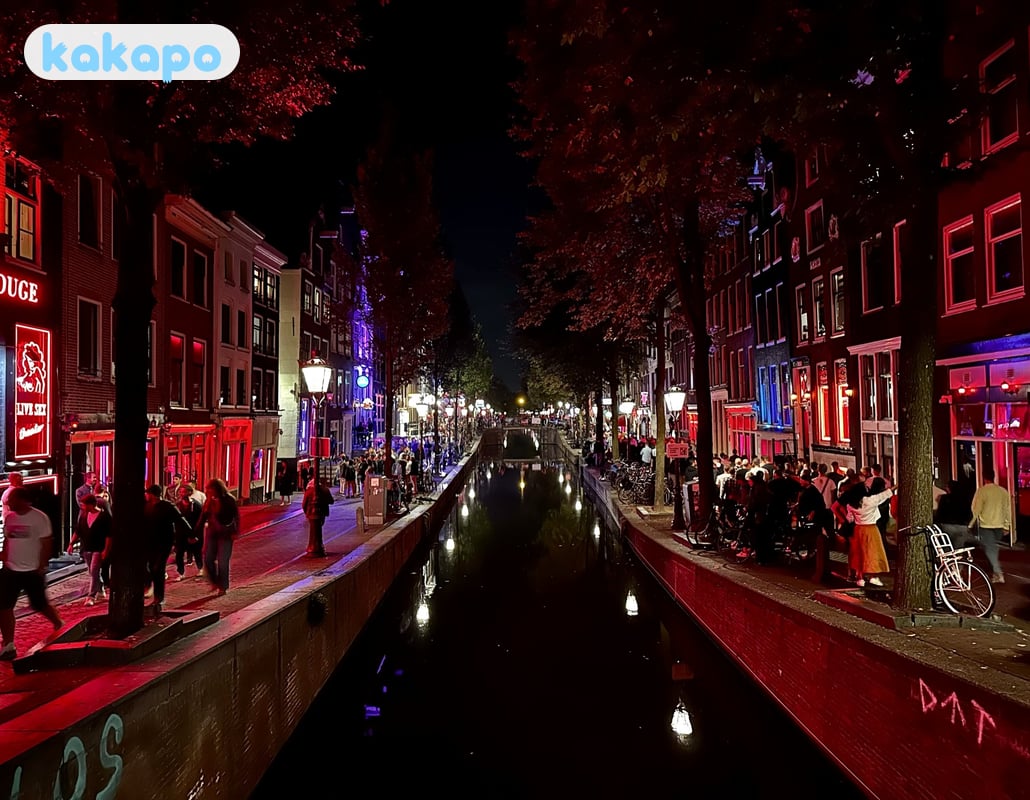
- Oudezijds Voorburgwal (the main north-south canal with the Oude Kerk) — busiest, most lit, highest police presence. Pickpocket density highest 10pm-1am. Safe to walk; not safe to stop and look at your phone.
- Oudezijds Achterburgwal (parallel canal one street east) — second-busiest. Same pattern.
- Warmoesstraat — the western boundary, bar-heavy. Drunk-tourist density highest after 1am. Aggressive coke-touts ("psssst, cocaine?") work this street. The substance offered is almost never cocaine; ignore them.
- Bloedstraat / Molensteeg / Sint Annenstraat — the small cross-alleys between the canals. Heaviest window-density; tightest crowds. Watch bags closely.
- Zeedijk (Chinatown side) — calmer than the canals themselves. Mostly restaurants, mostly fine.
- Side alleys after 1am — the narrow connectors when they empty out, particularly south of Nieuwmarkt towards the Universiteit, are where the few actual muggings happen. Stick to the canal-side streets, not the unlit cuts.
- Nieuwmarkt (south end) — the open square at the south edge of the district. Well-lit, well-policed, safe.
- Centraal Station forecourt (north end) — busy until ~3am with trams and night buses leaving. Pickpocket-heavy but safe to be in.
The pickpocket pattern in De Wallen
- Tactics: the classic "bump and grab" on the bridges over the canals (where crowds funnel through narrow points); coordinated teams of 2-3 working the densest stretches of Oudezijds Voorburgwal between 9pm and midnight; phone-snatch by bike — a cyclist passes and lifts the phone out of an outstretched hand.
- Targets: outside-pocket phones, back-pocket wallets, half-open shoulder bags, anyone obviously photographing a sex-worker window (hands occupied, attention divided).
- Prevention: front-pocket only; cross-body bag worn zip-side-forward; phone in an inside jacket pocket or zipped pocket; lanyard if you use it as a camera.
- Police presence: the Politie has a permanent post inside the district at the Beursstraat substation. Foot patrols are visible from about 8pm to 4am every night, more on Friday/Saturday.
- If lifted: report at the Beursstraat substation in person within the hour for the best chance of CCTV recovery; phone tracker (Find My iPhone, Google Find My Device) gives police a lead but resolution is variable.
The no-photo rule and other actual rules
- Photographing sex-workers in their windows is illegal under Amsterdam municipal bylaw and aggressively enforced by the bouncers who work the district and by the sex-workers themselves. The standard response is the bouncer dumping water on your phone or smashing it into the canal. Don't.
- Smoking weed on the street has been illegal in the Red Light District since 2023. Police can fine €100 on the spot. Use a coffeeshop. Coffeeshop hours were tightened in 2024 to a 1am closing; many coffeeshops in De Wallen now stop admitting new customers at 12:30am.
- Public drinking outside licensed terraces is a €95 fine. The "alcohol-free zone" is signed.
- Drug tout offers — buying from the street is never cocaine. It's typically lidocaine or chalk. Buying is also illegal; arrests of buyers happen.
- Pissing in the canal — €140 fine. Public toilets at Centraal, Nieuwmarkt, and several paid ones inside the district (Plassmateron units).
- Group tour bans — guided tours of more than 15 people are banned inside De Wallen since 2020. Small tours up to 15 are allowed but operators must hold the city tour-guide licence.
Drink-spiking and side-street bars
- Drink-spiking inside the well-known De Wallen bars (Cafe de Engel, Hill Street Blues, the bigger Warmoesstraat venues) is rare — staff are watchful, the venues are licensed and inspected.
- Where it does happen is in the small unbranded bars on the side alleys advertising "live show" or "private room" with a tout outside. The pattern matches the Roppongi-style scam: you go in for a "cheap drink", end up with a hugely inflated bill, and the venue spikes the drink to enable card-running. Avoid any bar reached via a street tout's invitation.
- Stick to bars with a posted menu, a visible card-reader and a clearly marked door — most of De Wallen's bars meet that bar.
- The Bulldog and Grasshopper coffeeshops are not bars; they're licensed retail. No drink-spiking risk there.
Solo women in De Wallen
- De Wallen is one of the more comfortable nightlife districts in Europe for solo women — there are always women everywhere (tourists, sex-workers, locals walking through), it's heavily lit, heavily policed, and street-level harassment is comparatively low.
- The exception is the after-2am drunk-British-stag crowd on Warmoesstraat, which can be loud and occasionally physically rude. Walking on the canal-side streets rather than Warmoesstraat itself avoids most of it.
- Walking from De Wallen back to a hotel in Jordaan, the Nine Streets, or the Plantage at 2am is normal practice; the streets between are quiet but well-lit and not high-crime.
- Centraal Station at night is busy and safe; the night bus and night tram network covers everything tourist-relevant.
Getting home after midnight
- Metro — the metro stops running at 00:30 on weekdays, 02:00 on weekends.
- Night buses (N-series, GVB) run every 30-60 minutes from Centraal Station to all districts; €3.40 single, €8.50 for a 24-hour pass on the GVB app.
- Trams stop running around 00:30 (lines 14, 17, others as late as 01:00).
- Uber / Bolt work normally in Amsterdam. Typical De Wallen to Jordaan or Plantage 8-14 EUR; to Amsterdam Zuid 18-25 EUR. Surge after 2am on weekends 1.3-1.6x.
- Bike — if you arrived by bike, the bike racks at Centraal Station's east side are well-lit and supervised. The whole district is rideable late at night; just stay sober enough to handle Amsterdam tram tracks.
- Walking back to most central hotels (Jordaan, Nine Streets, Plantage, even Vondelpark) is safe and a 15-30 minute walk.
Frequently asked questions
Is Amsterdam's Red Light District safe at night in 2026?
Yes for most practical purposes — it is one of the most heavily policed neighbourhoods in Europe and stranger violence against tourists is rare. The realistic risks are pickpocketing (highest density 10pm-1am on the canal-side stretches), drug-tout fraud (street 'cocaine' is never cocaine and buying is also illegal), and inflated-bill drink-spiking scams in the small unbranded side-street bars advertised by touts. Avoiding those three things makes a night in De Wallen feel routine.
What are the rules in Amsterdam's Red Light District?
Key 2026 rules: no photographing sex-workers in windows (enforced aggressively by bouncers and workers themselves); no smoking weed on the street since 2023 (€100 fine); no public drinking outside licensed terraces (€95 fine); coffeeshops stop admitting new customers at 1am; large group tours (>15 people) are banned. Smaller licensed tours up to 15 people are allowed.
Is De Wallen safe for solo women?
It's one of the easier major-European nightlife districts for solo women — heavily lit, heavily policed, always crowded, low street-level harassment. The main exceptions are the after-2am drunk-stag crowd on Warmoesstraat (avoidable by using the canal-side streets) and the side-street tout bars (avoid any bar reached via a street tout). Walking home alone to Jordaan or the Plantage at 2am is normal practice.
What is the cocaine-tout scam?
Touts on Warmoesstraat and Zeedijk approach tourists with 'psssst, cocaine?' for €40-50 a gram. The substance is essentially always lidocaine, paracetamol or chalk; actual cocaine is sold through different channels. Buying is also illegal under Dutch law and arrests of foreign buyers do happen. If you want a controlled-substance experience in Amsterdam, the answer is a licensed coffeeshop, not a street tout.
Can I take photos in the Red Light District?
You can photograph the streets, canals, signage and architecture. You cannot photograph or film sex-workers in their windows — it is illegal under Amsterdam bylaw and physically enforced. Bouncers will smash phones; sex-workers can call police on you. The 'sneaky angle' photos are also enforced. The wider streetscape — Oude Kerk, the canals, the Erotic Museum — is fine to photograph.
How do I get home from De Wallen after the metro stops?
Night buses (N-series, GVB) run from Centraal Station to every district from ~00:30 to ~07:00 — every 30-60 minutes, €3.40 single. Uber and Bolt work normally; expect 8-14 EUR to most central neighbourhoods. Walking is also fine — central hotels in Jordaan, Nine Streets and Plantage are 15-30 minutes away on well-lit streets.
Is the Red Light District being moved to Zuid?
It's being discussed, not done. The Amsterdam city government's 'Erotic Centre' plan to relocate window sex-work to Zuid was announced in 2023 but as of mid-2026 has not progressed past planning — site selection is stalled. The Red Light District in De Wallen continues to operate as it has for decades, with tighter enforcement of nuisance bylaws (coffeeshop 1am close, no street weed, group-tour bans) but no relocation.
Sources
Run a business in Amsterdam Red Light District?
Show visitors your Amsterdam Red Light District business is a safe choice. The free Verified by Kakapo badge puts Amsterdam Red Light District's live safety score on your website, links back to your verified page, and updates itself. No cost.
Get the free badge →